

The One Retro '60s Thrift Store Find That Isn't Worth It

Many younger homeowners are scouting out vintage items for their retro-inspired home designs. It's only fair to warn them: There are some things that are better off left at the thrift store. If you grew up in the 1960s or '70s, you probably could think of a few retro design trends that maybe shouldn't make a comeback and would be better left in the past. One item in particular that you should absolutely leave at the thrift store is the console television set. First off, if you can get the dang thing to your house without throwing out your back, you'll be lucky. Secondly, other than the kitsch factor, console TVs from the '60s are pretty much not worth the effort it takes to get them home from the thrift store. Unlike the JVC Videosphere TVs of the 1970s or the compact console TVs of the '40s and '50s, these giant units are really not worth much.
Console TVs were not just something you watched your favorite sitcom on; they were literally a piece of furniture. A console TV had a real or faux wood cabinet that housed your television and either had cupboards that opened to reveal HiFi equipment or contained a large TV set that had large, enclosed speakers on either side of the screen. Many of these 1960s consoles contained a record player and AM/FM radio, for a full entertainment center experience. While a console TV from this period may seem like a great addition to your retro-inspired living room, there are other reasons, besides the fact that they are huge and not worth much, that should make you walk away when you spot one at the thrift store.
Why you should skip the '60s console TV at the thrift store
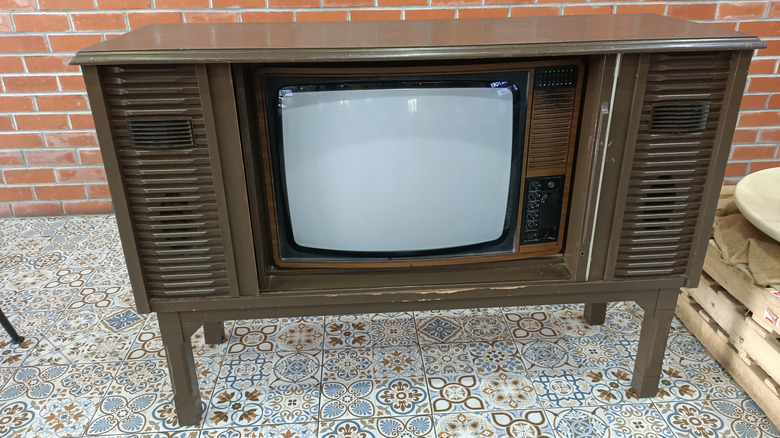
While console TVs were being sold all the way into the '90s, the 1960s console TVs are what many of us envision when we think of a "console TV." Large, bulky, tube-style TV encased in a piece of furniture that practically disappears into the wood paneling of a 1960s den. These vintage TVs were what's known as CRT or Cathode Ray Tube televisions. This is a big reason why the larger the screen was on your console TV (which meant a larger tube), the heavier it was. CRTs can actually be dangerous if you open one up and don't know what you're doing. They contain toxic metals like lead, cadmium-based phosphors, and other dangerous heavy metals, and can also carry a high-voltage charge long after they've been unplugged. If, for example, you plan on upcycling an old console TV into an indoor plant display, you should absolutely have an electrician remove the internal components.
A 1960s console TV from the thrift store, with its aging electronics and outdated technology, will most likely not work without special adapters to showcase today's cable or streaming technology. Ultimately, a console TV can seem like a great thrift store find; but because of its weight, awkward shape and size, depreciated value, and it's dangerous, aging internal components, it's really not worth the effort. Thankfully, there are many wonderful modern reproductions and frames you can put your modern TV in that can add a retro feel to your interior design. This retro console screen magnifier for your phone feels straight out of the '60s.