

The Low-Growing Alternative To Traditional Strawberries That Gives You Multiple Harvests

If you enjoy growing your own food, there are a few plants that you probably consider a staple in your garden: peas, carrots, potatoes, squash, and of course, strawberries. Strawberries are a core memory of early summer days for many people — after all, not many things beat the smell of freshly picked strawberries from the garden. The problem is that the strawberry season can feel far too short for some of us. If you're only planting June-bearing strawberries, this might very well be the case. June-bearing strawberries produce large berries and harvests early in the summer, but after this, they are done for the year. If you want multiple harvests in the summer, you should consider planting everbearing strawberries in your garden.
While there are a couple of mistakes people make when planting strawberries in their garden, not knowing which type of plant is best for your specific needs is a big one. If you like big, juicy berries all at once with a large harvest early in the summer, June-bearing might be a good idea. But if you want repeated harvests and you don't mind slightly smaller berries, everbearing varieties are the way to go. There is a third type of strawberry called day-neutral, but many people group them in with everbearing because of their similar traits. Everbearing strawberry varieties are a great choice for gardeners to consider for a variety of reasons. You may even want to plant a mixed bed of June-bearing and everbearing plants to get the best of both worlds. With that said, if you are limited on space and want to harvest strawberries all summer, everbearing plants are the way to go.
Reasons you should consider everbearing strawberries for your garden
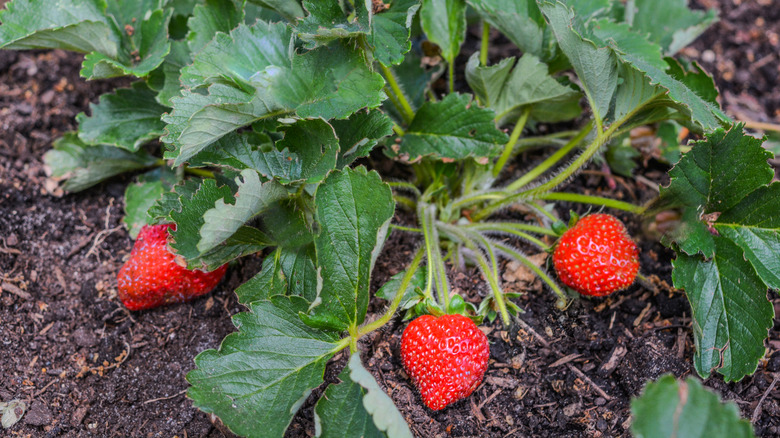
Everbearing strawberries tend to be easier to maintain and better suited to smaller spaces because of their low-growing, compact nature — they don't send off runners like June-bearing plants. This fact alone makes them the best variety of strawberries to grow in container gardens, raised beds, and even hanging baskets. Everbearing strawberry varieties also tend to be less sensitive to cold weather than their June-bearing cousins, and because their berries are slightly smaller and sturdier, they are perfect for freezing and won't get squishy in the refrigerator as quickly.
There are many amazing tasting varieties of everbearing strawberries to choose from. 'Quinault' (Fragaria x ananassa 'Quinault'), 'Ozark Beauty' (Fragaria 'Ozark Beauty'), and 'Fort Laramie' (Fragaria 'Fort Laramie') are among the most popular. The 'Quinault' and the 'Fort Laramie' varieties of everbearing strawberries are best grown in USDA Hardiness Zones 4 through 8, while 'Ozark Beauty' is a slightly more cold-hardy variety that can be grown in Zones 3 through 9. Everbearing strawberries can be planted in locations with full sun to partial shade. They should have at least 1 inch of water a week, but it's better to underwater than to overwater. The only complaint many gardeners have about growing everbearing strawberries is knowing when the best time to pick them is. The key to harvesting this type of strawberry is to check them often; otherwise, the critters might beat you to it.