

Never Overload Your Washer Again: Here's How Much Is A Full Load Of Laundry

It's easy to just go through the motions when doing tedious, everyday tasks like the laundry, never really thinking about the details of how the machine works or how best to use it. Then, one day, your basket of dirty clothes is overflowing, you're short on time, and you wonder just how much you can squeeze into the washer. Whether you take the time to learn your machine's capacity or just go for it and possibly end up with clothes that are still smelly or dirty after the wash, it is important to know how much a full load of laundry really is to avoid worse outcomes. Generally, a full load involves filling your machine between about half and three-quarters of the way without packing the clothes in too tightly, rather than actually stuffing the drum full.
Washing machines require spaces to churn the clothes around in the detergent, removing stains and odors and generally making them fresh and clean. When you add too many items to the machine, it may vibrate or move loudly. The machine also might leak water, and your clothing could come out partially dry, soapy, or dirty because the machine was too full for water to reach it. It's important to recognize these signs that your washing machine is too overloaded, because while inadequately washed clothes can be rewashed easily enough, repeated overloading can wear down the washer and lead to fire hazards, expensive repairs, or even the need to replace the machine entirely. Following the general half to three-quarters full method should help, but it can be more detailed for your specific machine, too.
Determining your washer's exact capacity
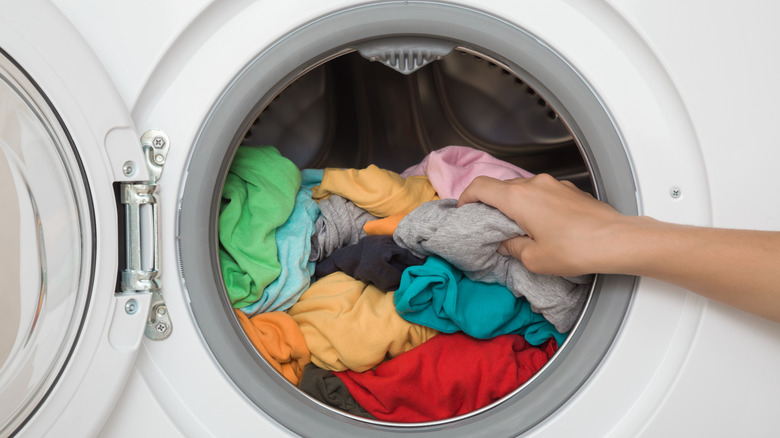
If you've had both a top load and front load washer, you know that they can be quite different. Luckily, the general rule of loading the machine no more than about three-quarts of the way applies to both. In a top load machine, you'll need to note the depth of the drum and the halfway point before filling it, while in a front load machine, you may be able to see the fullness more easily.
If filling the drum to three-quarters leaves you with any signs of an overfilled machine, switch to two-thirds or half full. While it may feel like too little, it will make your laundry more efficient by protecting your washer and making sure the dryer isn't overloaded as well. The reason washing machines are smaller than dryers actually makes sense, as dryers need even more space for air to circulate and dry the clothes.
It may also reassure you to look more into the specifics of your machine. Washers have capacities advertised in cubic feet, and larger washing machines will fit larger loads. Finally, you may see information about capacity by weight, such as pounds of laundry. Regardless of the advertised weight limit or capacity, the three-quarters limit is still an appropriate guideline, and it's a bit easier than weighing your dirty clothing or trying to calculate the volume. Knowing how much a full load is can save you some headaches, but be sure to learn about more laundry mistakes that are surprisingly easy to fix to protect both your washing machine and your clothing even more.