

The Type Of Allium Ground Cover You Don't Want Taking Over Your Lawn Or Garden

The pungent smell of garlic and onions is a familiar one in the kitchen, but if you're outside mowing or weeding in the yard, you may catch a whiff of this scent and wonder where it's from. If you're on the West Coast and this happens to you, it could smell like you stepped into an onion field, but it's more likely that you have the three-cornered leek (Allium triquetrum) growing in your yard. Hardy in USDA Zones 7 to 10, the three-cornered leek is also known as a wild onion, and it's an invasive plant some should avoid. It's considered invasive in certain areas, but not everywhere in the U.S. Because it can be aggressive in areas with no winter, it can't even be shipped to Idaho, Oregon, and some parts of Washington state.
Allium triquetrum is a pretty plant that blooms in February to April, depending on your region. It has triangular stems, which gives it both the names "triquetrum" and "three-cornered leek." This feature is often used to identify it, as it has white bell-shaped flowers that are similar to white bluebells (Hyacinthoides non-scripta) and lily of the valley (Convallaria majalis).
The plant itself looks like slender false garlic (Nothoscordum gracile), but it's the unmistakable scent of the crushed leaves and stems that makes it easy to identify. The bulbs are small, just over ½-inch in diameter at the largest, and are the main problem when you're trying to eradicate the three-cornered leek. When you pull this plant, the bulbs break off and remain in the ground, and it comes right back.
Tips for getting rid of the three-cornered leek
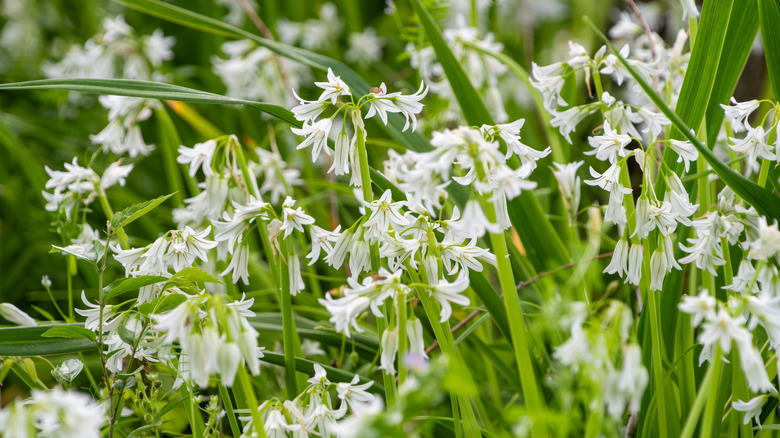
Fast-spreading invasive ground covers like Allium triquetrum can be a headache for homeowners, but it's easy to see why someone would plant it. With the charming white bell-shaped flowers that have a green stripe down each petal, gardeners have introduced this plant all over the world, and some nurseries still market it as a hardy ground cover. But if you're a homeowner who already has this plant, you're probably more interested in how to get rid of it.
In areas with mild winters and wet climates, specifically coastal northern California and Los Angeles County, this plant spreads easily. It takes more than one pass to get rid of it. Hand pulling is one of the most effective strategies for removing weeds, and the best time to do so may be in December and January, when the tops don't break off so easily. After March, the tops start snapping off, making it difficult to pull up intact. When bulblets fall off, even small fragments left behind in the soil will keep growing. Preventing it from going to seed is critical, since it propagates easily from seeds, as well as bulbs. Also, when you're trying to eradicate the three-cornered leek from your yard, keep all plant parts far away from your compost pile.
Although aggressive plants like the three-cornered leek can make hardy ground covers, there are better choices. Consider using native plants, which can compete with weeds and don't require as much maintenance as lawns or other invasive ground covers.