

What To Do If You Find A Norway Maple Tree In Your Yard
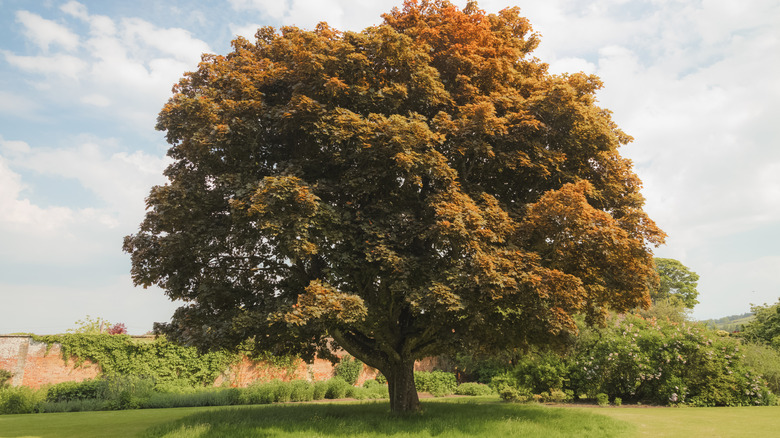
While they may be beautiful, Norway maple trees (Acer platanoides) are not the type of trees you want hanging around in your yard. Luckily, there are some good alternatives to the Norway maple to plant instead, including sugar maples. If you already have a Norway maple in your yard, it's best to take immediate action to get rid of it to prevent damage to your local ecosystem.
Norway maple trees, native to Europe, are known for producing an impressive amount of seeds that spread rapidly. With their broad canopies, they easily shade out native plants and damage their populations. For this reason, the Norway maple is listed as invasive in much of the northeastern region of the United States, as well as Oregon.
Although the Norway maple grows into a 40- to 50-foot tree with a stunning display of vibrant fall colors, it is ultimately considered a weed. Since it grows and spreads much faster than native maple species, it is worth removing Norway maple trees as soon as you notice them in your yard. If you are unable to remove the tree completely, you should prune away any seed-bearing limbs while the tree is dormant in winter or early spring.
How to remove a Norway maple tree from your yard
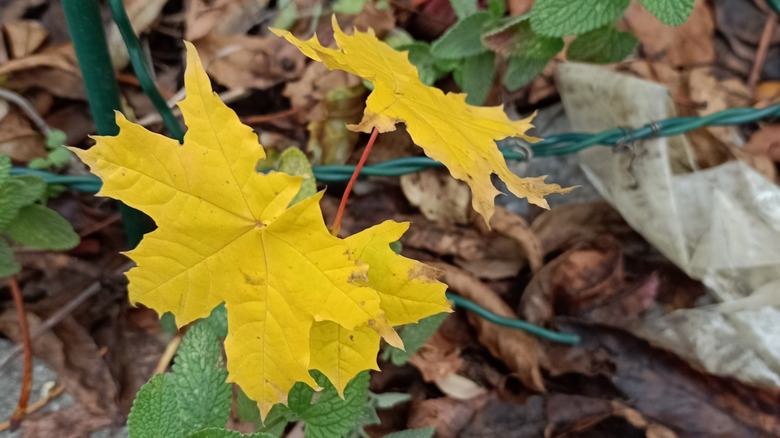
How you go about removing a Norway maple tree from your yard will largely depend on the age of the tree. For seedlings, you can simply remove them by hand or use a weed wrench to lift out the entire root system. Saplings are a bit more difficult, but they still don't generally present too much of a challenge. To remove a Norway maple sapling, use loppers to cut through the stem. Cut as close to the ground as possible. Then, you can use herbicides to kill the stump, such as glyphosate or triclopyr. Alternatively, you can burn the stump away by cutting the bottom out of a large metal can, like a coffee tin, and placing it around the stump. Fill the can with charcoal briquettes. Once the stump has completely burned down and the can is cool enough to remove by hand, you can simply bury it in place.
If you are unlucky enough to find a full-grown Norway maple in your yard, it will require a bit more work and possibly professional tree removal. Your options are to cut down the tree and spray herbicide on the trunk, or cut deep into the bark near the base of the tree and spray herbicide into the wounds. Before you attempt removal, consider the important things to know to cut down trees in your yard, and contact an arborist to make sure you're in the clear.
Identifying a Norway maple tree
Before you do any pulling or spraying, you should be certain you're dealing with a Norway maple. Because Norway maple trees spread so freely, it is possible to find seedlings, saplings, and/or full-grown trees in your yard. This European native tree resembles other maple trees with five lobes per leaf, but it can often have up to seven lobes, which is a good indicator that you are dealing with a Norway maple. They also mature earlier in the spring than native species, and their leaves may appear broader and more deeply lobed than native maple leaves. The most notable sign, however, can be observed when you cut through the leaf stalk. Norway maple trees have milky sap that will seep out of the cut; native maples have clear sap.
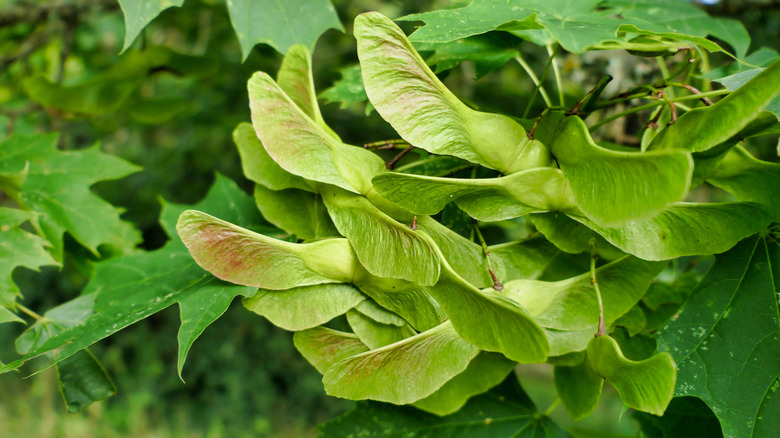
Young trees have smooth, grayish-black bark, but as they mature, the bark becomes furrowed. You can also look at the seeds, called samaras. Unlike the paired samaras produced by sugar maples or black maples, which point downward, Norway maples have paired samaras that resemble a handlebar mustache. These seeds are often referred to as helicopter seeds, and many trees carry them, including the Japanese maple and silver maple, so be sure to confirm identification before settling on removal.