

The Fast-Growing Shrub That'll Easily Fill Bare Garden Spots And Add Curb Appeal

Got a bare spot in your garden that could use a jolt of color? Consider upping the saturation with a shrub offering both colorful leaves and flowers. 'Gold Mound' spiraea (Spiraea japonica 'Goldmound'), a deciduous shrub, forms mounds of golden leaves that later show off fall hues. Pink flowers join the curb-appeal show in late spring to the delight of butterflies and other pollinators. Great news if you're impatient to see this colorful shrub on your property — it's among the fast-growing flowering shrubs that add color to your yard.
'Gold Mound' spiraea is among the deer-resistant shrubs to landscape your yard and protect your garden, and is rabbit-resistant, too. The shrub grows up to 3 feet tall and 4 feet wide. Best of all, care is easy for 'Gold Mound' spiraea, which resists disease. It demonstrates its resilience from winter dieback by recovering after a bit of pruning in late winter.
How to care for 'Gold Mound' spirea
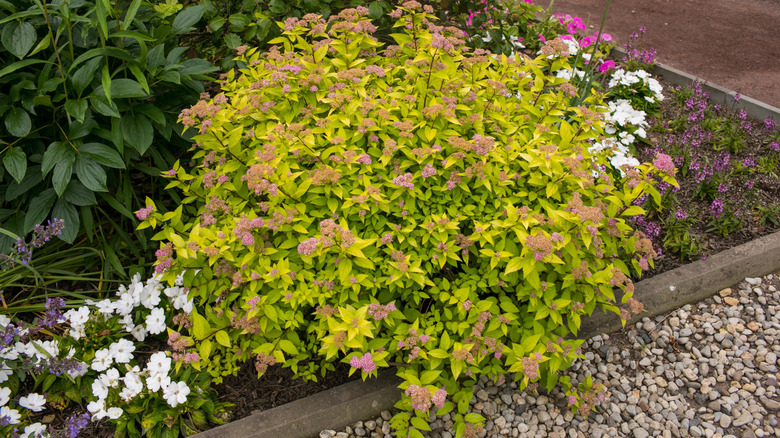
'Gold Mound' Spirea can weather the winters in USDA Hardiness Zones 4 to 8. Transplant from nursery pots in rich, moist, well-draining soil. It's one of those shrubs that are perfect for full sun areas in your yard; it can also tolerate partial shade. Water weekly in summer, but avoid overwatering. Before new growth emerges in the spring or in late winter, give the shrub some general-purpose fertilizer following label instructions.
Expect bring pink blooms in June and continuing through August. Once they've faded, deadhead the spent flowers to make way for new blooms. Pests that could plague your 'Gold Mound' spirea include armored scale and soft scale, aphids, and both redbanded and white-lined leaf roller. Pruning isn't critical, but you can do so in late winter to early spring to maintain your shrub's compact shape or to get rid of suckers. Propagate using stem cuttings; you can also divide the plant.
The shrub will spread in the garden by sending up suckers from its roots. The spreading tendency that makes 'Gold Mound' Spirea great for filling in bare spots unfortunately translates to invasiveness in some regions, significantly supplemented by its self-seeding habit. The Spiraea japonica species as a whole is classified as invasive in Virginia, North Carolina, South Carolina, Tennessee, Pennsylvania, New Jersey, Georgia, and Kentucky, where "fills in bare spots" becomes "rapidly take[s] over disturbed areas," according to the Global Invasive Species Database.