

What To Do If Gravel Keeps Piling Up At The End Of Your Driveway
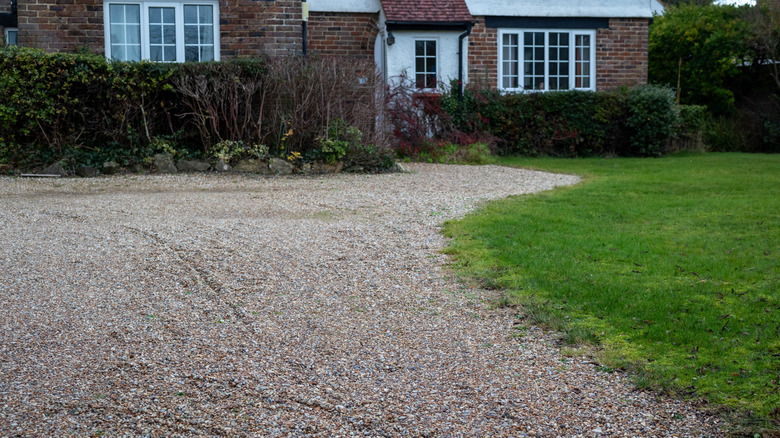
Nothing ruins the rustic charm of your landscaping quite like your gravel driveway gradually spilling out into the street. If you find yourself constantly shoveling these escaped rocks back into place, you already know how frustrating it is to keep seeing them piling up at the end of your driveway after every rainstorm. That escaping gravel is a sign that your driveway has a serious erosion problem. While you can resort to one of the many ways to keep your gravel driveway secure, like just sweeping the rocks back into place and hoping for the best, that's only a temporary band-aid at best. However, you can fix this problem by taking steps such as regrading your driveway and adding better drainage.
When water doesn't have a clear path off your driveway to follow, it can end up pooling or even channeling down the middle, picking up any loose gravel and carrying it to the bottom of the slope as it flows. This essentially means that your driveway has incorrect grading and a poor setup for water management. Every time you ignore the issue, you're literally watching your hard-earned money wash down the street. Ignoring the issue can lead to deeper ruts, bare spots, and even potholes. Gravel driveways are a cost-effective option, but they have drawbacks like erosion. Luckily, you can stop your gravel migration by simply addressing the way water interacts with your driveway.
How to boost your driveway's drainage and regrade it
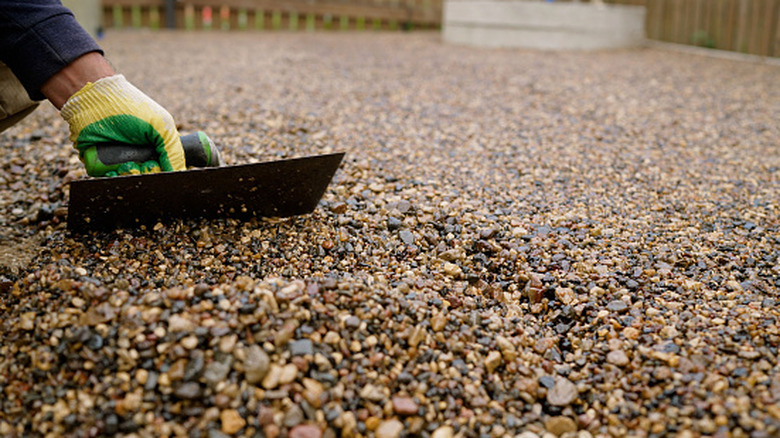
The name of the game is keeping your driveway's gravel right where it is, and there are a few ways to do this. The first is regrading your driveway surface to set up a crown. That sounds complicated, but it just means creating a slight slope from the center of your driveway down both the left and right edges. This redirects the water away from your driveway, which is what normally drags your gravel out into the street.
That's only half the battle, though; you also need to give that runoff somewhere to go. If the water just pools at the edges, then it affects the gravel there and pushes it off to the sides. Installing a driveway drainage system along the edges can help keep water away from it, whether it's to your yard or out to the street gutters. Together, these two steps can help keep your gravel in place.
While those two options are a solid solution to fixing your erosion issue, there are some smaller steps you can take, as extra precautions. For one, use a better gravel type for your driveway, like crusher run, a type that has jagged, angular edges that can easily catch and lock onto other pieces. Over time, it gets more compacted and resists moving around. Standard gravel, on the contrary, usually has smooth, rounded edges. You can also put physical barriers on each side of your driveway gravel to help contain it. Options like brick or concrete blocks work great. By combining a graded crown with better drainage and perhaps even some upgraded gravel, you can put down your shovel and just enjoy your driveway.