

The Hosta Companion Flower That Will Fill Your Garden With Butterflies
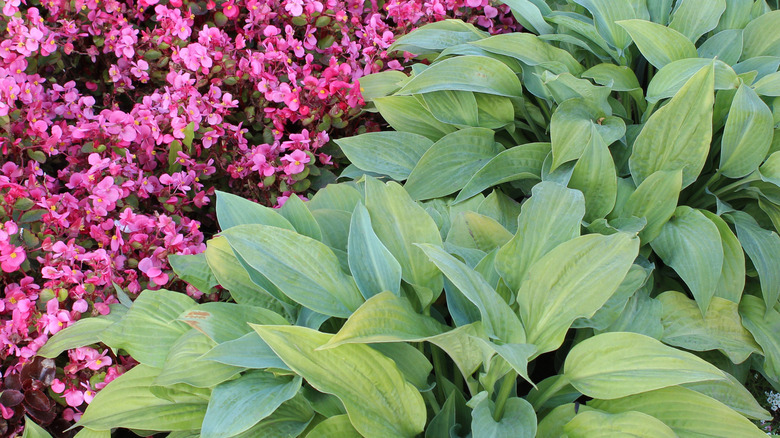
Hostas are shade-loving garden perennials, popular among gardeners for their easy care and long-lived foliage. Although hostas do have flowers that attract pollinators (even hummingbirds!), they're not terribly dramatic or colorful. Planting flowering perennials in the hosta bed can create eye-catching accents for your summer garden. One shade-friendly flower that lends lovely color and attracts butterflies and other pollinators is the wax begonia (Begonia semperflorens).
Called a wax begonia because of the waxy sheen to its leaves, this begonia is usually grown as an annual and can add long-lasting color to your containers. Planted in the shade bed amongst your hostas, this unassuming plant provides weeks of blooms in shades of white, pink, and red, luring butterflies to the shade bed. Wax begonias can be planted in the front of the shade bed near your miniature hostas, or beneath your larger hostas for some unexpected color.
These well-known annual favorites are usually available in nurseries starting in late April or May, along with most summer-blooming annuals. There are varieties with bright green leaves, or bronze leaves, adding to the color combination possibilities; the bronze-leafed varieties are said to be slightly more sun-tolerant. The wax begonia is also known as a fibrous begonia, because it has a fibrous root system, making it easy to distinguish from the tubers of tuberous begonias. It also has much smaller flowers than tuberous begonias, and its signature glossy, waxy leaves are usually rounded in shape.
Caring for wax begonias
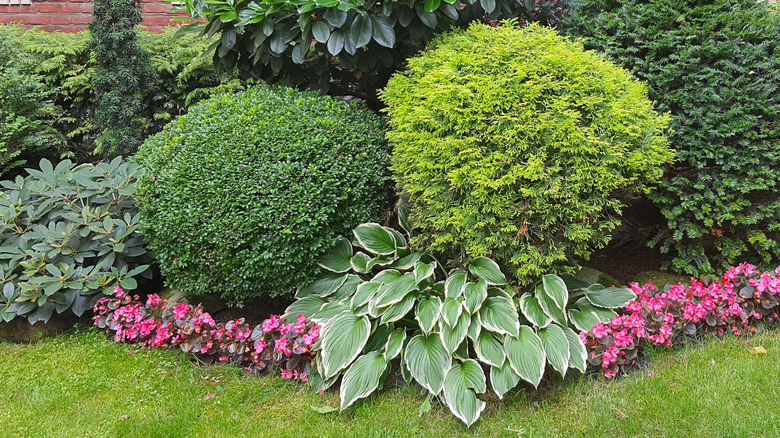
Plant your wax begonias in rich, well-draining soil: you can add some compost or peat moss to improve the soil texture in the bed as needed. Other than regular watering, wax begonias are easy to take care of plants that need very little maintenance. Putting some natural mulch, such as wood chips or pine bark mulch, around the base will help them conserve water in a dry summer season.
If the leaves of your wax begonias get torn or get brown edges, they can be easily snipped off to keep the plants looking neat. Also, wax begonias are "self-cleaning," and the spent blooms drop off without needing to be deadheaded. If the flower stems get leggy or too long, pinch them back gently, which will stimulate new buds to form. These long-flowering annuals are generally deer and rabbit resistant (unlike hostas, alas), and when grown outdoors, are not bothered by pests.
Wax begonias in shades of red and pink look especially nice alongside blue-leaved hosta varieties such as Blue Angel (large with white flowers), Blue Mouse Ears (small with purple flowers), or Abiqua Drinking Gourd (medium with white flowers). Bronze-leafed wax begonias add intriguing color near chartreuse hosta varieties like Fire Island. Some hostas are sun-tolerant, but if you want to plant your wax begonias in a sunny spot with hostas, try to place them so they'll get some afternoon shade (or shade from larger hosta leaves) to keep the blooms fresh.