

How To Choose The Best Type Of Retaining Wall To Help Prevent Flooding
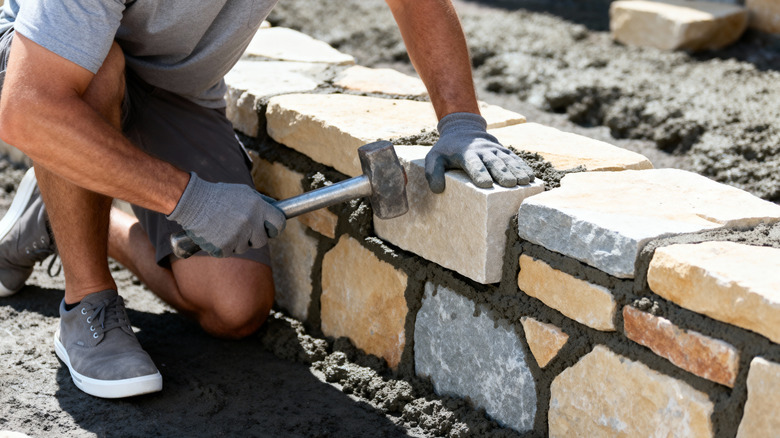
If you've never thought it was worth building a retaining wall, you may want to think again. Whether it's due to a tropical storm, hurricane, or severe storm, the chances of extreme rain events causing floods in your yard and basement are greater today due to climate change. A 2026 University of Alabama study showed that over 17 million United States residents are dealing with high flood risks. Along with proper grading of the land around your home and natural solutions like rain gardens, retaining walls are one method that can help make sure your home is safe from a flood. Deciding on the right type of retaining wall can be intimidating, so we've turned to Brad Holley, owner of The UnDesign, who spoke exclusively with House Digest to explain the options, most important features, and pitfalls to avoid when you're choosing a retaining wall for your property.
Retaining walls are structures used in sloped yards to keep the soil steady and minimize the erosion that raises flood risk. The expert first noted that the best type of retaining wall will vary due to the land you're working with. "Retaining walls are put in place to retain; meaning their whole purpose is to hold soil in place that would otherwise have a tendency to move without a wall stopping it from doing so," Holley said. "Deciding which kind of wall to build and which materials to use has everything to do with how much soil needs to be 'held' in place, and what kind of liabilities might exist in, on or around that soil."
Select the right retaining wall materials for your risks, budget, and preferences
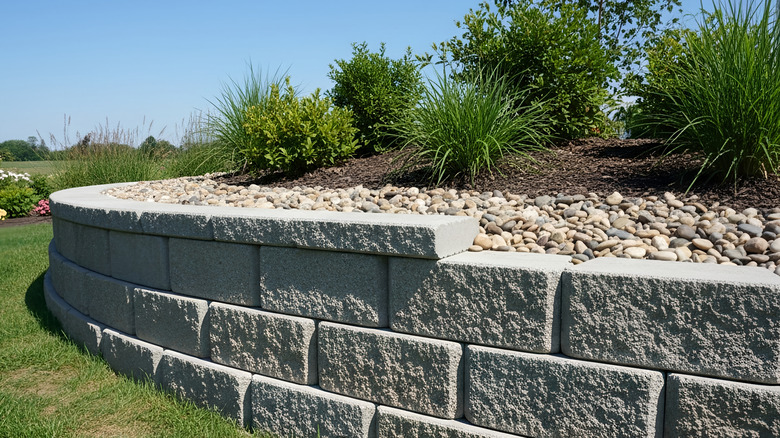
If you're planning a retaining wall, there's no shortage of options. Holley outlined the most important features to consider in his exclusive interview with House Digest. "The first is the material it will be made of," Holley began. "The second is the height and thickness. And the third would be how it will be 'finished.' Another way of saying that would be to ask, 'Are you going to see the materials that the wall is made of when it's done? Or would you prefer to apply a decorative veneer (like stacked stone or tile) to the outside?'"
According to Holley, a concrete retaining wall can protect your outdoor landscape because it can be waterproofed. Waterproofing "involves applying a special coating to both sides of the wall that makes the wall impermeable on both sides," he said. "The most common types of walls for preventing flooding are going to [be] solid walls with smooth surfaces. And this comes in the form of concrete walls (poured in place, shotcrete, or gunite), or CMU (concrete masonry units) block walls."
Calculate how long and high you need the walls to be to stay within budget. "If the wall is going to span a long length, the most budget-friendly materials for a simple wall would be landscape ties/timbers reinforced with screws or galvanized spikes," Holley said. "If the wall is going to be rather short in length and not very tall, the absolute most economical choice is to dry stack landscaping blocks in a "running bond" pattern (think of the way bricks are typically laid in an interlocking, stair-step style)."
What to avoid in a retaining wall project
As tempting as it may be to try adding a DIY retaining wall to your sloped yard, Holley advises caution. Speaking exclusively with House Digest, the landscape designer said, "If flooding is a reasonable expectation and you need the highest probability that a retaining wall is going to mitigate or prevent that problem, then what you really ought to do is hire a licensed structural engineer to design a wall that will not only do its job, but will do so reliably for years to come."
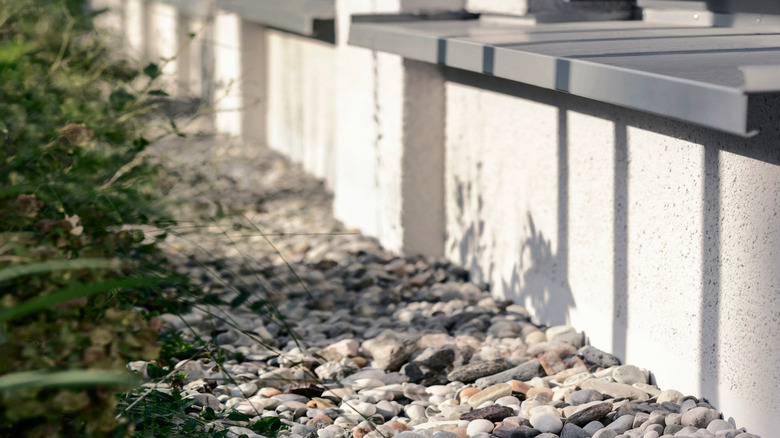
Whether you're calling in a pro or building on your own, it's vital to prevent overflow with drainage solutions. "If you don't consider how water wants to move through your soil during a heavy rain, or the implications it can have, your amazing wall will come tumbling right down," he warned. "The soil under your feet is like a kitchen sponge. And if you've ever played with a kitchen sponge you know that it can only get so full of water before it can't hold any more, and the rest of it just runs off or falls through. If higher elevation water runs into a wall that is equipped with a gravel trench or a French drain system, then it doesn't have the opportunity to stay there and build up into a hidden lake." The most effective walls "could mean going as far as building a wall on top of a deep, subterranean concrete footer, or having it poured monolithically out of solid concrete, waterproofed on both sides, and then protected by a generous drainage system behind it, and in front of it," Holley said.