

Nothing's Affordable, Everything's A Scam: The Illusion Of Saving On Home Decor

When I moved into my new apartment last year, I had a mood board full of ideas. From Instagram to Pinterest, I had built a vision for what my apartment would look like: a mix of '70s-inspired bright colors with metal and wood accents, sleek pieces with a mid-century modern take, and a bit of funk sprinkled on top. When it was time to actually furnish the place, I was sourly disappointed. Small couches from a local upscale home decor store cost thousands. Even a glorified ottoman pouf retailed for upwards of $600. When I turned to much more affordable options, like furniture pieces on Amazon that hovered around $100 or so, I couldn't help but feel like I was being scammed by low-quality products that reviewers claimed didn't last long. I don't care what anyone says — $100 might not seem like much compared to the price of high-end products, but it's still $100 — and it's sad to think that no longer means anything.
In an attempt to save some money, I ended up on a side of TikTok full of "dupes" of luxury decor. The prices looked appealing in comparison to the real deal. For a fraction of the price, the Amazon product, which looked like something from a magazine in the photos, would be delivered to my doorstep. I entered my credit card info, inputted my address, and waited for the packages to arrive. A few weeks later, I was met with a rude awakening. One folding desk I ordered felt like it was made out of paper (close, it was plywood). The metallic mechanism to open and close it felt like it wouldn't hold my laptop for much more than a few months. Sure, $100 was much cheaper than the $500 alternatives, but was it even worth that much? I don't think so. If I hadn't been comparing this model to more expensive ones, maybe I wouldn't have been swayed to make this purchase.
Why the dupe economy is duping you

One way to get scammed into thinking some affordable home decor and furniture pieces are a good deal is with the "dupe" economy. These are pieces that look like high-end furniture and home decor but cost a fraction of the price. Here, the issue is the price comparison: When looking at a $6,000 Togo loveseat, an Amazon dupe for $250 seems like a great deal. And instead of spending $2,000 on a Crate and Barrel solid wood dining table, a $400 Wayfair alternative seems cheap. But in the end, you're still spending a lot of cash.
And the issue is that you don't really know what you're getting. Sure, those prices seem like a steal if you were guaranteed to get the high-end version of the piece. But when the quality is not there, you're really just wasting your money and signing up for more purchases down the line. When that loveseat's cheap polyester lining rips after a year, you'll need to buy a replacement. The same is true for my "affordable" folding desk and its weak hinges that I will likely need to replace soon.
Now, I'm not suggesting you drop $6,000 on an original Togo loveseat, because honestly, stores like Pottery Barn have taught us that high-end doesn't always mean good quality. But instead, stop using it as a benchmark. Forget about the original price tag and look at affordable models for what they are: read the materials list, browse customer reviews, and try to picture how they'll age. You can do this no matter if you're shopping online at Amazon or Wayfair, or at brick-and-mortar shops like Home Goods, Costco, and Walmart. You might start to notice that, often, pieces don't seem quite as affordable once they're closely analyzed for what they're worth.
Where can you go for truly affordable home decor?
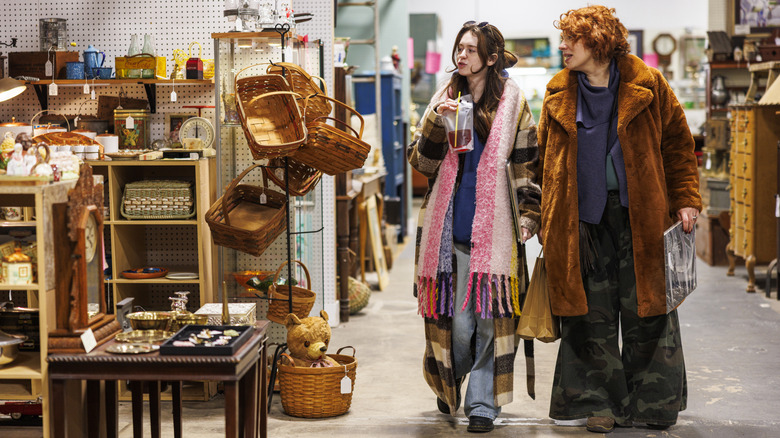
In a home decor world where nothing is affordable and everything is a scam, I'm thankful for the second-hand market. When shopping used, you already have a quality guarantee: those pieces were strong enough to withstand the test of time. And if you have the right tips and tricks, you can learn how to spot valuable and high-end items at thrift stores. But the goal isn't even to find collector's items, it's just to furnish your home without breaking the bank. Oftentimes, even forgotten thrift store finds can turn into unique statement pieces, and a bit of paint stripper, a scraper, and some lacquer can give them a second life.
Personally, I've learned my lesson. I won't replace my folding desk yet — I'll wait for it to break — but I've stopped looking for furniture at "cheap" stores. Instead, I found a cute coffee table for $10 at the local thrift store and paired it with a second-hand IKEA swivel armchair. For my desk, a few trips to the second-hand store were enough to score a $10 desk chair that looks brand new. All in all, I managed to spend less on three pieces than I did on my desk alone. How's that for affordable?
And if you really want to buy new, another option is to play the long game and wait for deals and sales from your favorite high-end home decor brands. No matter what, you'll probably end up spending more than you would on second-hand pieces, but at least you might end up with items that will last for decades. But please, stop buying so-called affordable mass-produced furniture and decor that break within a year.