

How Often Do I Need To Replace A Riding Lawn Mower Battery?

While a riding lawn mower might be overkill for some homeowners, it is the most practical choice if you have a large property to maintain. But like any machine, it depends on a healthy battery to start and operate properly. If your equipment suddenly struggles to turn over or refuses to start altogether, it could be a sign that the battery is nearing the end of its lifespan. How long a riding lawn mower battery lasts depends largely on the type of battery. Traditional lead-acid batteries typically last three to five years, while lithium-ion batteries can last five to seven years with proper care. However, factors such as maintenance, frequency of use, climate, and storage conditions can shorten battery life.
Lead-acid batteries are used in gas-powered riding mowers, and they require more maintenance than lithium-ion units. Leaving a lead-acid battery stored for months on a low charge can cause lead sulfate crystals to form inside the battery, permanently reducing its ability to hold a charge. Cold temperatures can also weaken battery performance, which is why proper winter storage matters.
Lithium-ion batteries, on the other hand, are found in electric and cordless riding mowers. They are not vulnerable to sulfation and do not require maintenance, but they can still degrade over time if exposed to high heat, stored at a full charge, or subjected to repeated deep discharges. Fortunately, regardless of battery type, there are simple tricks for protecting your lawn mower battery as the weather changes, such as storing the equipment in a cool, dry place and following the manufacturer's charging recommendations.
Signs your lawn mower's battery needs replacing
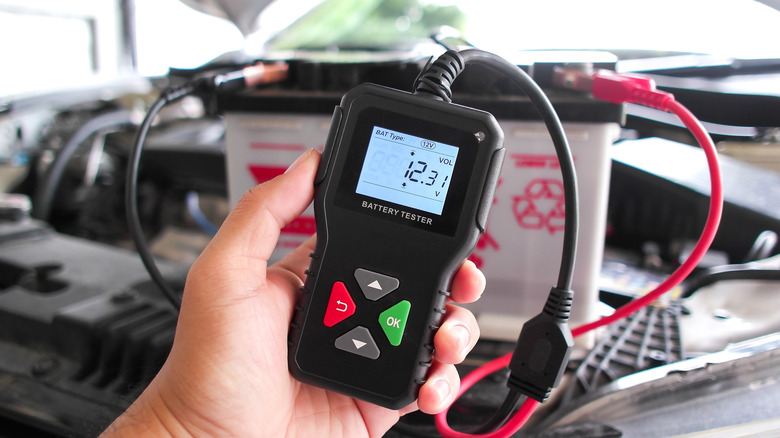
Even before your mower battery completely stops functioning, there are usually warning signs that it may need replacing. One of the most obvious is slow engine cranking. This often means the battery can no longer deliver enough power to activate the engine efficiently. Other common signs include shorter operating times and more frequent charging. A healthy battery should be able to hold a charge between uses. Visible corrosion on the terminals, acid leaks, a swollen battery casing, or dim headlights can also point to battery trouble.
A battery tester, such as a multimeter, can help confirm whether your mower battery is failing, but the proper voltage depends on the battery type. For a fully charged 12-volt lead-acid battery, a reading between 12.6 and 12.8 volts is considered healthy. If the voltage drops below 12.4 volts, the battery may need charging, while anything below 12 volts can indicate the need for replacement. Lithium-ion mower batteries use different voltages depending on the manufacturer and battery system, so it's best to consult the owner's manual for accurate readings. While lead-acid riding mower batteries generally need replacing every three to five years and lithium-ion batteries every five to seven years, paying attention to performance issues and keeping up with overlooked lawn mower maintenance tasks, such as cleaning battery terminals and checking charge levels regularly, can help extend their lifespan.