

What Does AQI Mean On An Air Purifier?
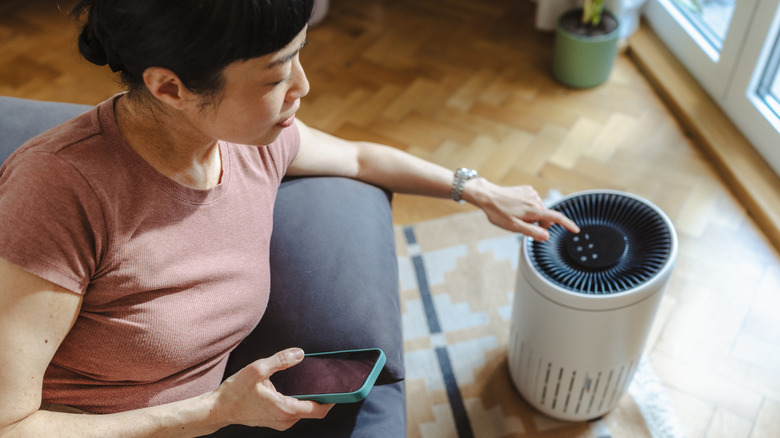
When looking at the display of an air purifier, you might have noticed a number that's labeled "AQI." This acronym stands for Air Quality Index, which is a way that your air purifier measures how clean or polluted the air is in your home. There are many modern air purifiers for your home that won't break the bank that use AQI readings. These readings display indoor conditions and alert you when levels change.
The Environmental Protection Agency (EPA) created the Air Quality Index to report on air pollutants that pose potential health risks. It tracks ozone, carbon monoxide, sulfur dioxide, and nitrogen dioxide, providing an estimate of the level of these pollutants. It also focuses on indoor particulate matter, or more specifically, PM2.5. These airborne particles are 2.5 micrometers large or smaller, making them small enough to enter your lungs. They can come from various pollutants like cooking fumes, smoke, dust, pet dander, candles, or even outdoor wildfire smoke. With an air purifier, the PM2.5 levels can be reduced and maintained indoors — the World Health Organization recommends that daily average levels stay below 15 micrograms per cubic meter. Find an air purifier that's worth it by purchasing one designed for your room's size.
The AQI display can vary on different purifiers. They also may not always be accurate, depending on the brand. You can do some research to find the most reliable air purifier brand. Most brands come equipped with HEPA air filters, which work to capture very fine particles in the air.
What AQI readings mean and how to monitor them

In addition to the AQI, you may see a color or light that goes in conjunction with the air quality. Certain models may show simple "good" or "poor" readings. Others display a detailed number of the PM2.5 measurements alongside AQI values. Your air purifier measures the AQI using built-in sensors. Once particles move through your machine, the sensor estimates how polluted the air is, then converts it into a number showing your home's overall air quality.
The numbers on an AQI scale range from 0 to 500. Lower numbers mean that the air is cleaner, and higher numbers indicate increased pollution levels and potential health concerns. When levels are below 51, the air quality is acceptable. 51 to 100 is moderate, and once levels are above 100, it becomes unhealthy for sensitive groups, such as those with allergies or asthma. Numbers above 200 are unhealthy levels for all people, with over 300 being hazardous. Monitoring these numbers can be particularly helpful if you live in a place with high pollution or deal with health conditions.
You may notice a spike in the numbers when you're frying food, burning candles, or opening your windows. Many machines will automatically switch to a higher fan setting to improve the air quality. You can also adjust the fan settings manually during those times, or when you notice the air quality inside is poor to keep the AQI levels lower. You can also improve the AQI by changing out the air filter every few months to a year (depending on manufacturer recommendations), closing windows, and keeping humidity levels down.