

What To Do If You Find Black Ash On Your Tree Leaves
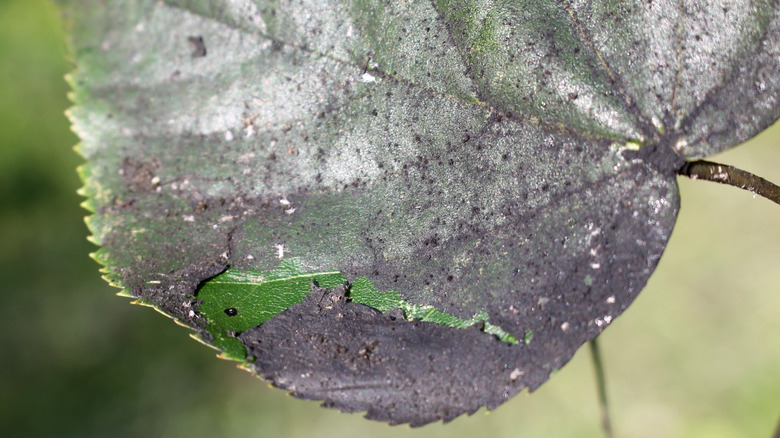
Discovering what looks like black ash on trees in your yard can seem alarming. Did you somehow miss a nearby fire? Not likely. Instead, you're probably seeing the result of one of the more annoying chain reactions in nature. It's possible to get rid of the dark substance on the leaves, but it doesn't solve the problem, which begins when a sap-sucking insect consumes the sweet sap of trees and other plants and then excretes what's known as "honeydew." This liquid happens to be a favorite food of several genera of fungi. It's the fungi on honeydew that make up what's known as "sooty mold" on foliage. When you see sooty mold on leaves, you can stop it by eliminating the sap-sucking, honeydew-producing insects.
The chain reaction that leads to sooty mold is an issue in every season except winter. Unfortunately, it doesn't end with the black substance because ants are also attracted to honeydew and will even protect the insects that produce it. If ants are removed from the equation, beneficial insects that prey on the sap-sucking pests can help you out with control.
The good news in all this drama is that sooty mold does not actively or directly damage your trees. A large amount of it covering leaves, however, can affect photosynthesis by blocking out light, and tree growth can be stunted. You'll want to remove it, though the more urgent task is tackling the insects. A non-exhaustive list of trees affected by honeydew insects and sooty mold includes some fruit and nut trees (apple, citrus, guava, fig, pecan), along with elm, maple, pine, linden, and crape myrtle.
Control sap-sucking insects to avoid sooty mold on tree leaves
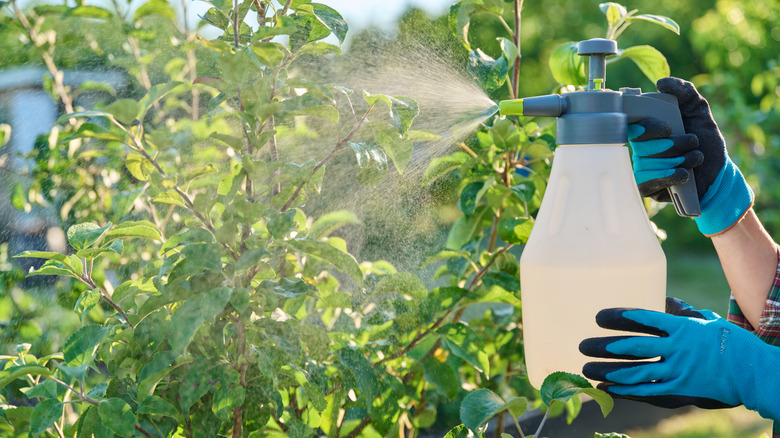
The University of California lists aphids, leafhoppers, mealybugs, psyllids, soft scales, and whiteflies as the insects to target for sooty mold control, and some of these are considered the worst garden pests you'll want to banish from your yard immediately. Aphids seem to get the most attention in the research literature, so thankfully, you can easily learn more about how to get rid of aphids if you're convinced they're the issue. Horticultural oil, neem oil, or insecticidal soap are used on foliage to control all of these pests. Before applying treatments on aphids, whiteflies, and mealybugs, try a forceful stream of water first; if those are the only sap-sucking critters you have, plain water may do the job.
All three of the oil or soap options will work on aphids, mealybugs, soft scales, and psyllids. They should also work on leafhoppers in the nymph stages. For whitefiles, insecticidal soap works on the crawler stage of the insects, while neem oil keeps eggs from hatching. One option is to clean off existing sooty mold with a stream of water or soapy water and then apply a soap or oil treatment to target the pests. If you have a heavy infestation or are dealing with multiple kinds of insects, you may want to consult a professional arborist.
As for controlling ants attracted to honeydew, you'll find many ways to deter or remove ants without killing your garden plants. For trees, a good solution is to apply a sticky product around the tree trunk that keeps ants from climbing any higher in the tree. You can also try ant baits with insecticide.