

Skip Hydrangeas: The Dainty Alternative That'll Look Great In Your Small Yard
Hydrangeas are popular flowers in gardens. They come in shades of pink, blue, white, and purple and often become the center of attention thanks to their large, showy blooms that last for weeks. The problem, however, is that hydrangeas are space-hungry plants with extensive root systems. If crowded, they develop diseases. Don't worry, though: Just because you have a small yard does not mean you have to give up on growing a plant with large, showy, abundant flowers. You can grow doublefile viburnum (Viburnum plicatum var. tomentosum) instead. It is a deciduous shrub that grows about 8 to 10 feet tall and 10 to 12 feet wide, making it a great choice for small gardens or tiny yards.
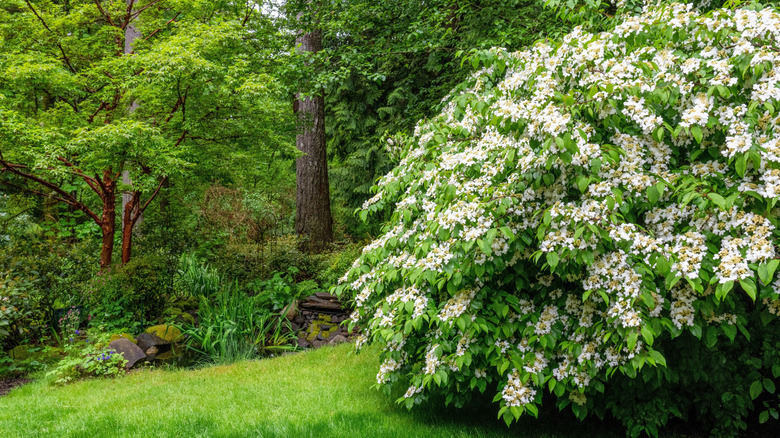
Doublefile viburnum can also be pruned into a small tree and grown on its own as a specimen plant, or in groups for mass plantings and hedges. It grows with a striking layered branching and produces flowers in spring from April to May. The flowers are often compared to lace-cap hydrangeas, and they are arranged in snowball-type clusters along the branches of the plant. Unlike many hydrangeas, the flowers of doublefile viburnum provide value for wildlife as well.
They attract a number of pollinators, including bees and butterflies. Plus, their berries feed many birds. Also, unlike hydrangeas, doublefile viburnum does not have any serious pest or disease issues. The only issue is that doublefile viburnum is hardy in fewer USDA plant hardiness zones than hydrangeas, and you can only grow it in zones 5 to 8. If you live outside these zones, you might want to find some other low-maintenance hydrangea alternatives to grow in your garden.
Growing and caring for doublefile viburnum in a small yard
The first thing you want to do when growing doublefile viburnum in your yard is to ensure that you find a spot that is either in full sun or partial shade. Avoid deep shade, as it will not flower well there. If, however, your small yard is naturally too shady, you can instead look into some other flowering shrubs that thrive in the shade, like slender deutzia (Deutzia gracilis) and Virginia sweetspire (Itea virginica). As for soil, doublefile viburnum is not very fussy and can thrive in many soil types. Still, for the best results, grow it in loamy soil with a slightly acidic to neutral pH.
Make sure the soil is also moist and well-drained. Try enrichinch it with organic matter for even better results. Then, grow the plants using cuttings or pre-grown nursery plants. You can also grow doublefile viburnum using seeds. However, it is a very slow process as it can take about one and a half years for its seeds to even germinate. No matter how you grow a doublefile viburnum, however, make sure you water it deeply and regularly during the first year. This helps plants develop a robust root system. Once the plants are established, reduce watering frequency and water as needed.
Don't forget to fertilize doublefile viburnum in early spring as well, making sure you follow all the label instructions and never overfertilize because this can reduce the number of flowers and even kill the plant. In addition, prune the plants once they have reached a suitable size, exercising the three D rule to properly prune your plants.