

Don't Fall For Its Beauty: The Yellow Flowering Tree You Don't Want In Your Yard

Ever heard the saying, "all that glitters is not gold"? Well, the same goes for certain plants. Sure, they may catch your eye with bright golden-yellow flowers, but some are messy, invasive, or so high-maintenance that you will regret planting them in your yard. Take Chinese flame tree (Koelreuteria bipinnata), for example. It is a small- to medium-sized deciduous tree with a beautiful vase-shaped form that grows about 20 to 40 feet tall and wide. The tree is sometimes used for shade in landscapes and has lush green leaves that change to golden yellow during fall.
It blooms in summer as well, producing abundant bright yellow flowers that can remain for weeks and create a dramatic display in the yard. Flowers are also followed by papery pink seed capsules. These capsules are highly popular in flower arrangements as they keep their rose color even after drying. Put simply, the combination of beautiful foliage, an excellent fall color, abundant golden flowers, and a graceful form with a wide canopy make the Chinese flame tree highly desirable in gardens and yards.
The problem, however, is that it is extremely messy and high-maintenance. It drops an abundance of flowers and seed pods to the ground, which can clog up drains and litter patios, pathways, and driveways. Even worse? It is weedy. Plus, it has been declared problematic and invasive in some parts of the U.S., like South Carolina and Arkansas. All in all, if you are looking for trees that bloom with gorgeous yellow flowers to grow in your yard, the Chinese flame tree is not the one you want.
Removing the Chinese flame tree and what to plant instead
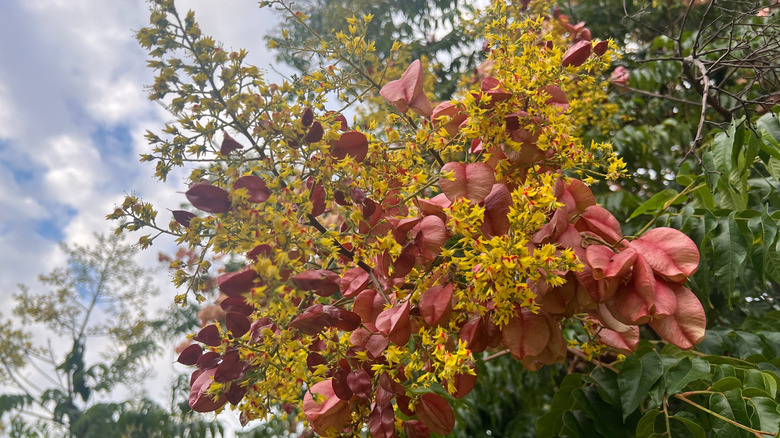
If you suspect there is a weedy or invasive plant in your yard, like the Chinese flame tree, you should start taking measures immediately to remove it from your yard. How you do it exactly varies from tree to tree. For instance, if the tree is relatively small, you might just be able to pull it out with your hands, taking care of the problem. Just make sure you get all the roots out when pulling. Otherwise, the roots might sprout into new plants again. If, however, the tree is large and pulling it out is not possible, you can kill it using herbicides and then cut it down.
Cutting alone is usually not enough, as invasive trees like Chinese flame tree have a habit of resprouting. As for the chemical treatment options, they come in several forms, from foliar sprays to stem injections to basal bark and cut-stump treatments. Regardless of which herbicide you use, always follow the label instructions. Then, once you have removed the Chinese flame tree, replace it with something else.
Some good options include American smoketree (Cotinus obovata) and yellow buckeye (Aesculus flava). American smoketree has an excellent fall color, just like the Chinese flame tree. However, unlike the Chinese flame tree, it does not have a litter problem. Plus, it is native and low-maintenance. As for the yellow buckeye, it has yellow, showy flowers just like the Chinese flame tree, and is one of the best options if you want to add color to your landscape.