

Don't Let Its Beauty Fool You: The Flammable Tree You Might Not Want In Your Garden
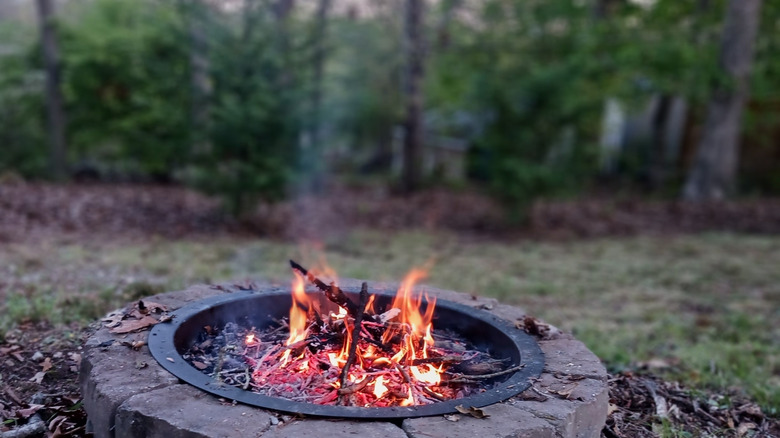
When it comes to picking out a tree for your garden, its flammability may not be something you consider. However, you should take it into consideration with at least one genus: Eucalyptus. They grow well in USDA Hardiness Zones 7 to 10, but should you plant one? The stately greenery isn't without its perks. They're low-maintenance trees that you can grow to naturally repel wasps. They're also beautiful, fragrant, and require little watering. However, the negatives may outweigh the benefits. For one, some Eucalyptus species are invasive in certain parts of the U.S. Most concerning, especially if you live in a drought-prone area or have a backyard fire pit, is how flammable eucalyptus trees are.
The bark of this tree sheds in long, lightweight strips that will quickly transform into flying embers in the event of a fire. You don't want those landing on nearby shrubbery or structures. Eucalyptus trees also produce oils that release volatile gases at high temperatures. While these oils make the tree smell good, they're also highly flammable. Once a eucalyptus starts burning, the fire rapidly overwhelms the entire tree. This is extremely problematic in areas where fires move underground — trees can catch fire or explode without any warning at all. Of course, a eucalyptus isn't going to spontaneously combust in the absence of a spark, but the fact that its bark, leaves, and oils catch fire so easily means a fire can get out of control and spread quickly. Native replacements — like Eastern redbud (Cercis canadensis), which is hardy in Zones 4 to 9 and produces stunning pink-hued flowers — are probably the better choice.
How to reduce fire risks with outdoor eucalyptus trees
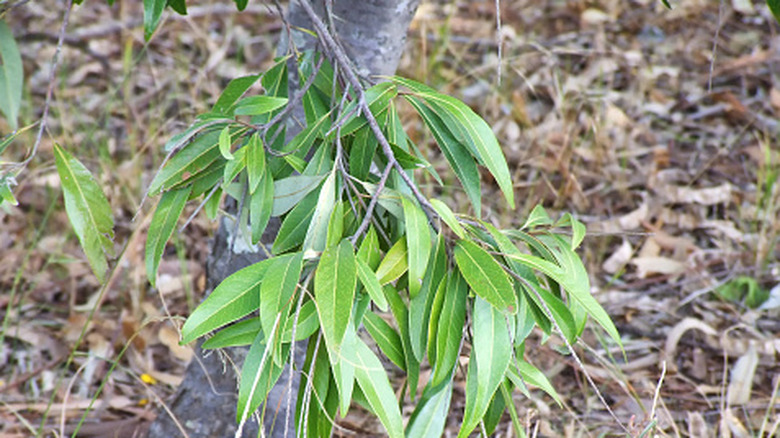
If you still love this fire-prone tree, you don't necessarily have to eliminate eucalyptus from your garden. There are steps you can take to make this flammable tree a little safer. For one, remove the bark from the ground around the tree shortly after it's shed. Make it a regular yard chore, particularly during wildfire season. Additionally, while the leaves are fire-resistant when they're green, the dead leaves are not. A good rule of thumb is to prune or pick up any dry, brown materials from on or around the tree.
Take steps to mitigate or reduce the impacts of a fire in the rest of your yard, too. For example, ponds, waterfalls, or streams are backyard features that may help if you live in a fire-prone area. They act as a fire break and give you quick, easy access to water in the case of an outbreak. You can also plant fire-resistant species, like prickly pear cactus, yucca, and western larch, in the garden beds closest to your home. Site fire-prone plants, like eucalyptus trees, at least five feet away from structures.
Still, you might want to think twice before adding a eucalyptus tree to your garden. As mentioned, some species are considered invasive — mainly in California — due to their enormous, spreading lateral roots. Blue gum (Eucalyptus globulus) and river redgum (Eucalyptus camaldulensis) are officially listed as invasive, while sugar gum (Eucalyptus cladocalyx) is on the watch list. Depending on where you live, the alpine snow gum (Eucalyptus pauciflora spp. niphophila) or the Jounama snow gum (Eucalyptus pauciflora spp. debeuzevillei) may be safer options because their roots are less aggressive and their oils are generally less potent.