

Not Honeysuckle, Not Petunias: The Hanging Basket Flower Hummingbirds Can't Resist
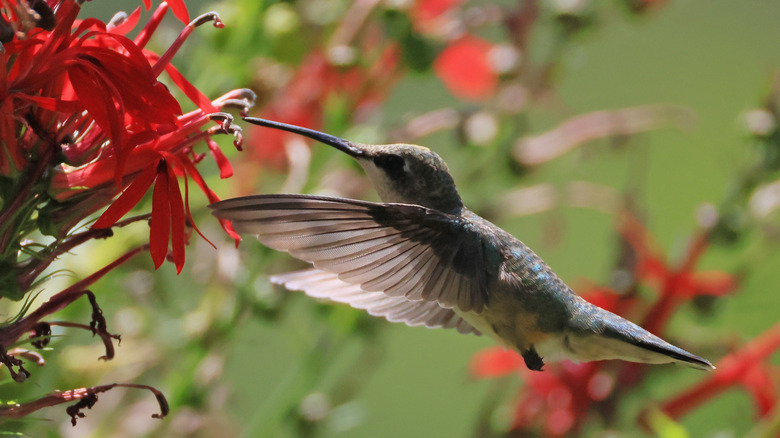
Looking for smart ways to draw more hummingbirds into your yard or garden? An easy way to do that is to divert your focus from the traditional garden and attract hummingbirds with hanging baskets. These aerial flower containers are ideal for accommodating hummers because they're highly visible in the air and dangling flowers are well-suited to the way hummingbirds feed. All you need to do is outfit them with blooms that hummers love to feed from. Petunias and honeysuckle are fine, but why not go for something more dramatic, such as cypress vine (Ipomoea quamoclit) — a beautiful, fast-growing, twining climber plant with fern-like, lacy foliage and bright red, star-shaped flowers?
Cypress vine — often confused with the hybrid cardinal climber (Ipomoea sloteri) — is a gorgeous hanging basket plant option that hummingbirds absolutely love. It offers a long bloom time from June to October, is easy to care for, and is deer- and drought-resistant. In a garden, the twining cypress vine needs support, so it's perfect for a hanging basket, which allows it to dangle lazily. Meanwhile, the basket also helps contain its fast growth and self-seeding.
Delight hummers with cypress vine in your hanging baskets
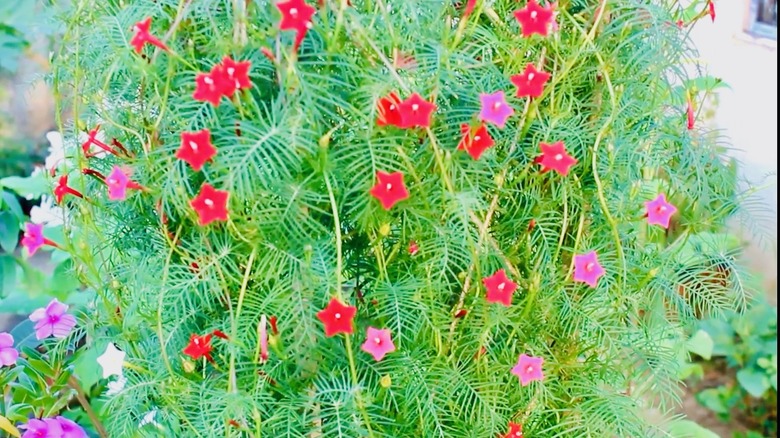
Cypress vine is grown as an annual in most locales, but it's cold-hardy in the warm climates of USDA zones 11-12. Grow the vine from seeds, which benefit from scarification and a soak in water for up to 24 hours before sowing. While you can start them indoors six to eight weeks before the last frost in your area, their delicate roots make transplanting difficult, so it's usually easier to simply sow directly in the basket a couple of weeks after the last frost. The vine is a lightning-quick germinator, popping up in just four days, and a fast grower throughout its life. In fact, Birds and Blooms notes 10 feet of growth in a matter of months.
Plant the seedlings in moist, well-draining soil in your hanging basket and place it in a spot with full sun. Keep cypress vine evenly moist, and avoid overwatering — yellow leaves are a sign of too much moisture. Fertilizer is not an absolute necessity for the vine, but applying a balanced fertilizer according to label instructions will promote growth. Feel free to prune liberally after the growing season.
Propagation by seed is extremely easy since the plant is self-seeding. In fact, you'll likely want to control the spread of seeds by cutting off seed heads before they hit the ground. The vine has no significant pest or disease issues. However, cypress vine seeds are toxic to dogs, cats, and horses and can sometimes cause nausea and hallucinations in humans.