

What Are The Lines For On Bath Towels?

Towels are vital to many of our cleaning rituals. Despite their omnipresence in our lives, there's a lot we don't know about them. One of the more mysterious aspects is those thick lines of stitching some towels have near the hem. This patterning is called a dobby border or cam border, and it actually serves a pretty important purpose: It helps the fabric hold its shape and reduces shrinkage.
Naturally, there are a lot of online theories floating about, as to the purpose of these lines. They range from solely decorative to odd functions, like separating sections of the towel for better hygiene. Some people believe the stitched areas absorb water better — which, to be clear, isn't the case. The fabric in the dobby border is stretched so tight that the piles (the small loops of thread) are flattened, unlike the rest of the towel, actually leading to poorer absorption.
As mentioned, the dobby border strengthens the towel, prevents fraying, and stops it from getting smaller over successive washes. When you tumble towels in a hot dryer, the center shrinks faster than the edges, distorting the shape. Not only does the towel lose its aesthetic appeal, but drying yourself with a wonky towel is a challenging feat. These patterned, stitched lines put a stop to shrinkage, keeping your towel in shape for as long as possible. Manufacturers stitch dobby borders into bath towels more often than with other household linens because towels are used and washed so frequently that they tend to wear out faster.
Which is best — dobby borders or cam borders on towels?
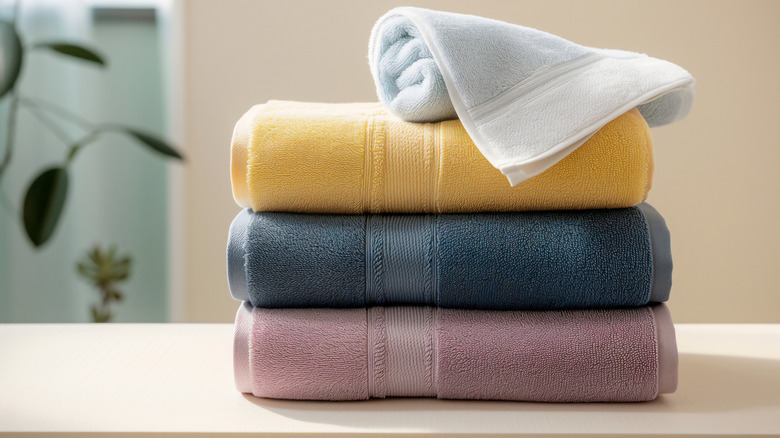
The terms dobby and cam may be used somewhat interchangeably, but they're not the same thing. They serve slightly different purposes. Dobby borders are typically the more decorative of the two border types, woven on a special loom. They're often employed on luxury towels sporting detailed patterning, but they still serve the same functional purpose — helping the towel to lie flat. Cam borders are simpler in design. Though they still look nice, they're really there to preserve the towel's structural integrity and prevent fraying. You may start to notice cam borders on towels at spas and in standard hotel rooms — it's a smart, functional pattern that helps fabric withstand frequent washing.
There aren't really any rules around whether you should choose towels with dobby or cam borders for home use. Either of these designs is great if you're looking for towels that will last. In some cases, these borders may help increase airflow — by hanging flat on a rack when wet and not bunching up — helping it dry faster and more evenly.
However, the borders have little to no influence on how fast a towel will dry a person. Most people dry themselves with the absorbent center of a towel rather than the edges. Although aesthetics isn't the primary reason dobby or cam borders exist, choosing a more detailed stitched pattern can elevate your bathroom design. Pair your fancier, dobby-bordered towels with this hand towel trick to bring a hotel-feel to your bathroom. Neatly fold and tuck your towels into themselves, then hang them over a decorative towel rack. It's ideal for guest bathrooms.
Are dobby or cam borders really necessary for bath towels?

While dobby and cam borders are designed to increase the lifespan of towels, it doesn't necessarily mean that bath linens without them are inferior. Not every bath towel has these patterns. Sometimes high-quality towels with a sleek aesthetic don't have them. For example, Consumer Reports' highest-rated bath towel brand in 2026 — Quince — doesn't include borders on all their products lines. On the flip side, cam borders also feature prominently on plenty of cheap, scratchy, poor-drying bath towels.
That's because, technically, they're not necessary. Even without them, your towel can do its job: Soaking up excess water. However, a towel without a dobby or cam border may wear out faster than a towel with one. For home use, the difference may be negligible. In industrial settings, it's more significant, where towels are washed and dried incredibly frequently at high heats.
In short, it's unwise to choose towels based solely on the presence or absence of dobby or cam borders. If you're deciding between two towels of comparable price and quality, and one has a border and the other doesn't, it may be worth choosing the towel with the border. However, in situations where price and quality are vastly different, the border is a nice-to-have rather than a must-have feature. Focus instead on things like choosing the best material for your bathroom towels — for example, sustainable, durable, and soft bamboo towels are trending.