

What Happens If You Don't Clean Your Dishwasher Regularly

If you're not regularly cleaning your dishwasher, it may be time to scrub up your routine. A 2020 YouGov survey uncovered that 45% of the 1,000 homeowners queried never give their dishwasher a deep clean, despite experts recommending a monthly overhaul. And nearly a quarter assume the appliance responsible for keeping their plates and flatware immaculate kind of just cleans itself. After all, it's constantly filled with hot, soapy water. But the dishwasher does important daily work and needs the same attention you pay your counters, floors, and other spaces.
The dirty truth is that if you're not regularly maintaining your dishwasher, it won't deliver at peak performance. Most dishwashers accumulate food particles in a filter — also known as the food trap — at the bottom of the machine or near the spray arm. And if those bits of leftovers aren't regularly removed, they can recirculate during each cycle and get trapped on your dishes. Even worse, when combined with grease and soap scum, they could lead to a clog or blockage in the filter, spray arm, or drain, further affecting the cleanliness of your dishes. Plus, all those food particles can cause bacteria and mold to grow, leading to quite the smelly situation. That's why regular maintenance is one of the top ways to troubleshoot common dishwasher problems.
How regularly to clean your dishwasher, and how to do it
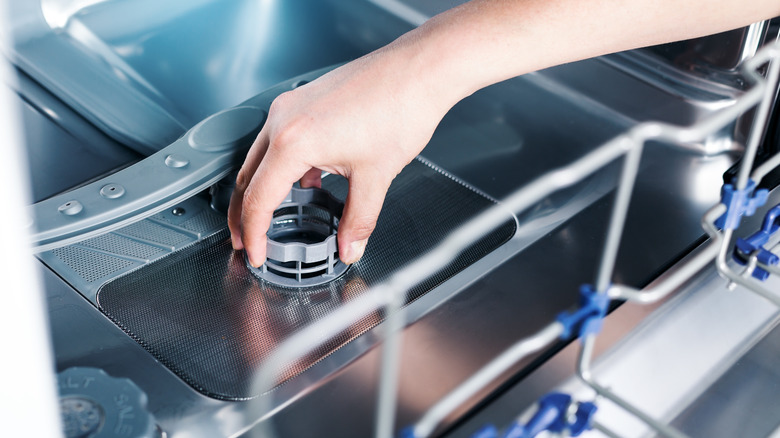
If you're ready to clean up your act, here's how often you need to clean your dishwasher. At least once a week, give it a thorough wipe-down with a damp cloth, making sure to get the edges of the door where grime can collect. Every other week, clean out the filter, a one-minute task that can boost your dishwasher's performance. Detach it from the machine (consult your owner's manual for instructions), then simply run it under warm water to remove any debris. If it's particularly grimy, you may need soapy water and a toothbrush for scrubbing.
Every three to six months is when your dishwasher requires its deepest cleaning. You'll want to fully pull out the racks to wipe them down and inspect the drain, utensil holders, and filter for any food debris or other build-up. Also survey the spray arms for clogs, using a toothpick to clear out all the holes. To treat the gasket — the flexible strip around the door — use a toothbrush to scrub the area, using a solution of 3 cups of hot water and 1/2 cup of white vinegar.
Then, let the dishwasher work for you. Place a cup of vinegar on the top rack and run a cycle on the hottest setting to remove accumulated mineral deposits. Finally, reach for some baking soda. A cup of the kitchen staple — sprinkle it on the bottom of the dishwasher, then run another hot cycle — will neutralize any odors. And to ensure that everything runs smoothly, make a note to inspect the water inlet valve and hoses for potential leaks at least once a year.