

How Long Do Lawn Mower Stripe Designs Really Last? (& How To Make Them Last Longer)

We may receive a commission on purchases made from links.
You work hard to create perfect stripes in your lawn that are the envy of your neighbors. Then those neat lines disappear just a few days later. It's frustrating, and makes you regret all of that effort. Don't give up. While those neat designs may only last three or four days normally, you can take steps to retain the pattern for a week or more — right up until it's time to mow the lawn again. Growing the right type of grass, noting the season, cutting the grass longer, and using a kit can, among other tricks, help you achieve your preferred aesthetic.
The stripes from mowing are the result of bent grass blades. As you push your mower over your grass, the safety shield behind the lawn mower pushes or pulls the blades in one direction. Grass blades that are bending toward you appear darker because they don't reflect as much light. The blades bending away from you are reflective, and thus appear lighter. Depending on the direction you mow your lawn in, you create some really intricate patterns. However, as the grass bounces back from the pressure and continues growing, the stripes — or whatever pattern you chose to make — start to disappear. Without extra care, they will last less than a week.
Creating stripes in a lawn is more work than regular mowing, but it also has some distinct benefits. Here's why you should be striping your lawn: it looks stunning (boosting your curb appeal), it helps distribute sunlight more evenly, it keeps the soil aerated, and your lawn looks denser. Thankfully, with a few simple tips and tricks, you can ensure the stripes you worked so hard to create last as long as possible between mows.
What influences how long mowing stripes last?
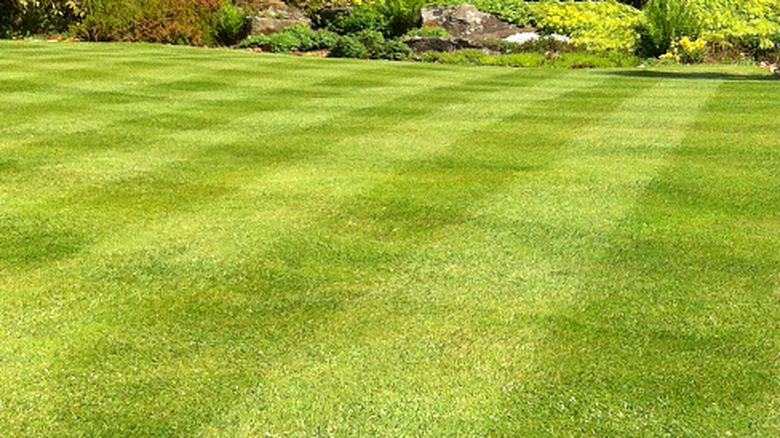
You can make lawn mower stripes in any patch of grass, but certain factors alter the growing conditions, which in turn influence how long the stripes last. The changing seasons play, arguably, the biggest part. During the growing season, your grass (perhaps obviously) grows faster, and any pattern you create will only stick around for a couple of days. However, when your lawn goes dormant, mowing stripes can last for several weeks. When these seasonal shifts happen depends on the species of turfgrass you have and the local climate.
The variety of grass you grow also influences how long mowing patterns last. Cool-season grasses are typically left a little taller than warm-season grasses — 3 inches to 4 inches for the former compared to 2 inches to 3 inches for the latter. Longer cool-season grasses bend more, holding the pattern better. By contrast, since the more tough blades of warm-season grasses are cut shorter, they're less likely to stay bent. Kentucky bluegrass and tall fescue are among the best turfgrass species for dramatic lawn mower stripes.
Mowing your lawn when it's dry is another way to improve your pattern-making game. Drier grass tends to bend more, which creates a stronger-looking stripe that may also last longer. Hold off on mowing until the late afternoon, when all the morning dew has evaporated. You also need to keep your mower blades as sharp as possible. Cleaner cuts keep your grass healthy, and healthier lawns are thicker. Mowing stripes are more prominent in lush lawns.
Cut your grass a little longer and use a striping kit for durable mowing patterns
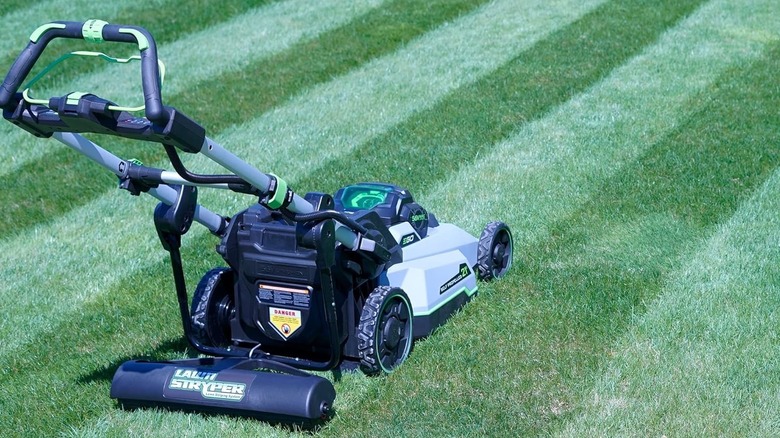
Leaving an additional ½ inch or so of length on your lawn when you mow may help the turfgrass retain stripes for longer. For example, if you usually cut your grass 2½ inches long, raise the mowing blades by ½ inch to 1 inch, and note how long the pattern lasts. Line striping kits are one of the best methods to mow stripes into your lawn — like this Hlxdv Line Striping Kit for EGO and RYOBI Walk-Behind Lawn Mowers for about $110. These large, elongated wheels attach to the back of a mower and bend the grass blades at an angle as you move over them. Some are designed for specific lawn mower models, but there are also generic designs that will fit any machine. The FixOasis Universal Lawn Striping Kit for about $99 is one such example.
How you create mowing stripes is important to get right, but you also need to consider your technique when creating them or you risk the long-term health of your lawn. For starters, you need to change up the pattern occasionally. Repeating the same design — say, thick and thin stripes — from one mow to the next is one of the surprising ways you've been killing your grass without knowing it. You'll likely successfully get longer-lasting stripes, but you'll do so at the expense of lush green grass. You might also ruin the soil underneath your lawn, causing ruts and compacting the soil, especially if you're mowing once a week. Instead, alternate patterns with each mow — for example, horizontal stripes one week, diagonals the next, and waves the week after.