

Don't Fall For Its Beauty: The Privacy Shrub You Don't Want In Your Yard
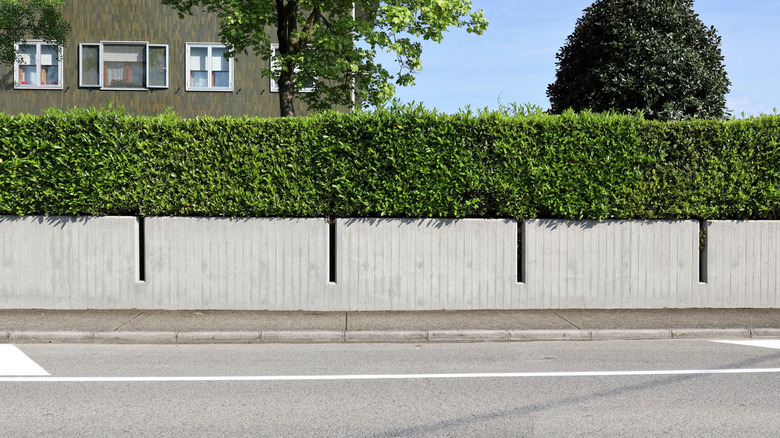
We all look for the same things when picking a privacy shrub. Something that grows dense, looks nice, responds well to pruning, and does not require much care and upkeep. This is exactly what border privet (Ligustrum obtusifolium) offers. It grows fast and looks beautiful, thanks to its lush green leaves, delicate white flowers, and arching branches that create an elegant layered look in the yard. It grows in a range of conditions, too. Plus, it does not mind heavy pruning and is able to thrive in even less-than-ideal conditions in USDA Hardiness Zones 3 to 7.
The problem, however, is that it is weedy. In some parts of the U.S., it has even become invasive, and it forms dense thickets that compete with and eliminate native plants and vegetation. Even worse? It can easily escape cultivation. This often happens when birds and other animals eat its berries and spread its seeds. Once in the ground, the seeds sprout, creating new border privet shrubs that easily move into fields, fencerows, roadsides, and forest understories. There, they shade out and exclude other plants, which not only reduces plant diversity but also impacts animal wildlife.
The issues don't just end here. Nearly every part of border privet is toxic, and if you ingest it, it can cause problems like vomiting, nausea, abdominal pain, and diarrhea. Even coming in contact with its leaves can irritate the skin and cause dermatitis. Put simply, border privet is not among those privacy shrubs you want to grow in your yard, and if you see it growing, it's a good idea to remove it and replace it with something else.
Here is how to identify & remove border privet from your yard
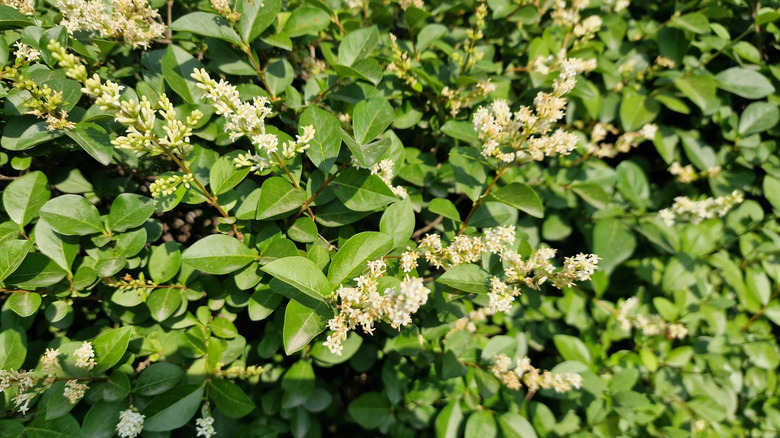
There are many species of privet in the U.S., and they look quite alike. This is why it is important that you correctly identify border privet, as not all privet species are weedy and invasive. So, how do you do it? Well, start by looking at the plant's leaves and bark. Border privet has elliptic to oblong leaves with smooth edges, arranged oppositely on the branches. Its bark is also smooth and has a grayish-brown color. Plus, the bark has numerous short, pale, horizontal lenticels. As for size, the border privet grows about 9 to 12 feet tall and blooms, too. The flowers are small, tubular, appear on the shrub in June, and smell bad. Another reason why you don't want border privet in your yard.
Once you have correctly identified border privet, cut its top parts using a pair of loppers and work your way down. If needed, however, you can use a chainsaw for thicker branches. Just make sure to use safety gear. Not using safety gear is one of the most dangerous mistakes you should never make when using a chainsaw. Once the above-ground growth has been removed, dig out its roots. This is important because, in addition to growing from seeds, border privet also grows readily from roots. So, if you leave the roots in the ground, it will come back.
Once you have removed the border privet, replace it with local alternatives. Some good options include arrowwood viburnum (Viburnum dentatum) and inkberry holly (Ilex glabra). If you want something that is easy to grow and low-maintenance, plant arrowwood viburnum. It will also help bring color to your yard. However, for something with berries, inkberry holly is also worth a look.