

Why Do People Have Eagle Plaques On Their Homes?
We may receive a commission on purchases made from links.
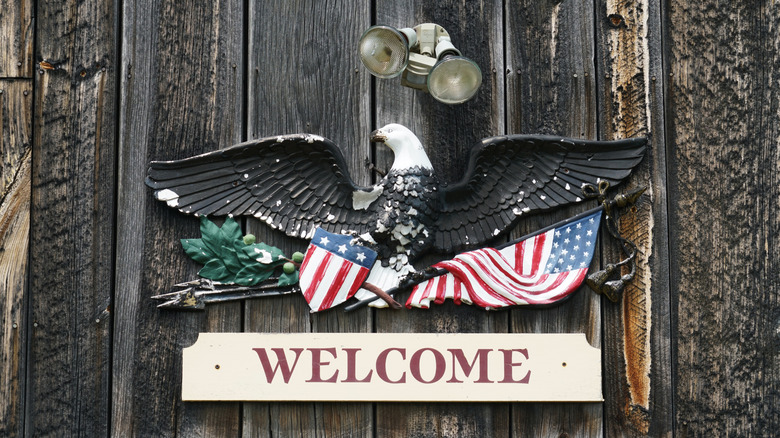
If you've ever driven through an old neighborhood lined with ranch-style homes, you may have noticed a curious pattern: a black plaque of a winged eagle fixed atop their garage doors, front doors, near a flagpole, or on top of their siding where it's sure to catch the eye. And perhaps your initial response was to chalk it up as a show of quirky decor or patriotism. After all, the bald eagle is a national symbol and is often used to showcase American pride.
But as it turns out, there may be a more historic reason for this eagle-eyed display: signaling freedom from debt. While the world sighed in relief when WWII finally ended, it also created a massive social challenge. Many veterans who had spent years fighting the war returned to a dramatically different world with limited opportunities to rebuild their lives. To ease their transition, the Roosevelt administration introduced the Servicemen's Readjustment Act (1944), better known as the GI Bill. Under the bill, veterans gained access to favorable loans for homes and education — a program that ultimately helped many purchase about 20% of newly introduced homes. And when they were done paying off the mortgage? They celebrated by putting up a "freedom flyer," a decorative eagle plaque, often carved from bronze, cast iron, wood, or some metal to signify they're truly free from a major financial obligation.
How relevant are eagle plaques to modern times?

Many Americans spend their lives chasing the dream of owning a home, and then even longer in fully owning the equity in it. While it's already an accomplishment to save for a down payment alongside all the extra expenses that can sneak up on you when buying a home, it usually isn't enough to purchase the house outright in cash. According to Redfin, as of March 2026, only 28.8% of new homeowners bought their homes in a cash deal. This means a sizable number of buyers still take out mortgages, often with 30-year terms, to fund their American dream. The economic climate remains tenuous — mortgage rates remain high, with the recent May update clocking 6.53% (oh my!), causing many existing homeowners to pause relocation plans for fear of refinancing at higher rates.
And yet, the U.S. census paints an encouraging picture. Per the data collected between 2020 and 2024, homeowners who have fully paid their mortgages constitute 39.4% of the total ownership, an increase of five points from the previous 5-year estimates. What's more, this increase is reflected across states and counties, though some have fared better than others. In other words, if homeowners still followed the tradition today, you could theoretically spot an eagle plaque on roughly two out of every five homes. Though if we're going state-wise, West Virginia and Mississippi would take the cake since over 50% of homeowners are mortgage-free.
Spotting eagle plaques in old homes, and whether you should get your own
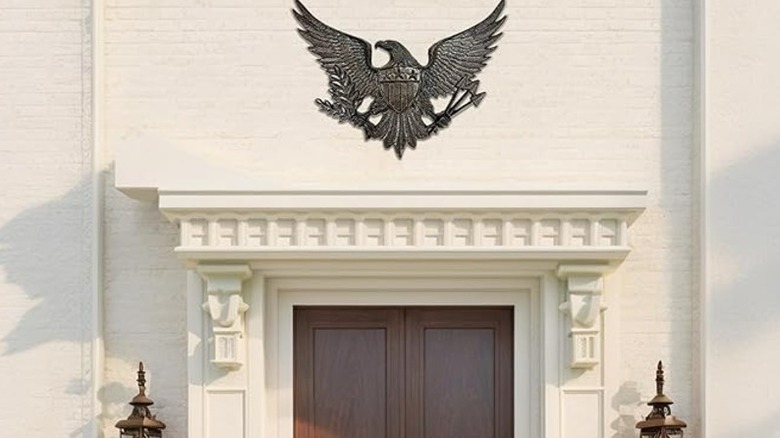
Today, if you explore neighborhoods filled with last-century home styles – think farmhouses, ranch homes, or split-levels, especially the builds of the 1970s – you may still find them proudly displaying eagle plaques. They're also heavily prominent in Charlottesville, Virginia. However, if the ownership has exchanged hands, the meaning may not hold anymore, for it is quite possible that buyers took out a new mortgage and retained the décor until they're ready to undertake exterior renovations to boost home value.
Still, you can take heart in knowing that at least some of the people who once lived in those homes were proud of reaching the milestone of becoming debt-free and wanted to celebrate it. While this long-standing tradition may not be as relevant today, you can still get yourself a winged eagle plaque if you'd like to subtly signal that you own your home free and clear. There are options galore on Amazon, like the Linton Arts Cast Iron Black Eagle Wall Decor, or you could thrift one from a vintage store and coat it in a lick of dark paint, in hopes that once upon a time it may have meant freedom and ownership to someone.