

What Happens If I Put Multi-Grade Oil In My Lawn Mower?

Keeping your lawn mower running smoothly requires a variety of maintenance tasks that should be performed after every mow, from sharpening the blades to cleaning the deck. You also need to check and possibly replenish the engine oil. If it's your first time doing so, however, you might be overwhelmed by the number of oils available in auto parts stores. Since these oils are not the same, you may also be wondering what happens if you put multi-grade oil in your machine instead of the single-grade oil that manufacturers often recommend. The good news is that, since it's multi-grade — meaning it's formulated with additives to work year-round and in a wide range of temperatures — it's unlikely to harm your mower.
Many modern lawn mower manufacturers approve certain multi-grade oils for use in their engines due to their versatility. For example, a 10W-30 multi-grade oil is thin enough to facilitate cold starts, and it thins out even more when the temperature rises to ensure a steady performance. If you mow in varying weather conditions throughout the year, using a multi-grade oil in your mower is advantageous. Not only does it maintain good lubrication while the machine is in use, but it also protects the engine from wear and improves fuel efficiency.
Nonetheless, it's still important to check your user manual on how to pick the right oil for your lawn mower. Even though multi-grade oils are safe to use, some models require specific single-grade oils to function properly.
The downsides of using multi-grade oil in your lawn mower
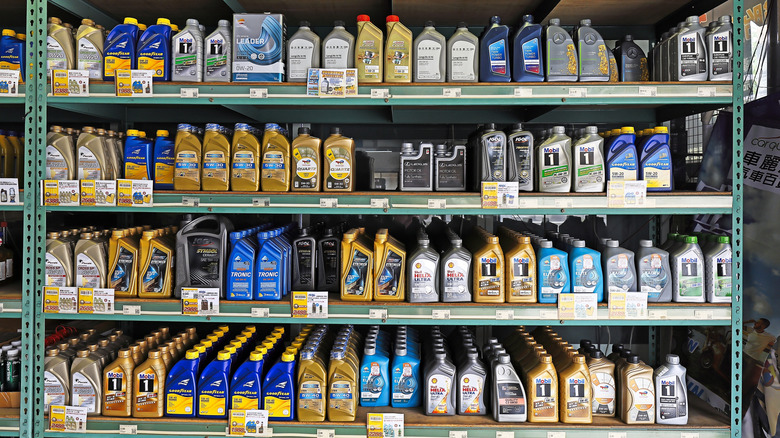
There's a reason why lawn mower manufacturers specify certain products in the user manual. Engine oil is one of the most important factors determining how long a lawn mower will last. The right oil guarantees optimum performance each time the equipment is in use. Traditionally, small engines are designed to run specifically on additive-free single-grade oils, like SAE 10, SAE 20, and SAE 30. These oils perform well in warm temperatures, so they are not the type to use year-round. While using a multi-grade oil in a small engine is possible, there are certain downsides to consider.
One drawback is that certain multi-grade oils may be consumed more quickly in extremely hot conditions, resulting in higher oil usage. This may not be a serious problem, but it does warrant constant checking of oil levels. Manufacturers may indicate if a multi-grade oil is recommended for general use, along with a guide on which viscosities are allowed. It's important to note that an oil that's either too thick or too thin can affect fuel efficiency, lubrication, performance, and long-term durability.
Cost is another downside. Multi-grade oils tend to be more expensive than single-grade oils. Granted, you only change your lawn mower's oil once a year, so the difference may seem minimal. Still, if you are looking to keep maintenance costs as low as possible, sticking with the recommended oil will save you money.