

The Bold Glassware Style You'd Be Thrilled To Find At The Thrift Store
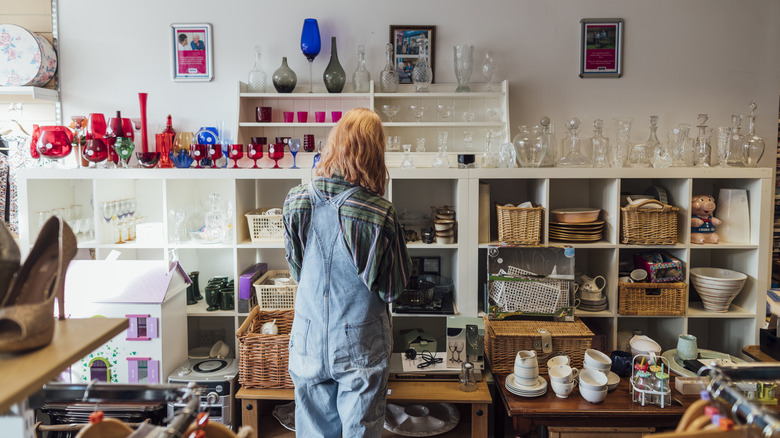
The thrift store is a goldmine for treasure hunters, as you never know what priceless knick-knack got donated to its racks. Sure, there is a lot of junk to sift through, whether that's plastic Halloween decorations from the dollar store or cracked porcelain figurines that once decorated someone's China cabinet. But every once in a while you can find something truly special, which is what makes the art of digging so fun. And one such treasure is the bold glassware style called Bohemian glass. It's one of the valuable glass items to look for at thrift stores and estate sales.
Bohemian glass was made in Bohemia, or the modern-day Czech Republic. Its popularity peaked between the 17th and 19th centuries, and while you probably won't find a wine glass from the 1600s in the thrift store, it continues to be manufactured today. To be authentic, this fine crystal has to be made in the Czech Republic. While it comes in all sorts of colors and designs, its most iconic options are brightly hued glasses with deep ornate etchings that reveal the white crystal underneath. You would be thrilled to find even a single Bohemian wine glass at the thrift store, since a high-quality vintage stem can go for upwards of $90 on eBay, with highly sought after single goblets even going for around $130, and full sets sometimes fetching over $1,000. However, that all depends on the brand and color you find, so it's important to know what you're looking for when it comes to Bohemian glass. The following tips will help you to distinguish valuable crystal from cut glass.
What to look for in Bohemian glass
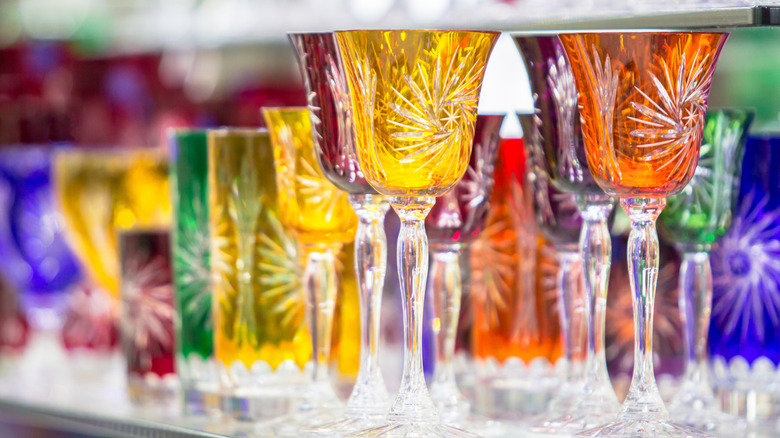
You'll want to know which Bohemian glass pieces are the most valuable so you can spot them while thrifting or estate hopping. The first step is to familiarize yourself with the most sought-after makers. Their stamps are on the bottom of the stemware and drinking glasses. Best-known for its handblown, brightly colored, highly engraved glass, Moser is one such prestigious brand. Founded in 1857,it was (and is) considered a luxury brand, often ending up in royalty and high-society collections — so much so that it was nicknamed "Glass of Kings." There's also Egermann, a maker from the mid-1800s who developed the iconic ruby stain that most people associate with Bohemian glass. Another brand to look for is Caesar Crystal, which was established in 1861 and is known for its intricately designed, handblown products. It was the first glass company to be awarded the "Czech Made" label by the Minister of Industry of the Czech Republic, which is not only a testament to its quality, but to the prestige it offers.
Once you've familiarized yourself with the most famous brand names, get to know the different colors available, since some shades are more valuable than others. This is driven by how difficult it is to create a certain hue, how intricate its engravings are, which maker made it, its rarity, and so on. For example, the iconic red and cobalt shades are a lot more valuable than the amber options, so keep an eye out for them while thrifting. However, since the value of the glass hinges on so many different factors, this isn't necessarily a hard and fast rule — it's just something to be aware of while treasure hunting.
How to spot the difference between real Bohemian glass and a reproduction
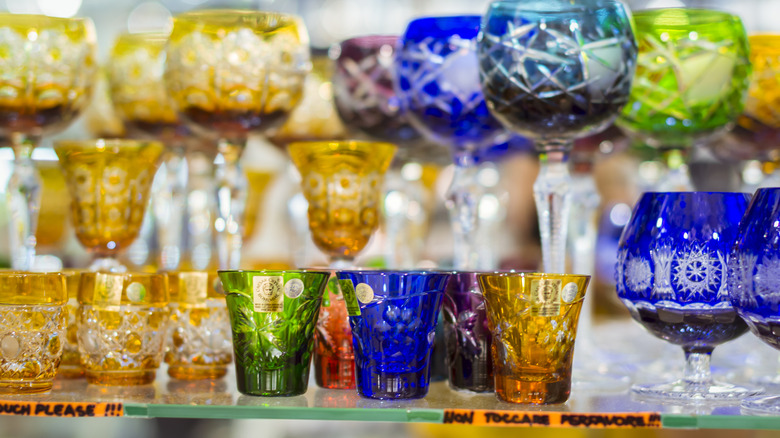
Like with anything luxury, there are plenty of Bohemian glass reproductions. The trick is knowing how to spot the fakes so you don't take a dupe home thinking it's a treasure. The first is to look for maker's marks or stamps that say "Made in Czechoslovakia" or simply "Bohemia." However, not having a mark doesn't necessarily mean it's a fake. If it doesn't have one, next see if there are any seams on the glassware. A handblown, genuine glass piece won't have any such lines.
You also want to take a close look at the etching. Since Bohemian glass is made by hand, the etching won't be perfectly uniform. If the design looks machine-perfect, it probably wasn't made by an actual artisan, and so it's a reproduction. You also want to look at the lines of the scratches in the etchings. If they're all uniform, then they were likely added by a machine to mimic a handmade look. If it was authentically made by an artisan, the scratches would go in various directions, depending on which way the chisel went. While real Bohemian glass is a glassware piece you'd be thrilled to find at the thrift store, it also might be quite rare. But that's part of the fun! Keep these tips in mind and you just might find something valuable on those dusty shelves.