

Ditch Traditional Shelves: This Clever Solution Makes Your Book Collection Float

We may receive a commission on purchases made from links.
Traditional bookcases are great for displaying your books, but can also take up valuable space on your wall or floor. If you're looking for an unexpected way to showcase your collection, a floating bookshelf arrangement is one of the creative ways to store books that enhance your home's decor. Invisible bookshelves are popular because they conceal hardware, allowing the books to take center stage on your wall. This clever design relies on using hidden supports that disappear behind your books and stacking them in such a way to create the illusion of floating in the air.
One unique approach to this method was shared by vlogger Sydney Dianelly on YouTube. She mounted multiple metal brackets closely together on the wall. Instead of leaving gaps between the shelves when stacking, she placed them in such a way that the books went continuously from one support to the next. The result was stunning: a single column of books appeared to float upward on the wall. The staggered placement of the books added some visual interest so that they looked like they were defying gravity, transforming a cluttered book collection into wall art.
To create this floating effect, start by getting some L-shaped steel brackets or floating shelves, like the STORAGE MANIAC Floating Book Shelves. These particular floating shelves have an extra pocket under the ledge for you to tuck the back cover. It holds the book more securely in place and helps conceal the shelf. For installation, most shelves you purchase will come with the necessary screws, but you'll need a level and screwdriver or power drill.
Creating the floating bookshelf effect with hidden supports
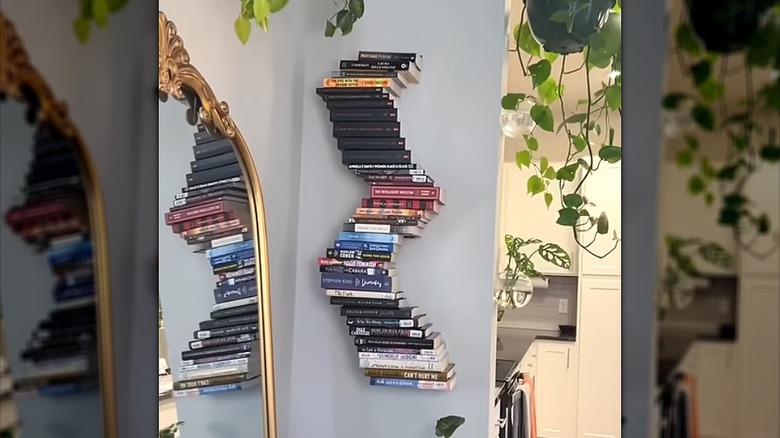
If you're using simple L-shaped brackets rather than a shelf kit, you may need to make some adjustments to spacing and alignment so it sits flush against the wall. It may be more beneficial to find the most reliable floating shelf hardware to ensure it holds. First, map out the shape you want the books to take on your wall. Consider arranging them to create a fun pattern and flow in a zigzag shape, or like a staircase. Locate wall studs on drywall, so your brackets are securely anchored. If you can't locate studs, you'll need wall anchors. Measure the spacing between the shelves with a tape measure and mark the wall to ensure accuracy. For example, you might space each bracket 12 inches apart vertically for average-sized books, or you could increase it to 18 inches if you plan to display larger coffee-table books. Use the level to keep your lines straight, and attach the brackets to the wall using screws at your pre-made marks.
Once the supports are installed, you can stack the books. Each shelf can hold a surprising amount of books, but you can test it by checking sturdiness as you go. When the hardware is fully covered, the display creates the illusion of a seamless column of books suspended on your wall. Slightly adjusting the position of each stack gives your display a more artistic look, and it becomes a sculptural feature as well as a storage solution. Try it out in a reading nook, home office, or small apartment where floor space for a bookshelf is limited. With the focus on the books themselves, it can make even a smaller book collection feel like a design statement.