

What To Do If You Find A Sinkhole In Your Driveway
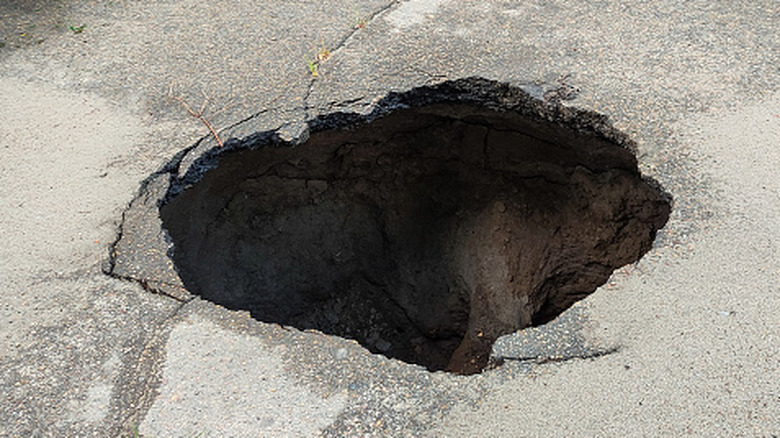
Driveways are often taken for granted until they suddenly begin to show signs of distress. If you notice what looks like a sinkhole forming in your driveway, it's natural to feel alarmed. After all, sinkholes cause approximately $300 million in damage per year, according to the U.S. Geological Survey. If you're wondering why your driveway is sinking, it's worth investigating whether a sinkhole is the culprit.
To start, it's important to understand what a sinkhole actually is. Unlike potholes, which are a surface-level issue, sinkholes occur when the ground underneath your driveway collapses or dissolves. This creates a void, which leaves the space above unsupported. Sinkholes usually occur for one of three reasons: the soil wasn't properly compacted during construction, poor drainage under the driveway is causing erosion, or a leaking utility line is washing away too much supporting soil.
The first step to take if you think you're dealing with a sinkhole is determining whether you need to call for help or if you can DIY a solution. If the sinkhole is presenting signs of immediate danger to you or anyone nearby, call 911 immediately. If it's deeper than three feet, actively growing, or located near your home's foundation, you'll need to call a professional driveway contractor for help. For smaller sinkholes that don't show signs of danger, you could consider fixing it yourself if you're up for the challenge.
How to fix a driveway sinkhole yourself
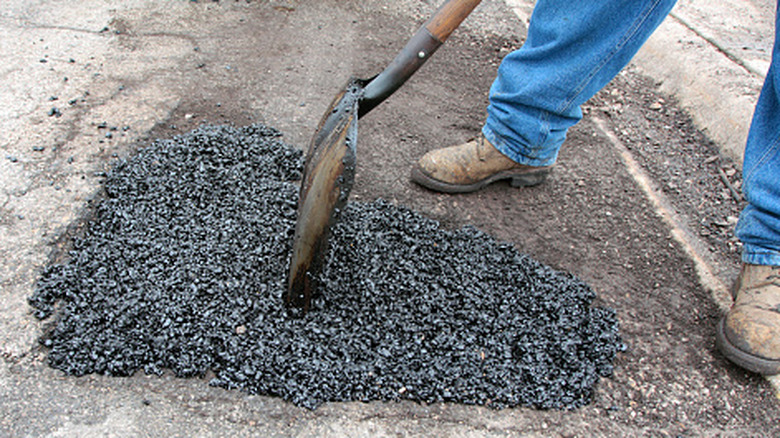
If you notice a sinkhole forming in your driveway, you'll want to take immediate action to address it before it gets worse. While it's easy to fill potholes in a driveway, you can't fix a sinkhole by patching it up because since it won't address the cause of the problem below the surface. Instead, you'll need to dig up the entire area, fill the void with aggregate, and lay down new asphalt or concrete.
To do this, use a concrete saw or jackhammer to remove the concrete or asphalt surrounding the sinkhole, extending several inches past the visible edge of the void. Next, thoroughly clear out any loose debris or organic matter from the area. Organic matter will eventually decay and disintegrate, which could cause another sinkhole down the road. Once the area is clear, fill the void with a granular material that is compact and will drain well, like a hot or cold asphalt mixture. It's best to add the mixture a little at a time and compact it down until it's flush with the surface of the surrounding driveway. Finally, add a new section of asphalt or concrete on top.
Another option that is less time-consuming and invasive is compaction grouting, also called permeation. This process involves injecting a cement-like mixture into the ground of the sinkhole to fill the void. As a bonus, the mixture could end up filling other voids that haven't created sinkholes yet. Whether you decide to fix a driveway sinkhole yourself or call a professional, addressing the problem quickly can ensure your driveway is safe to use and will last for years to come.