

11 Reasons Your Homegrown Tomatoes Have No Flavor
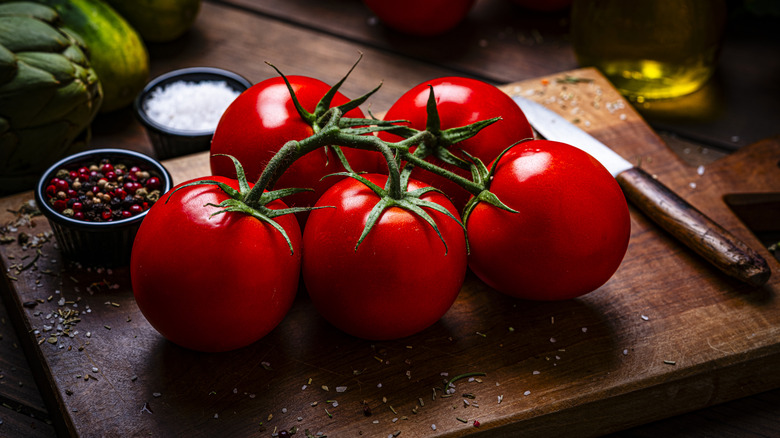
There are few greater rewards in the garden than the purpling tinge of your own tomatoes as they begin to ripen on the vine. The only thing that really surpasses it is the satisfaction of biting into a juicy, tangy, and tart tomato that's bursting with home-grown flavor. Unfortunately, that's not always how it goes. That's because there's a lot more to flavor than simply getting them to grow.
To help you avoid the bland taste of disappointment, we've pulled together a list of common mistakes that gardeners make that usually lead to tasteless tomatoes. Some are easy to rectify, like the areas around your yard in which you grow them. Others may take a little more care and consideration to put right, like the things you feed your plants, and the stages at which you feed them. Some mistakes need nipping in the bud from the earliest stages of tomato growth, and some happen right at the end that can render all of your hard horticultural work worthless. All are easy to make, and with the help of the tips laid out below, all are reasonably straightforward to put right.
Your soil pH is untenable for tasty tomatoes
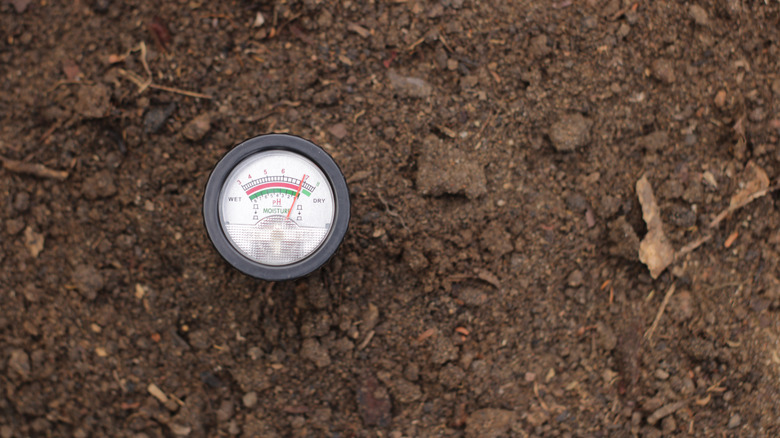
One of the best tips we can offer for growing better tomatoes is to pay attention to your soil's pH. It's hard to overstate its importance, and not just with tomatoes. Some plants favor neutral or slightly alkaline conditions. Others, tomatoes included, like it more on the acidic side. That's not to say that tomatoes won't grow in soil conditions that are more on the "neutral" end of the spectrum. However, if you want to do away with bland bites at the dinner table, it's worth paying closer attention to your soil's pH. That's because it can have an impact on the nutrients your plants can take from the soil, which in turn affects things like sugar accumulation — critical to tomato flavor.
So, what's the best soil type for tomatoes? Well, in terms of pH level, you should shoot for soil that's between 6 and 6.8. A slightly acidic composition will help your tomatoes eat up as many nutrients as possible, thus contributing nicely to sugar production. To achieve it, first take a soil pH reading, using either a strip-test kit or a digital soil meter. If it's currently reading as closer to neutral or even alkaline, consider adding leaf mold, pine needles, sulfur, or a layer of compost to your soil. Do this a few weeks before transplanting, which will give your bed a chance to acidify and thus provide the optimal conditions for your seedlings to thrive.
You didn't give your tomatoes enough sunshine
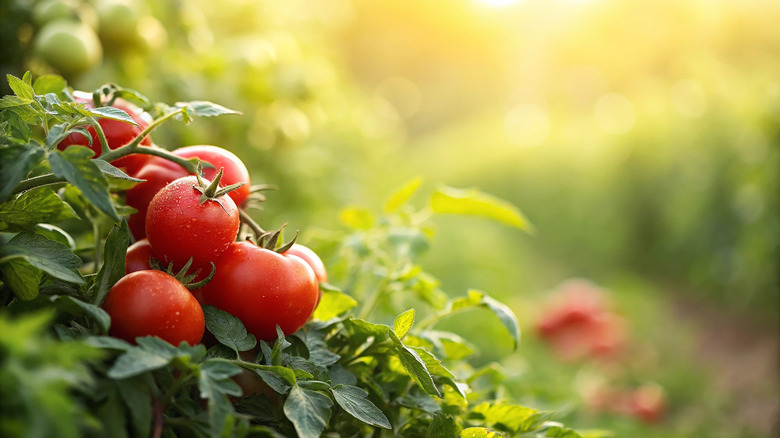
If you've been growing tomatoes on a wing and a prayer, without worrying too much about the science, then good for you! Learning as you go is as exciting as it is rewarding, and as Julius Caesar once said, "experience is the teacher of all things." But if you're fed up with tasteless tomatoes, then digging into the science can really help. For example, did you know that tomatoes require lots of sunshine to promote great flavor? Without it, they can't photosynthesize as well, which means they develop less in the way of sugars and acids. And when tomatoes are deficient in sugars and acids, they are almost always deficient in flavor.
A lack of flavor isn't the only sign that your tomatoes need more sunshine. You may also notice that they become stunted or "leggy," or that they have fewer leaves than the plants on Pinterest that inspired you to try growing them. If you can, you should plant your tomatoes in a spot that receives at least eight hours of sunlight every day. Failing that, give them the sunniest position possible. They may still yield fruit with fewer hours of daily sunshine; however, the less sunlight your plants get, the more watery the resultant fruit is likely to taste.
Your watering strategy needs some adjustment
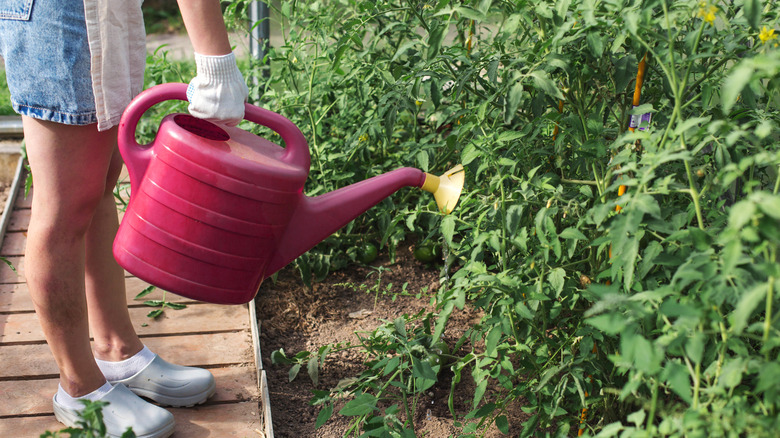
Like your soil's pH and the amount of sunlight you give your tomatoes, you should also pay close attention to how you water them. Watering is critical to processes that directly influence flavor, including photosynthesis. If your plants don't photosynthesize effectively, then as we've already discovered, they'll struggle to produce optimal amounts of sugars and acids. But before you go ahead and start dousing your plants daily, stop! It's not necessarily about regularity when it comes to watering. Instead, it's about consistency.
By this, we mean that you should never allow your soil to dry out too much. Infrequent, deeper watering is best, aiming to soak your soil to a depth of approximately 8 inches. You may need to do this every few days during the height of summer, especially if you live in a hot, desert climate. Remember, too, that containers and pots dry out much more quickly than soil in the ground. In other areas, like those that still experience rain during the warmer months, fewer waterings may be required. You can use mulch as the weather improves to protect your plants and keep the soil from drying out too quickly, which will make your watering more manageable.
The variety of tomatoes you grew isn't tailored to your taste
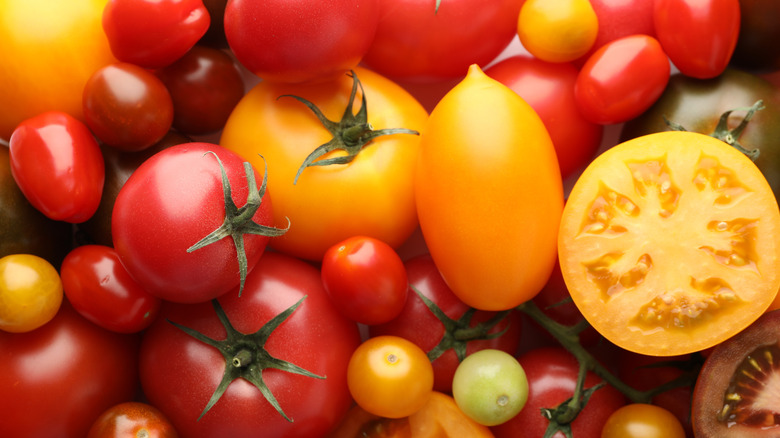
There is, as the old saying goes, no accounting for taste. Nor is there any telling the types of tomatoes your taste buds will prefer. One of the most wonderful and addictive aspects of growing tomatoes is the sheer variety. All have slightly different flavor profiles. Some are more acidic and punchy on the palate, others bring a much milder, earthy flavor to salads and the bottoms of our burgers. Some sit somewhere in the middle. If you pick a type of tomato that isn't actually tailored to your taste, then even if you do absolutely everything right to get the most out of them, chances are that you still won't enjoy them.
So, what should you do? Well, you could always work it out by trial and error, or by growing different varieties at the same time and seeing which tickles your taste buds the most. The only downside here is that, if you're not 100% sure what you're doing, and you get your soil pH, sunlight exposure, or fertilizer strategy wrong, then even the tastiest tomato could end up bland.
Luckily, there are plenty of resources online nowadays to help you find a tomato type that matches your taste preferences. Some say that the tastiest tomato you can grow in your garden is the Sungold tomato, while others prefer something a little more savory, earthy, and even salty, like purple Cherokee tomatoes. If you know what you like from a tomato when you buy it from the store, you can quickly get yourself a shortlist of varieties by running a search for those descriptors online.
You didn't fold enough food into the soil
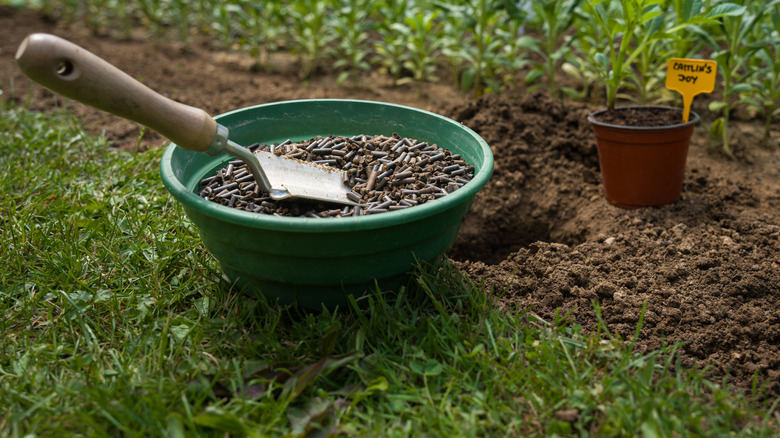
With tomatoes, food equals flavor. It's not the only thing that goes into making a tasty crop, but it's one of the most important parts of growing tomatoes if you hope to beat the flavor of those you buy from the store. And it starts before you add your plants to the ground. As well as testing your soil's pH and ensuring it's ever-so-slightly acidic, you should also ensure there are plenty of goodies for your gourmet growers to eat. As Angela Judd, master gardener, tells Martha Stewart, "Poor soil limits the availability of micronutrients and minerals like potassium and magnesium that influence flavor."
In order to set your tomato plants up for success and give yourself a fair chance of flavor, you'll want to amend your soil before transplanting. As well as adding nutrients to the soil, folding in things like compost and well-rotted manure will help to "loosen" the texture of the substrate, making it much easier to drain excess water. As for how much to add in, aim for around 2 inches worth of matter, working it deeply into the top 10 inches of soil. And remember, tomato roots tend to spread outwards. They may shoot out 2 feet or more from either side of the plant, so ensuring that all of that soil is topped up with goodies is key.
There was too much nitrogen in the soil
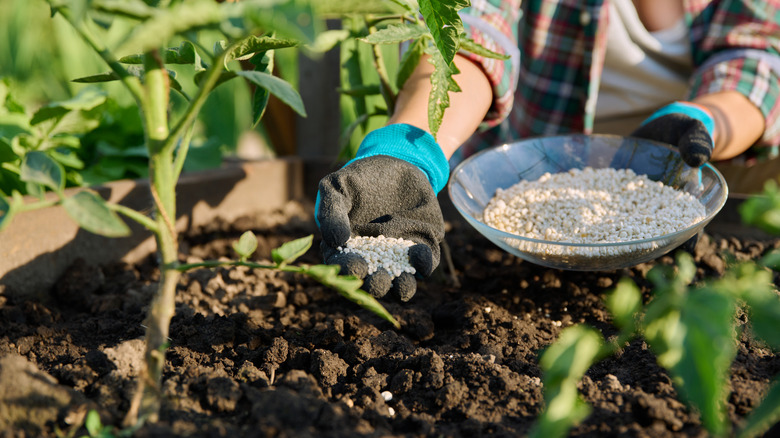
Without contradicting our previous point about feeding your tomatoes, it's also important not to overdo it. Yes, your plants need lots of micronutrients and rich soil to grow abundant, flavor-filled fruits. And sure, nitrogen is a key ingredient in the tomato's growing journey. Specifically, it's important for leaf growth. This, in turn, means it's important for flavor. Your plant needs lots of foliage to photosynthesize, which is what helps to develop the sugars and acids that contribute to flavor. But if you add too much nitrogen to your soil, you'll end up learning the hard way that less is often more.
The problem with too much nitrogen is that it'll encourage your plant to focus more on leaves, potentially leaving you with smaller, less tasty fruits. Things that often lead to excesses in nitrogen, including using fresh amendments like horse manure, instead of those that are well-rotted. You should also stick to fertilizers that are specifically formulated for tomatoes, since those that aren't often contain too much nitrogen. Provided that you amended your soil properly to begin with, you shouldn't need to do much to tweak the nitrogen levels once your plants are approaching maturity.
You will want to fertilize your plants again once they flower; however, you should switch to a lower-nitrogen feed and instead use one with higher amounts of potassium and phosphorus. Do this, and your plant should focus appropriate energy levels on fruit production, instead of more leaves, giving you the best chance of a full-blooded and flavor-packed crop.
You harvested the tomatoes too early
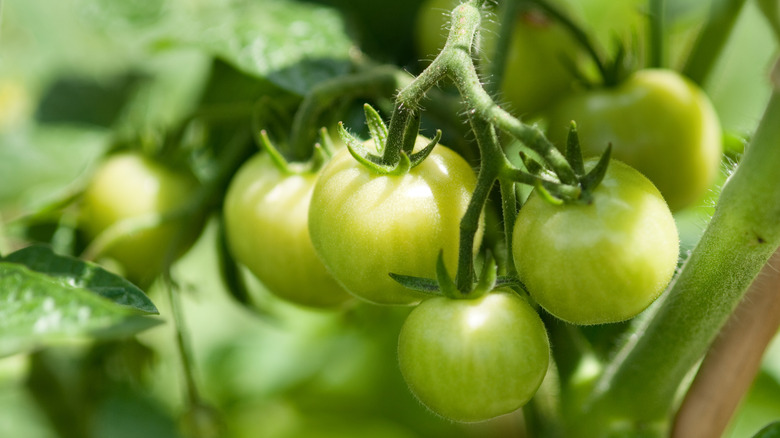
We know how tempting it is to start pulling those multihued orbs of deliciousness from the vine before they're ready. And yes, it is entirely possible to ripen them off the vine. However, for optimal flavor, you need to give the plant a chance to work its magic first. If you pick them too early, the flavors won't develop as fully. Equally, if you pick them too late, then they could become compromised by pests, rendering them unfit for even the least fussy foodie.
So, when is it best to pick tomatoes? It's generally recommended that you pick them at the "breaker" stage. This is the stage at which they're not completely green, but they're not quite fully ripened, either. Instead, they should be starting to "blush." When tomatoes reach this stage, they've had plenty of time on the vine to develop lots of flavor. You can continue to ripen them indoors, like you might with very green tomatoes. But if you run a taste comparison between green tomatoes and your "breaker stage" picks, you're sure to taste a difference.
You picked a variety for its resilience, which came at the cost of flavor
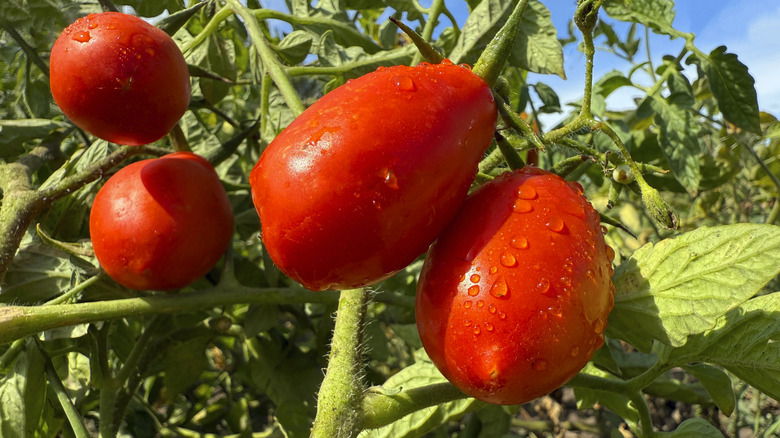
It's important to bear in mind the characteristics of the fruits you hope to harvest. Some varieties are tempting to pull from the seed rack of your local garden store simply because they're listed as resistant to disease. And why wouldn't you be tempted? These varieties stand up well in the face of things like fungal wilt diseases, blight, and leaf spot, powering through and producing tomatoes even if a part of the plant becomes infected. The problem is that disease-resistant hybridization often comes at the cost of flavor.
This could go a long way towards explaining why your tomatoes lack a substantial taste profile, even if you got everything else right in your growing strategy. Fortunately, there are some exceptions to the rule, including some tomatoes that yield excellent-sized harvests. For example, you could grow 'Roma VF' tomatoes (Solanum lycopersicum 'Roma'). These tomatoes are determinate (meaning they're restricted to a certain amount of fruit growth before they stop growing), and are resistant to verticillium wilt and fusarium wilt. Another popular variety is coyote (Solanum lycopersicum). These develop a sunny yellow color and yield rich, honey-laced tomato flavors. Crucially, they also have resistance to common tomato diseases, like blight, which can lead to rotting, and septoria leaf spot, which can cause leaf-drop and stunted growth.
Your feeding schedule was inconsistent, especially to begin with
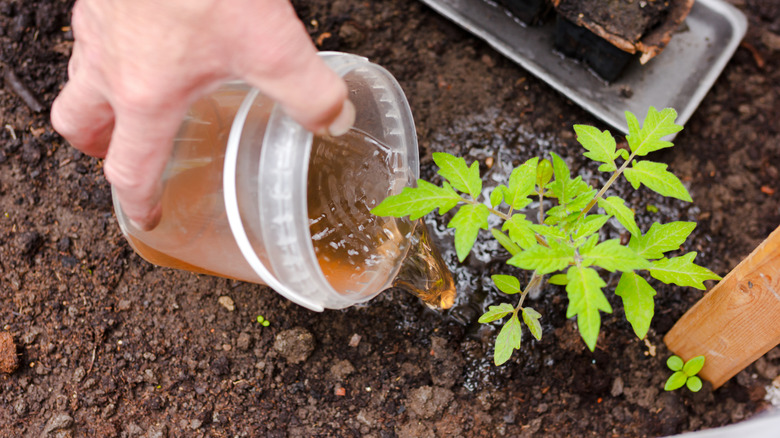
We've already discovered that healthy, nutrient-rich, slightly-acidic soil is a winner as far as tomatoes are concerned. But so, too, is consistent feeding. In order to grow tasty tomatoes, your plants need the right conditions to create sugar and acids. They produce these things via photosynthesis, for which they require leaves. And in order to establish healthy, bushy growth from the outset, early, consistent feeding is key.
Now, in case you're wondering whether this is really necessary given that you've already folded loads of new nutrients into your growing beds, yes — it is. With many plants, the golden rule is to feed the soil, not the plants. But for vigorous, heavy-fruiting, edible plants like tomatoes, additional feeding goes an awfully long way. This is especially true in containers, where nutrients can leech more quickly than in the ground.
Early on, once the plants' first true leaves have formed, feed with a more nitrogen-rich fertilizer. This will help your plants to establish abundant leaf growth, which is key to photosynthesis and therefore sugar and acid production. Aim to feed at half your fertilizer's recommended strength, to avoid nitrogen-induced leaf scorch in younger plants. Later, when they start to flower, our earlier tip to switch to a lower-nitrogen, more potassium- and phosphorus-rich feed will help your plants to focus on tasty fruit production. The goal, throughout, is consistency.
You didn't realize that your plant was deficient in potassium
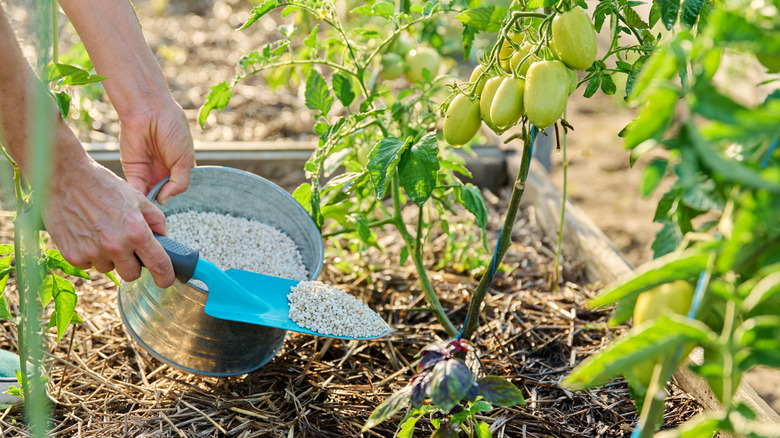
Potassium is one of the key ingredients for flavorful tomatoes. It plays an important role in improving uniformity of ripening, shape, and acidity — the latter of which is key to flavor. The reason it earns its own section in this guide is that, unlike other nutrients, it can be hard to spot a tomato plant that's deficient in potassium.
For example, if you overdo it with nitrogen, you may notice that your plant simply continues to bush out, without producing many tomatoes. But with potassium, a plant can appear completely healthy, and it may even produce a reasonable supply of fruit, even though it's "invisibly" hungry for potassium. This means that, although your plant is developing fruit, those that you do grow may lack in flavor as they didn't have the required potassium to develop acidity. What's more, if there's an "invisible" deficiency, you could unknowingly be sacrificing an even bigger yield.
To address this, you want to ensure the soil is rich in potassium. You could fold in a dedicated potassium sulfate product, which will easily increase your levels. Alternatively, you could sprinkle some hardwood ash over your soil, but this could raise pH levels, so be sparing. Later, when the plants flower, using potassium-rich tomato fertilizer will help to keep the good stuff flowing when your plants need it most. The goal is to ensure you never reach a "deficient" stage and maintain a steady supply of potassium to develop those all-important acids.
You left your tomatoes to ripen in the wrong place
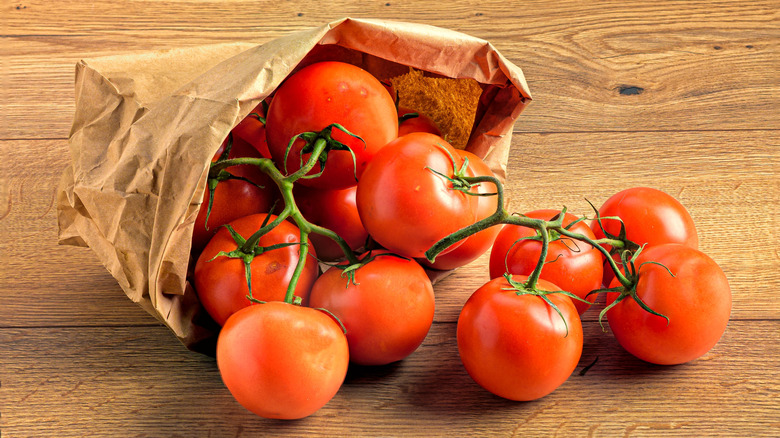
If you took our advice to pick your tomatoes at their blushing "breaker" stage, then good! The next thing to do is learn the best way to ripen those semi-green tomatoes. Just picking them at the right time and allowing them to ripen on the vine isn't enough. You also need to find a suitable environment in which to ripen for optimal taste. For example, if you place them in the fridge, you risk ruining their flavor altogether. Similarly, if you pop them in a sunny spot in your yard to ripen, you risk scalding the tomatoes.
Instead, you want to place them somewhere between 65°F and 75°F. Consider placing them in a paper bag or a cardboard box — something that's breathable — and allowing them to ripen in their own time. Covering them in something breathable will prevent them from spoiling. It'll also allow your tomatoes' natural ethylene emission to do its job. Ethylene is a natural gas emitted by ripening fruit. In turn, it helps other fruit in its vicinity to ripen faster. By placing your tomatoes in a paper bag or cardboard box, those that are slightly ahead of the game will encourage their neighbors to speed things along, too.