

Not Tiffany: The Stunning & Valuable Vintage Porcelain Brand To Look For At The Thrift Store
We may receive a commission on purchases made from links.
If you're an avid thrifter and a lover of vintage porcelain, you're probably familiar with big luxury names like Tiffany & Co. But those well-known brands aren't the only treasures that are worth hunting for at the thrift store. Behind stacks of mismatched plates and dusty lamps, there's another prestigious name that casual shoppers might overlook: Coalport porcelain.
This English porcelain maker had a long history of making fine china. The factory that made Coalport porcelain was founded in England in 1795 and had tons of success in the following decades, becoming a go-to maker for the aristocracy. This continued until the 1960s, when the company was bought and ceased production. Today, you can find Coalport china via secondhand stores, antique markets, and online resellers. If you're lucky, you can find pieces that are more valuable than you think and resell them, or build your collection of vintage and antique fine china.
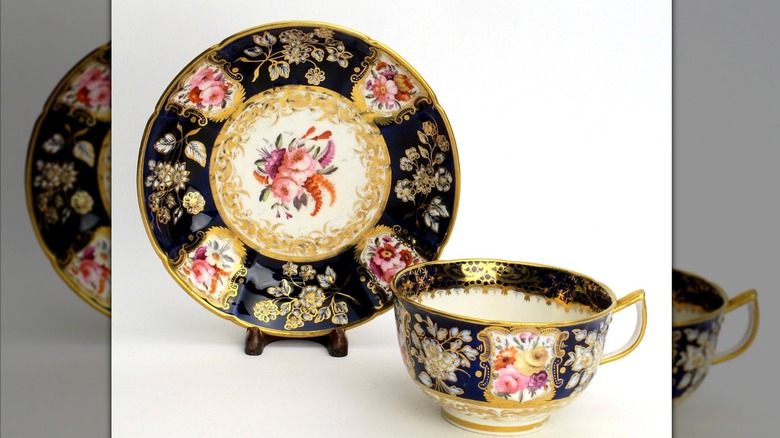
Because of its long history, there isn't one unique pattern that all Coalport china features. Still, these pieces typically have rich colorful patterns and bright gold accents. The patterns often include colorful florals, Indian trees, birds, and detailed rococo-style designs. As with many vintage pieces, the exact value of a Coalport piece depends on a few things such as its overall condition, rarity, pattern, and age. A single teacup can cost over $600 if it's a rare and collectible model, while another plate can sell for $25. They can be found individually or in entire matching sets, which will cost more.
How to find Coalport china at the thrift store
As with any antique item, the key is to learn how to authenticate your latest finds. Luckily, Coalport china can be easily recognizable because it's often stamped. Through the years, several stamps were used, and the later ones from after 1881 are easier to read. These typically have a simple "England" and "Coalport" inscription along with a small image of a crown. If you find Coalport china from that time period, you should nearly always see one of these stamps on the bottom. The exact layout and design of the stamp can help you identify the age of the piece, which is important information when assessing its value and rarity.
Earlier pieces are where it gets complicated. Before 1881, Coalport used some other variations of stamps that are less easily recognizable, often looking somewhat like a monogram. Even trickier: Very early pieces from before the 1820s were not necessarily stamped. Of course, these old pieces are the most collectible ones, which adds to the challenge. If you find a piece that looks like real Coalport china but isn't stamped, your best bet is to ask an appraiser or antique expert to help you date and identify it.
Some of the designs used on Coalport pottery were inspired by trends and makers abroad, like Sèvres, Meissen, Chinese, or Japanese porcelain. So if you see vintage china that looks authentic at the thrift store, they could still be from other valuable brands of vintage porcelain, even without the Coalport stamp. If you like how they look, add them to your collection, but make sure not to overpay for a piece if you can't authenticate it with certainty.