

5 Blooming Succulents You Probably Didn't Realize Existed
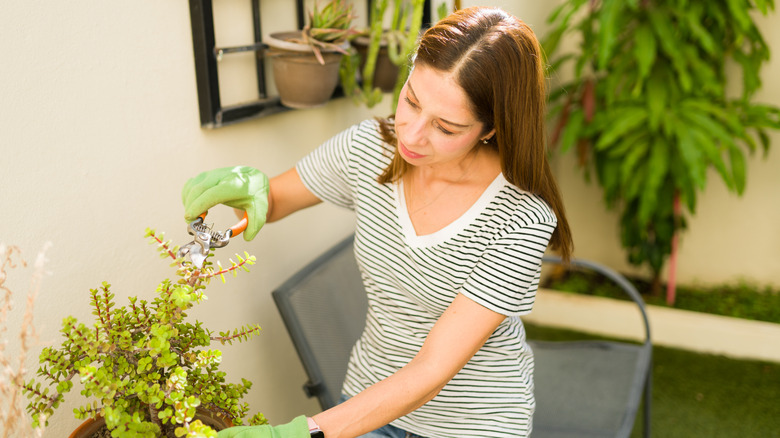
When you think of blooming succulents, it's almost certainly pink ice plant or Christmas cactus that comes to mind. And it's true, they are beautiful plants. With that being said, however some of the best succulents to grow indoors are a bit off the beaten path. You'll be unlikely to find these at a run-of-the-mill plant nursery, and it could even be hard to find someone outside of a botanist or succulent collector who has ever heard of them. Most people don't actually collect succulents for their flowering, but rather for their structural geometry, like the tight rosettes or the precision of their spine arrangement. I know some succulent gardeners who actively remove flower stalks as soon as they appear because they want the energy to be directed back into the plant.
I'm a master gardener who loves the slightly wild chaotic look of a cottage garden, but people also frequently gift me succulents. Now I have quite the collection, and I've grown to love their forms. However, I'm definitely not one that would remove flower stalks unnecessarily. With succulents, it can be challenging to get flowers, because growers often struggle to replicate the conditions that trigger flowering. If you want a flowering succulent, whether that's a late-blooming cone plant or a beautiful propeller plant, you have to remember that succulents evolved in environments with dramatic seasonal contrasts. Many flowering succulents respond to a strong seasonal rhythm of light, temperature, and watering, but the exact trigger depends on the species and its native climate. Find yourself some interesting, less common succulents like those below, and have a go at getting them to bloom. It's addictive and super satisfying to see the results of your hard work.
Cone plants
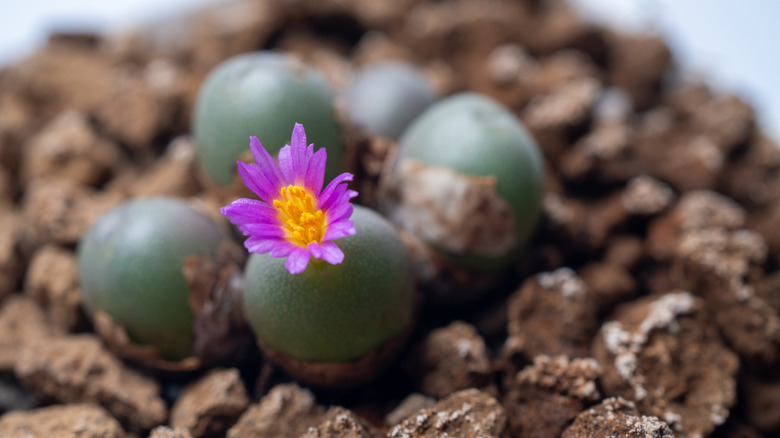
Many people take on a cone plant (Conophytum) and assume it's dead because it doesn't show any signs of life during the first half of the year. By late spring, instead of seeing new growth, you'll see this tiny plant retreat into a dry, papery sheath that's formed by last season's leaves. Lots of succulent novices make the mistake of watering them repeatedly at this point, in the hopes that they can coax their cone plant to start growing. The plant isn't dead, unless of course you overwater it. It's just dormant.
When fall finally arrives, you'll see the sheath on your cone plant start to split and peel, and fresh growth emerges. Not too long after you see these first signs of life, a flower will appear from the central fissure that's often nearly as wide as the plant itself. It's a fascinating and startling effect. Flowers can be white, pink, magenta, yellow, or orange, and are daisy-like, with dense stamens. The genus includes day-blooming, twilight-blooming, and fully nocturnal species. They just don't bloom when you expect them to. Keep them bone dry from late spring all the way through summer and don't water until you see the sheath start to split in August or early September. I have a shallow tray full of mixed Conophytum, and they are such interesting little plants. Mine look like small pebbles for most of the year until they produce those fantastic flowers that really don't look like they belong. Most cone plants are best treated as tender succulents, generally suitable outdoors only in very mild USDA Zones around 10b to 11b, or grown in pots under protection elsewhere.
Concrete leaf
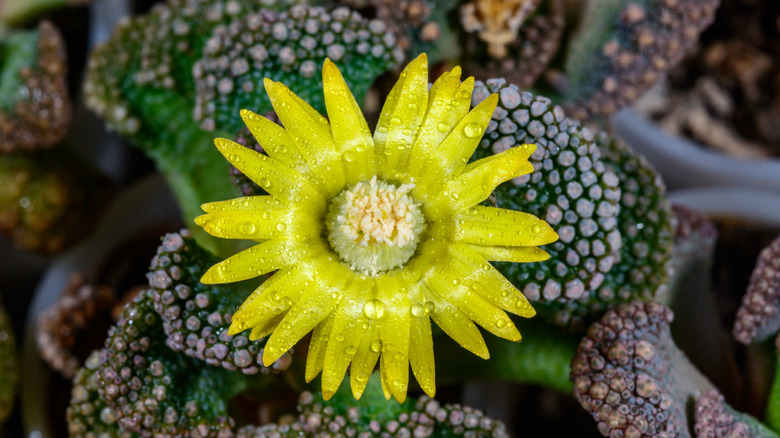
To me, concrete leaf (Titanopsis calcarea) looks somewhat prehistoric and almost fossil-like. Each rosette is a slightly off-putting cluster of blue-green club-shaped leaves covered in whitish bumps and warts that closely replicate the texture of limestone. Its stony appearance is an effective form of camouflage, as it looks very much like the limestone outcrops where it grows natively in Africa's Bushmenland and Upper Karoo regions. The camouflage is so effective that in its natural habitat, the plant is often only spotted when it is in bloom and the flowers give it away.
You'll get a single bloom from each rosette in fall and winter. The flowers are bright yellow to orange-yellow, daisy-like, and usually open in good light from midday or afternoon rather than at night. These succulents are fairly small, only reaching around 4 inches wide. They grow slowly in dense, spreading mats. They are hardy in USDA Zones 9a to 11b. Outside of their zones, these really are houseplants or at best container plants that you bring inside before temperatures drop below 25 degrees Fahrenheit.
Starfish flower
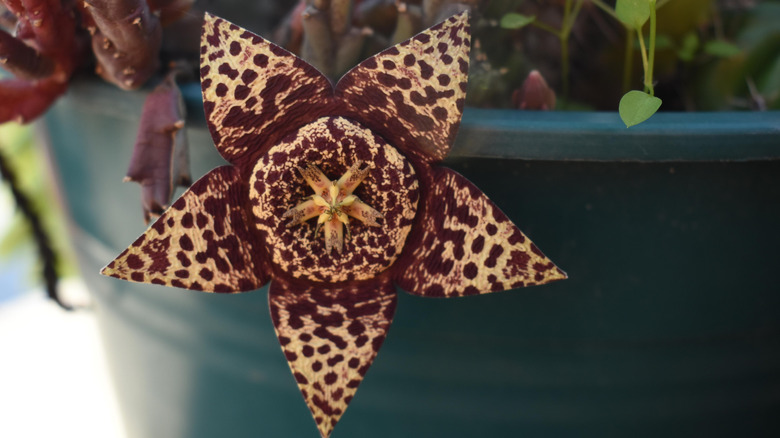
The starfish flower (Orbea variegata) is, in my opinion, one of the oddest succulents you'll come across. It grows in low-spreading clumps of leafless grey-green angled stems around 4 inches tall. They are decidedly plain and uninteresting to look at. Nevertheless, collectors love them because in late summer and into fall, five-pointed star-shaped flowers appear at the base of the stems and reach up to 2 ½ inches across. Another prehistoric-looking plant, with flowers having a greenish-yellow background overlaid with purple chocolate splotches, they are ornate and detailed, yet still look like an ancient throwback. It's the smell that's truly memorable. The starfish flower is also one of the many types of carrion flower, and the blooms produce an intense odor of rotting meat that attracts flies to pollinate them.
Orbea variegata, however, is one of the milder-scented carrion flowers, so the scent is only really noticeable if you lean in close and inhale deeply, which I wouldn't recommend. This succulent is pretty easy to grow and just requires some gritty, well-draining succulent compost and minimal watering. It's hardy in USDA Zones 9b to 11b and the stems store water efficiently, tolerating periods of complete neglect and drought better than many other succulents.
Chalk liveforever
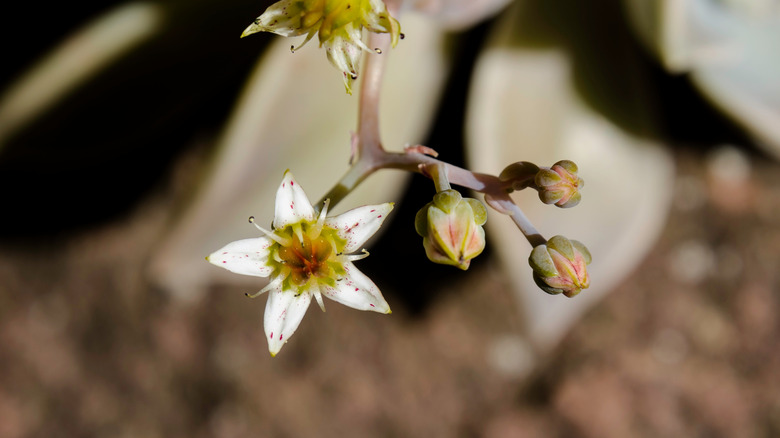
While most people think of South Africa, the Sonoran Desert, or the Canary Islands as the places where succulents come from, chalk liveforever (Dudleya pulverulenta) comes from the rocky slopes and sea cliffs of California. These tough little succulents can persist on bare cliff sides for decades and are capable of surviving heat, drought, and wind that would finish off almost anything else. Its flat rosettes are coated in a thick layer of chalky white wax that smears off on your fingers when you handle it. Each plant consists of a single rosette made up of clusters of fleshy succulent leaves that finish in a sharp point, and can reach 2 feet wide. This plant is wonderfully attractive even without flowering. In late spring and early summer, you will see arching flower stalks rise from the center of the rosette. These can get up to 3 feet tall and they open into candelabra-like clusters of tubular rosy red blooms that draw in hummingbirds.
If you want these plants, please make sure that you get them from a reputable succulent seller, as wild populations have been utterly devastated by large-scale poaching. Hundreds of thousands of these succulents have been stripped from California wildlands and sold into overseas black markets. Therefore please make sure you only buy from nurseries that propagate from seed or cuttings not from plants harvested from the wild. If a seller can't tell you where or provide proof or provenance for their succulents, then I strongly advise you don't order from them. This particular plant is hardy in USDA Zones 7 to 11 and outside of these zones, like most succulents, should be grown indoors.
Propeller plant
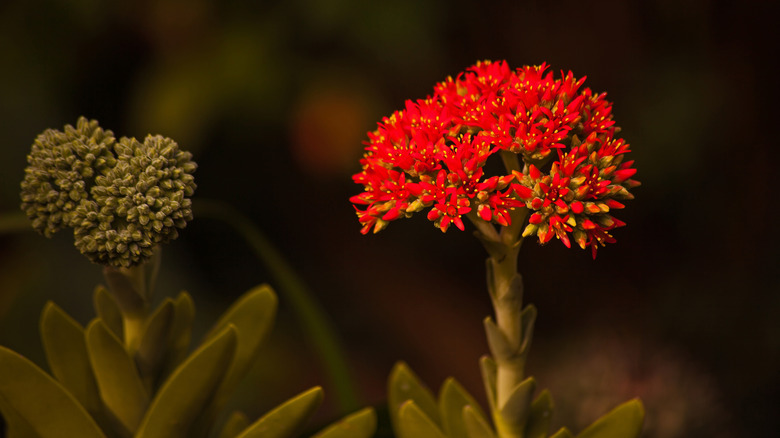
A close relative of the jade plant (Crassula ovata), the propeller plant (Crassula falcata), has thick, sickle-shaped grey-green leaves arranged in towers of opposite pairs, spiraling around an upright stem. From above, it does look remarkably like an airplane propeller. This was one of the first succulents I was gifted and grows near my two mammoth jade plants. Unlike jades, in mid-summer, the propeller plant produces a dense cluster of tiny vibrant red florets with bright yellow centers. These appear just above the foliage and they last for around a month. The flowers are bright and bold, with a gentle cinnamon-like scent that surprises people. These little florets are very attractive to pollinators.
This plant can grow outside in USDA Zones 9a to 11b. Like jade, Crassula falcata prefers to be slightly root-bound and tends to bloom with more enthusiasm when you keep it that way. Don't be tempted to repot unless the plant very clearly needs it. When you do, follow the same technique as when you repot jade plants. Use a decent potting mix and don't be tempted to overwater. To give your propeller plant the best chance of flowering, you need to make sure that it gets a truly cool but bright and dry rest from late fall through early spring. I overwinter mine in my unheated conservatory, where the temperature stays cool but there's plenty of bright sunlight.