

7 Bad-Smelling Trees To Avoid Planting (& 5 To Consider Instead)

Have you ever wandered through the local park, nursery, or your friend's garden, and wondered where on earth that awful smell is coming from? It could be the faint smell of cat urine, or worse, the unmistakable musk of a skunk. Of course, it could simply be that a cat or a skunk has paid the area a visit. But did you consider that the culprit behind that smell could, in fact, be a tree? Believe it or not, even some of nature's most beautiful creations have a knack for offending the nostrils.
If you're thinking of adding a new tree to your landscape, but you want to avoid the issues that come with nature's smelliest trunks, this guide is sure to help. In it, we've covered seven trees that are known for their unfavorable fragrance, like the misleadingly-named Osage orange. We've also found five alternatives that'll help to restore olfactory order to your garden, including one from Texas that smells deliciously close to bubblegum.
Callery pears are smelly spring bloomers
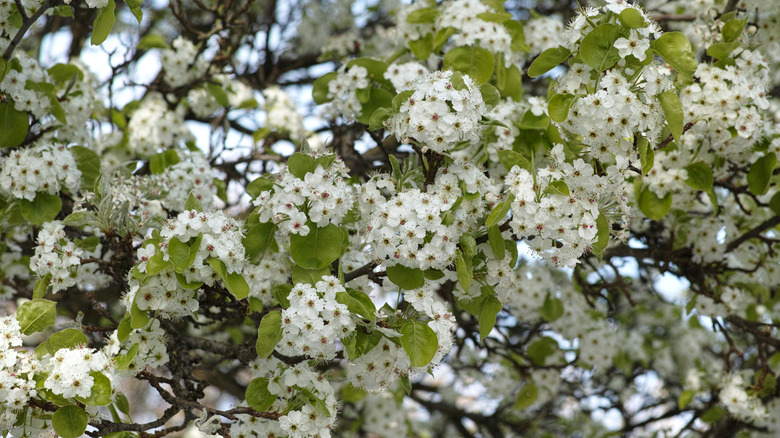
If you're getting a weird whiff of rotting fish or damp dogs, then it could be that you have a callery pear (Pyrus calleryana) growing in your garden. This family of trees is widely loved among ornamental gardeners, namely for its dense, reliable growth habit. In the spring, callery pears fill out their attractive, fast-growing branches with hundreds of delicate flowers. And therein lies the problem.
These flowers imbue the breeze with those aforementioned fishy, damp-doggy smells, leaving many homeowners regretting their ornamental choices. In fact, there are several reasons you should avoid planting these trees in your garden. One is that they tend to weaken and break after just 20 years, and are especially prone to storm damage once they start to reach their mature size. They're also invasive in some states, including California and Oregon in the west, plus various eastern states, from Maine to Missouri.
Female ginkgo stings the nostrils, in a bad way
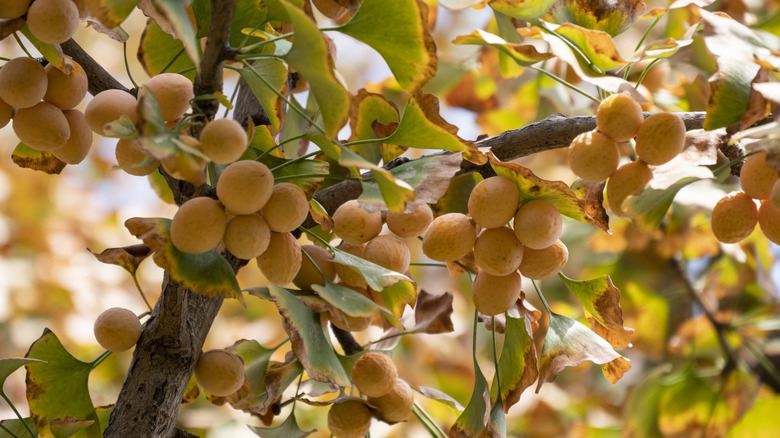
Few trees are as fascinating as the Ginkgo tree (Ginkgo biloba). It's known as the tree that outlived the dinosaurs, in fact it can be traced back more than 245 million years. And while time is often said to be the greatest healer, it's done nothing to salve the smell for which these ancient trees are renowned. Now, it should be said that these trees aren't inherently smelly. Instead, it's the covering of seeds produced by females that are renowned for their foul odor. It's often likened to rancid butter, vomit, and sewage, which is hardly what your guests expected when you invited them round for dinner.
Now, if you select this popular tree based on gender, then it is at least possible to avoid stinking up your yard. Indeed, you can buy male cultivars, like the Princeton Sentry (Ginkgo biloba 'Princeton Sentry'), and Autumn Gold (Ginkgo biloba 'Autumn Gold') which are bred, in part, to sidestep such problems. But if you decide to grow your own ginkgo from seeds, then it's impossible to determine your tree's gender until it reaches sexual maturity. This can take up to 20 years, and by then, your tree may be too well established to make removal easy.
The tree of heaven laces the breeze with burnt peanut butter
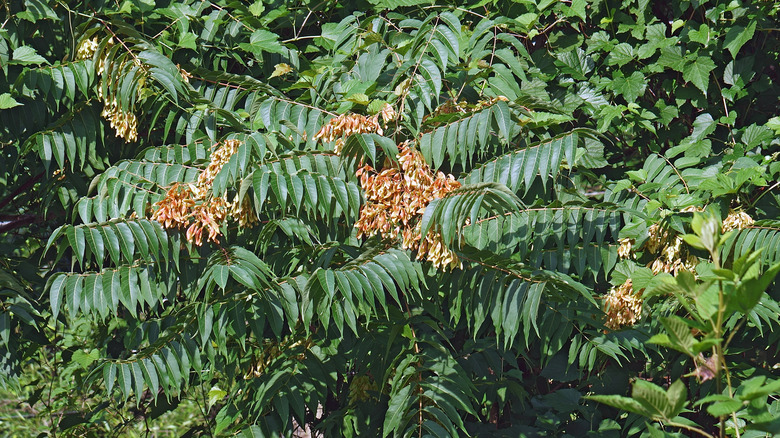
The tree of heaven (Ailanthus altissima) is perhaps the most misleadingly-named tree in North America. Native to China, it was introduced to the U.S. in the 1700s, and has since spread so aggressively that it's now deemed seriously invasive in states across the country. What's more, it's the favored host tree of the spotted lantern fly — another invasive species that has, in recent years, been wreaking havoc on agricultural industries. Driving the nail into its own coffin as far as American landscapers are concerned: this tree is also seriously smelly.
It's sometimes referred to as the "stinking sumac" (although it's not actually a sumac). The smell, which reminds homeowners of burnt peanut butter, occurs when the leaves are crushed. With all of this in mind, it's worth thinking twice about planting this tree in your yard. In fact, depending on where you live, you might be breaking the law by doing so. It's prohibited in several states by law, in fact, in some states, like Minnesota, any existing trees of this species must be removed and destroyed.
Mulberry berries can prove a bone of neighborly contention
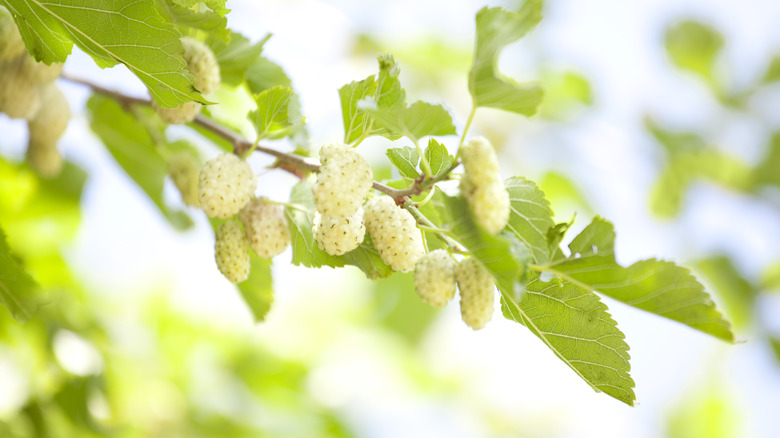
There are several reasons why you might want to reconsider planting a mulberry tree (Morus spp.) in your garden. We'll start by saying that the trees themselves don't smell. Instead, like the ginkgo tree, it's the fruits that pose a problem. Mulberry trees produce lots of berries, which initially sounds like a good thing. However, those berries will invariably fall off if you're not meticulous about picking them. When they do, they'll leave you with a sticky mess that's both hard to clean and irresistible to insects. They can also start to rot if not cleaned up, leaving your yard infused with the cloying, sickly-sweet smell of fermenting fruit.
If your tree happens to be growing on your boundary line, and the fruits spill into your neighbor's garden, then you could well find yourself facing some awkward conversations across the fence. What's more, some mulberry trees are actually illegal to grow. White mulberry trees (Morus alba), for example, are so prolific and hardy that they've been banned in certain cities, like El Paso and Albuquerque, and are recognized as invasive in several eastern states. In other words, not only do you risk trouble with your local authorities by planting them (depending on where you live), but you also risk losing your yard to a stubborn and very-smelly invader.
Female Osage oranges smell sickly-sweet
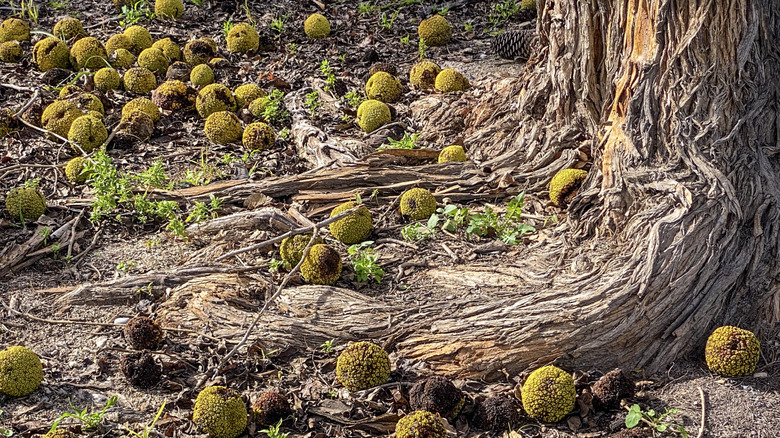
Despite its popularity, this fast-growing tree species comes with several downsides. Firstly, the Osage orange (Maclura pomifera) isn't actually an orange tree at all. Instead, it's part of the mulberry family, and like its cousins, it earns its smelly reputation thanks to its fruit. Often large, with a spiky, brain-like texture, the fruits are inedible. Instead, they tend to lie on the ground wherever they fall and begin to decompose, which is when they start to smell. As the fruits breakdown, microbes like bacteria and mold start feeding on the decaying matter, releasing the pungent chemicals responsible for rotting fruit's characteristic odor.
Of course, it's not all bad as far as this odiferous orange is concerned. It's sure to inspire conversations when you tell your guests that it's named after the Osage Nation, a Native American tribe who used wood from the tree to craft weapons. Plus, kids (and adults) are sure to be enthralled when they learn that the seeds of this particular tree are thought to have been spread across the continent by woolly mammoths. And until they start to decay, those fruits actually smell quite nice. However, it's a fast-growing tree, and once mature, will continue to produce lots — and lots — of fruit. What's more, while it is dioecious (meaning you need both males and females for the trees to reproduce), females will continue to produce seedless fruit, regardless of whether or not a male is nearby.
White spruce trees are nicknamed for their skunky odor
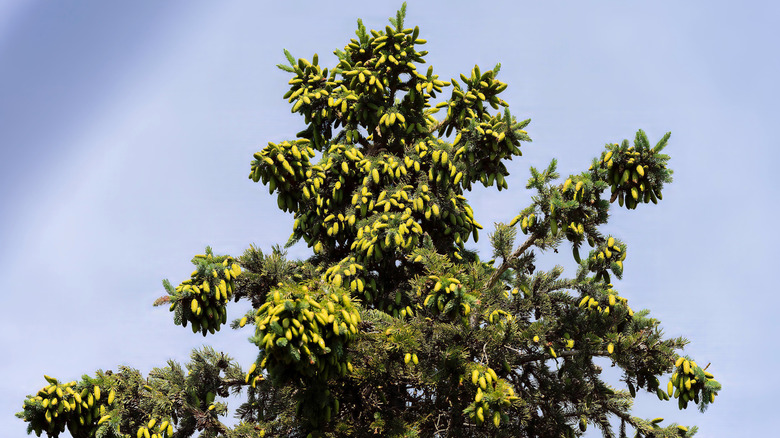
This one may come as a surprise. After all, spruces are usually known and grown for their inimitably earthy, terpene smell. They can lend an Alpine fragrance to gardens, and in many cases, spruce trees provide a hardy, natural means of improving your garden's privacy. The latter point is certainly true of the white spruce (Picea glauca). However, if you want to prevent stinking up your yard, you may wish to avoid planting this particular tree. While it's most commonly known as the white spruce, it's also the beneficiary of several less flattering nicknames, like the "skunk" or "cat" spruce.
Fortunately, those skunky, litter-tray odors only occur when the leaves of this spruce are crushed. You may only notice it when you come to prune your privacy screen, or if you accidentally stand on any dropped needles. Provided that you're precise with your shears, and that you keep those needles regularly swept, you should be able to avoid the worst of this native, nauseating spruce.
Boxwoods remind owners of cat urine, even if they don't have a cat
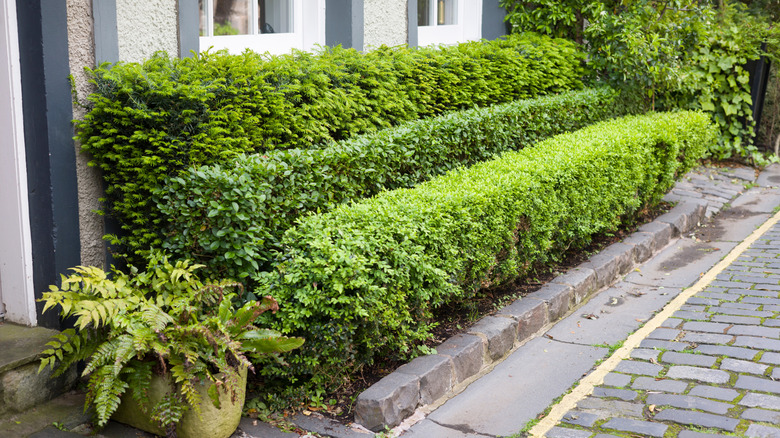
While technically classified as a "shrub," boxwoods (Buxus sempervirens) can be planted for privacy just like a number of other evergreen trees. They're known and loved for their deep-green, leathery leaves and dense growth habit, which also makes them excellent for ornamental gardens. However, they are also widely bemoaned for their unappealing scent. It's especially true with English boxwoods, which, according to some, emit a fragrance that's usually associated with felines.
This comes with a couple of caveats. Firstly, the smell, which is emitted by the shrubs' flowers, is only usually a problem in the spring. The leaves themselves are fairly inoffensive on the nose, if not a little musty when the sun heats them up. And while there are some homeowners who hate the flowers' smell, there are others who say that they can either live with it, or that they haven't noticed it at all.
Texas mountain laurel smells (and looks) like bubblegum
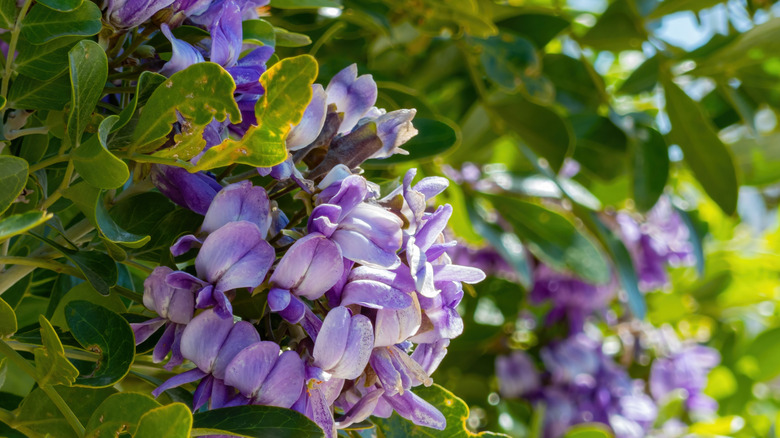
All of this talk of stinky flowers and foul-smelling fruit is enough to put even the most strong-stomached gardener off of planting trees. But before you rule the idea out entirely, allow us to introduce you to the Texas mountain laurel (Dermatophyllum secundiflorum). It's native, as you might expect given its eponymous nod to the lone-star state. And as for the smell, it rather outshines every other tree featured so far by offering your nostrils a nostalgic, bubblegum-scented blast from the past.
It's one of several native trees that are beneficial to both your yard and your local wildlife. Pollinators absolutely love the flowers that give off that wonderful fragrance, including bees, butterflies, and hummingbirds. And provided that you give it the right conditions, it's surprisingly low-maintenance. It grows best in hardiness zones 7 to 10, and needs very well-drained soil. Tick all of these boxes, and give it a warm, sun-soaked spot in which to grow, and your Texas mountain laurel could last for 80 years or more. Just know that it can be slow to grow, so it may not be the best choice if your landscaping needs are immediate. It also drops seeds, which can be toxic if eaten by children or pets.
Life's more likely to smell like lemons with a southern magnolia tree
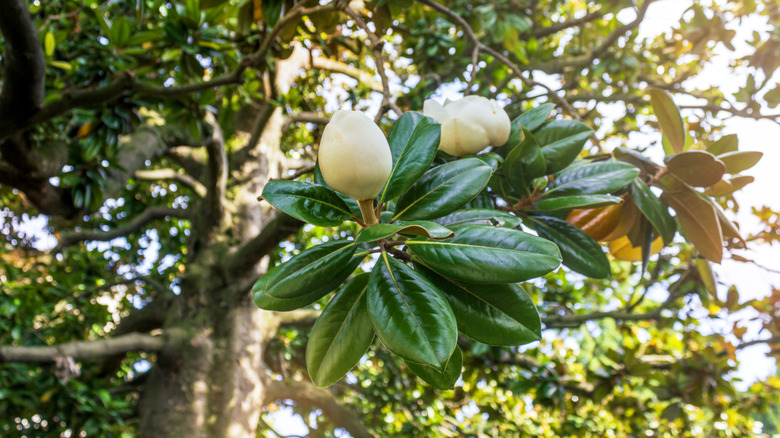
Whereas the smell of Osage orange trees is only pleasant until the fruit starts rotting, Southern magnolias (Magnolia grandiflora) deliver a heady, citrus scent for as long as its flowers are in bloom. It's one of the best magnolia species for gardeners who want white flowers, and it's also a favorite for various wildlife species. A number of birds, like robins, mockingbirds, and even wild turkeys will readily eat the seeds that this beautiful tree deposits. So, too, will small mammals, like squirrels and chipmunks. What's more, being evergreen, these trees provide a ready source of shelter for manifold species, especially during the winter.
For best results and maximum lemon-scented satisfaction, aim to give your southern magnolia as much sunshine as possible. Fertile, well-drained, and slightly-acidic soil is best, especially between hardiness zones 7 and 9. Given these conditions, these trees can reach up to 80 feet in height. They can also spread outwards up to 50 feet, so it's important to pick your spot wisely.
Fringe trees are both showy and fragrant, and bees love them
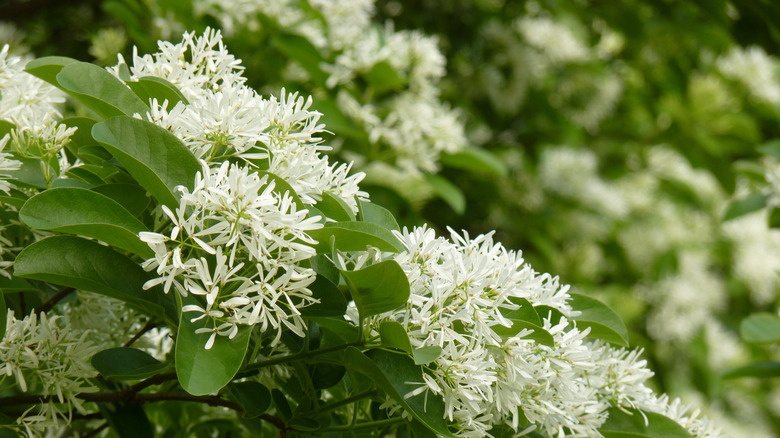
If you're planting out a smaller garden, then you probably need something a touch more compact than the grand Southern magnolia. But sacrificing size doesn't have to mean skimping on scent. Take the fabulously fragrant Chinese fringe tree (Chionanthus retusus) as an example. Starting with the scent, the tree's delicate white flowers smell subtly sweet — often reminiscent of lilacs. As for size, this species usually grows up to 20 feet in height (approximately a quarter of the size of Southern magnolias). It typically grows quite slowly — around a foot per season. But if you plan to stay put in your home for the foreseeable future, and you give it the right conditions, it'll continue to grow and mature for up to 70 years or more.
Another big tick in favor of Chinese fringe trees is that, even in the best growing conditions, they tend to require little maintenance. Yes, they're deciduous, so you'll want to clear those fallen leaves away come autumn. However, you shouldn't need to prune your tree too heavily in order to keep it in fine fettle. Provided that you live between hardiness zones 5 and 9, and that you give your tree lots of sunshine plus acidic, well-drained soil, it should grow quite happily with minimal input. Meet these conditions, and you can expect those showy flowers to nurture your nostrils in late-spring and early summer.
The katsura tree's fall foliage smells like toasted sugar or caramel
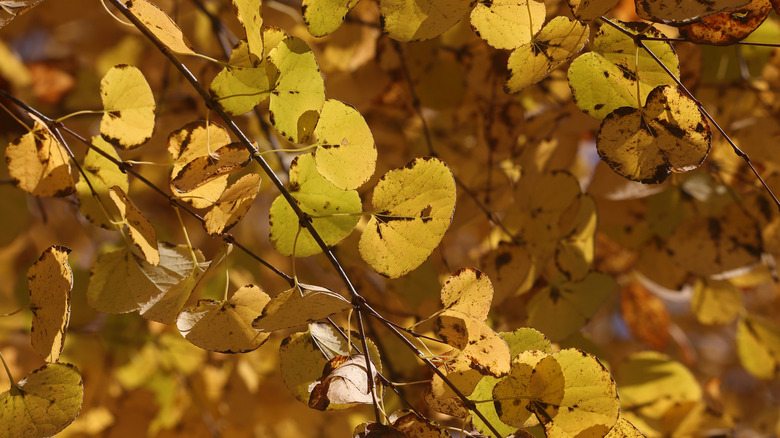
The katsura tree (Cercidiphyllum japonicum) is only the second species in this guide whose scent is attributed to its foliage. However, whereas the white spruce is decidedly noxious on the nostrils, the katsura tree laces the autumn breeze with the intoxicating smell of cinnamon and caramel. This happens as the leaves begin to brown at the end of summer, and it's fair to say that those sweet notes of cinnamon-sugar are entirely in-keeping with the season.
Hardy in zones 4 to 8, this species does best in a spot that's sunny, ideally with only partial shade. It likes rich, moist soil, and if it has those things, it'll happily grow up to 50 feet tall. It's virtually pest-free, which is reassuring for those who want to keep garden maintenance to a minimum. What's more, this underrated tree grows surprisingly well in clay soil — conditions that can stymie the growth of other showy species, like magnolias. And since the katsura tree's main season of interest is the autumn, it can help to extend your enjoyment of your garden when the rest of your plantings are starting to fade.
Pacific wax myrtle trees' fragrant leaves provide plenty of privacy
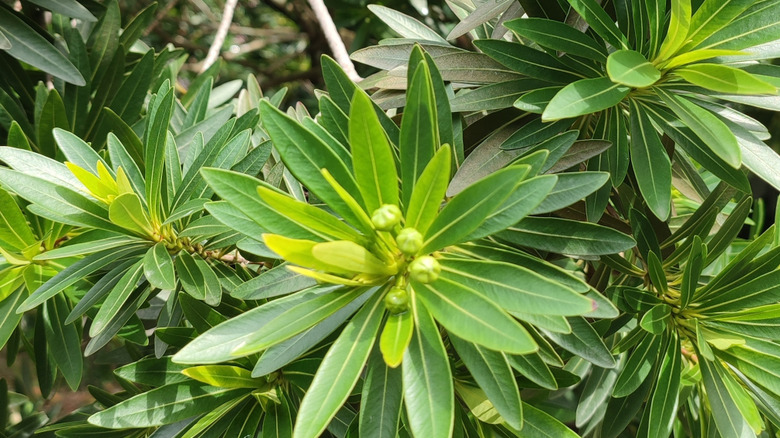
Like the katsura tree, Pacific wax myrtles (Myrica californica) are revered for their fragrant foliage. They respond well to pruning and shaping, plus they're evergreen, all of which makes them excellent privacy-screen alternatives to smellier shrubs like boxwoods. Depending on how you "train" them, they can grow up to 30 feet tall and up to 12 feet wide. And in the summer, their characteristic white flowers quickly turn to berries, which in turn provide food for birds in the autumn and winter.
Aside from pruning your tree or shrub into your desired shape, you shouldn't need to worry too much about maintaining your myrtle. This species is renowned for its hardiness, especially in wind-blown coastal climates. And it adapts well to various soil conditions, from sand and loam to claggy, clay-type substrates. All you really need to do is provide it with lots of sunlight and keep it well watered. Do that, especially if you live between hardiness zones 7 and 10, and you may find this tree grows as much as four feet in a single season.