

The Companion Flower For Peonies That Bloom At The Same Time
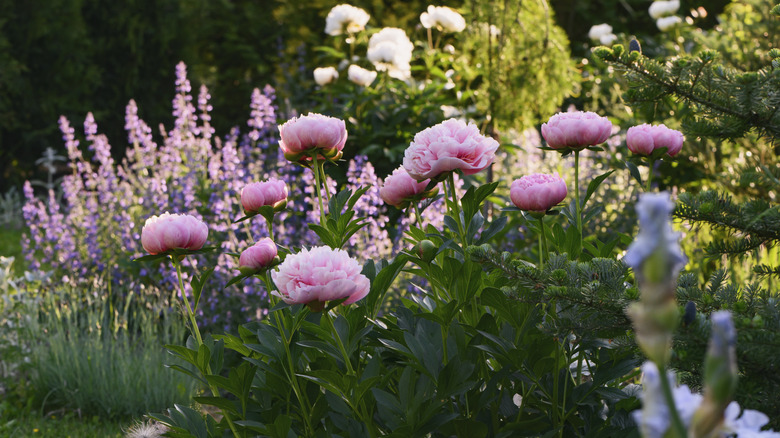
Peonies are a long-lasting garden staple that fills your yard with pollinators, but they often look lonely in empty flower beds, especially when the foliage dies off in the late summer. Fortunately, there are some companion flowers for peonies that not only help them thrive, but create a stunning spring or summer display when they bloom together at the same time. Baptisia (Baptesia spp.) is one such peony companion that adds a touch of delicate beauty among the large pink blossoms and neat foliage after peonies decline. In fact, this specific combination is commonly used to create a dynamic landscape or floral arrangements.
Baptisia, also known as false indigo or wild indigo, is commonly overlooked in favor of more popular, long-blooming spring flowers, but this tall flowering plant makes a stunning floral backdrop for garden bulbs. Even though peonies aren't true bulbs, the tubers still pair nicely with the baptisia plant. Belonging to the Fabaceae family, baptisia is an herbaceous perennial with about 20 different species, most of which grow best in USDA hardiness zones 5 to 8 (though some varieties may be hardy in zones 4 to 9). It is known for being resistant to deer and tolerant to heat and humidity, all while attracting helpful bees to your garden.
How to grow baptisia as a companion flower for peonies
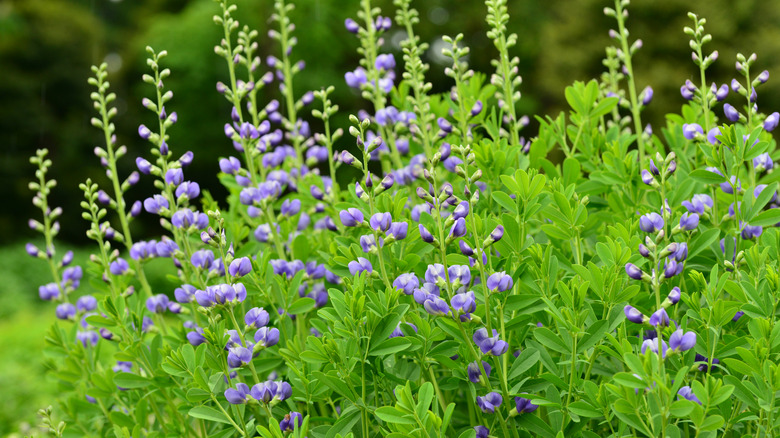
Peonies are also herbaceous perennials; they grow in USDA hardiness zones 3 to 6 and generally bloom between May and June. Peonies are normally white, pink, or red, and they grow between 2 and 3 feet tall. In contrast, baptisia are usually blue, yellow, lavender, or white, creating a great contrast with peonies. Baptisia will bloom in spring and produce clusters of small blossoms that mature to be 3 to 4 feet tall, though some varieties may grow taller. That bit of height difference also creates an aesthetically pleasing contrast.
Both peonies and baptisia do well when planted in full sun and in clay or sandy soil with good drainage. Depending on the variety, baptisia can grow between 3 and 5 feet wide, and peonies generally need at least 3 to 5 feet of space between plants, so make sure you give both plants plenty of room to grow.
Baptisia isn't invasive, but it has another cause for concern: its dense root system. When you select a planting location, make sure it is one you can commit to long-term. Once baptisia plants are established, their dense root system makes it nearly impossible to move them again. On the bright side, that means it's also a highly resistant plant, which makes it all the more valuable as a peony companion.