

Plant This Deer-Resistant Herb Next To Peonies For A Garden With Continuous Blooms
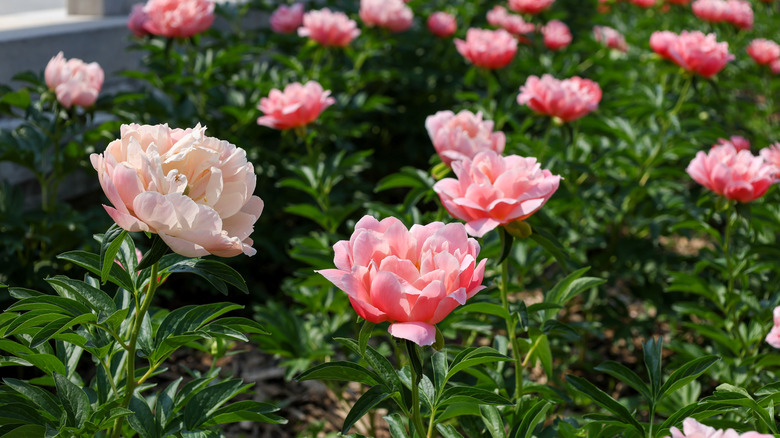
Few plants make a bigger impression than peonies. They have large, dramatic flowers, and are one of those perennials that will bring timeless beauty to your garden for years. The problem, however, is that they generally only bloom May through June, which can be frustrating for gardeners who want to keep their gardens and yards looking colorful year-round. Luckily, there are many perennials you can grow alongside your peonies to keep your garden colorful for longer. Take, for instance, Russian sage (Salvia yangii).
Russian sage is a herbaceous woody perennial and a relative of mint that blooms from July through September with small purple-blue tubular flowers in whorls. This, when combined with its elongate gray-green leaves and square silvery-gray stems, helps bring a soft, airy look to the garden, complementing peonies. As for the size, Russian sage typically grows about 3 feet tall and 2 feet wide. You can use it as a backdrop for traditional garden flowers or let other plants grow around it in your garden in mixed plantings.
Russian sage is also deer-resistant and releases a strong sage-like smell when crushed. Just keep in mind that if you want to grow it as a perennial, it is hardy only in USDA plant hardiness zones 5 to 9. Outside these zones, you will have to grow Russian sage either as an annual or attempt to overwinter it.
Growing Russian sage alongside peonies in your garden or yard
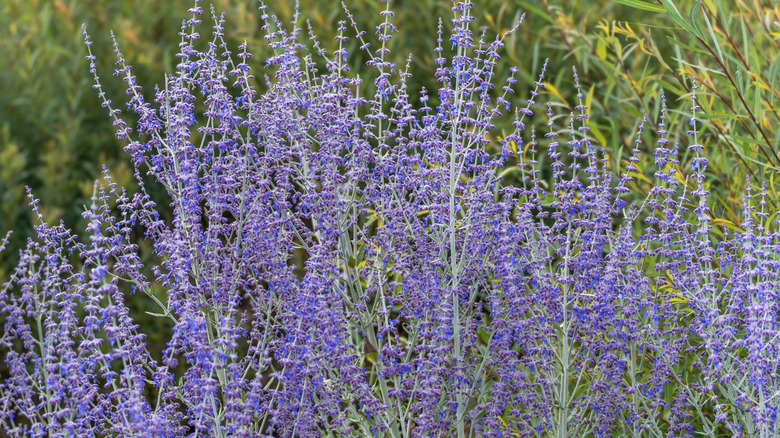
When peonies bring fullness, Russian sage brings height. It reaches well above most peonies, cementing its backdrop suitability. Peonies and Russian sage have similar growing needs, too. For instance, both peonies and Russian sage prefer well-drained soil and need full sun. They also share very similar soil pH needs. Peonies, for instance, prefer slightly acidic to neutral soil at a pH near 6.5 to 7, whereas Russian sage performs well in both slightly acidic and mildly alkaline soil at a pH near 6.5 to 7.5.
Both peonies and Russian sage need moderate watering at the start, and once established, their watering needs decrease. Russian sage, in particular, is one of those drought-resistant plants that will thrive without much water. As for soil fertility, peonies prefer nutrient-rich soils, whereas Russian sage can grow well in moderately fertile soils. However, avoid overly rich soils for both, as it decreases blooms in peonies and can make Russian sage plants flop.
Keep in mind that Russian sage has a habit of spreading through its seeds and underground runners. So, if you are growing it alongside your peonies, make sure to keep it contained. Other than what's mentioned above, you don't need to worry about it much, as it requires very little upkeep and becomes almost completely carefree once established in the garden or yard.