

Not A Tower, Not A Box: The Most Energy-Efficient Fan Type For Your Home

Global temperatures are rising and so are energy costs. So it's no surprise that energy-efficient appliances have become a big priority in a lot of homes, fans included. After all, it's hard to keep your cool when the thing meant to cool you is running up your electricity bill. This often leads people to compare different fan types. Tower fans, box fans, ceiling fans, the list just goes on. And while both tower fans and box fans look sleek and small, it is the good old ceiling fans that take the lead when it comes to saving energy in households.
To understand why ceiling fans are the most energy efficient option, it's helpful to know how fan efficiency numbers work. Energy efficiency of a fan is measured in terms of cubic feet of airflow per minute per watt (CFM/W). It is a number that tells you how much air a fan can move for every watt of electricity it uses. In other words, airflow delivered matters just as much as electricity consumed. So, the most energy-efficient fan type for the home is not the one that uses the least amount of energy. It is instead the fan that delivers the most useful breeze per watt spent. And that is where ceiling fans shine.
They tend to have a much higher CFM/W than tower fans and box fans. Even better? Modern top-rated energy-efficient ceiling fans can operate on just 4 to 40 watts as they use highly efficient, brushless direct current motors that can reduce energy consumption by as much as two-thirds compared with standard ceiling fans. You just need to make sure that you choose the right ceiling fan for your space.
Choosing the right ceiling fan to save on energy bills
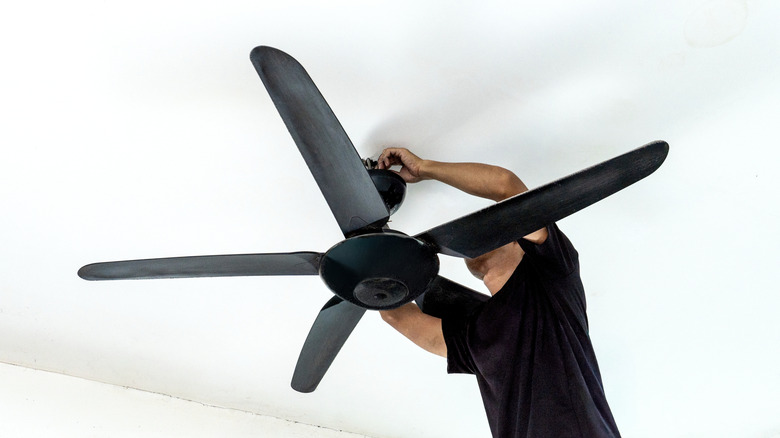
When buying a ceiling fan to reduce your energy costs at home, select the right ceiling fan is essential. Make sure you match it with the size of your room or space where you are planning to install it. A small fan in a large space won't do much, whereas a large ceiling fan in a small space will simply waste energy. According to ENERGY STAR's sizing guidance, rooms between 76 and 144 square feet need a 36- to 42-inch fan, whereas rooms between 144 and 225 square feet need around a 44-inch fan. If your room is larger than that, you might need a 52-inch ceiling fan, or even two fans, to keep you covered.
In addition to choosing the right ceiling fan, you also have to install and use it correctly in order to maximize energy savings. During installation, you'll want to make sure that your ceiling fan has at least 8 inches of clearance from the ceiling as well as 18 inches of distance from any nearby wall. This will allow safe operation and proper airflow.
Once installed, run ceiling fans counterclockwise in summer to push cooling air downward, and clockwise on low in winter to circulate warm air trapped near the ceiling. To save energy, you should also turn off ceiling fans when there is no one in the room. Unlike air conditioners, fans do not reduce the air temperature. Instead, they create a cooling sensation by moving air across your skin. In fact, running a ceiling fan allows you to set your thermostat by up to 4 degrees Fahrenheit higher than normal without a noticeable drop in comfort.