

Ditch The Pot: This Ancient Growing Technique Will Turn Your Orchid Into A Statement Piece
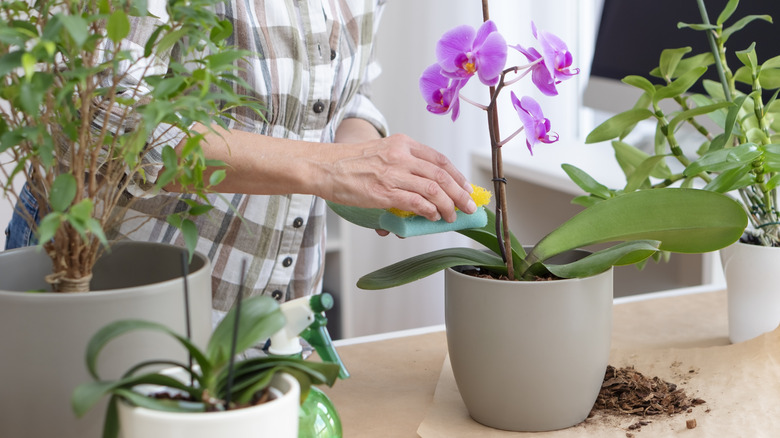
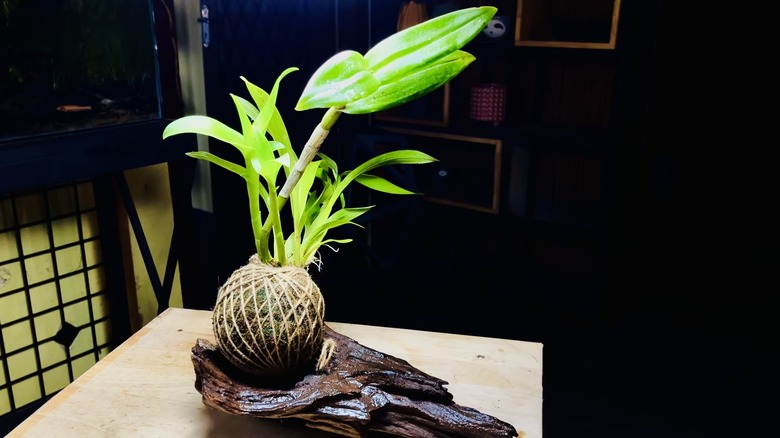
Orchids carry a certain delicate beauty, but they demand a potting setup that showcases their gorgeous blooms without overshadowing their appearance. Sure, a plain planter can work, but when there's a a no-pot method both displays them in a unique way and provides for all of their care needs, it's hard to ignore. Kokedama, the Japanese art of using a moss-covered ball as a vessel to grow plants, transforms your orchid into a statement piece while creating an effective growing environment for it.
The majority of orchids grown as houseplants, like phalaenopsis, are epiphytes that can pull nutrients from the air, which makes them perfect for this display method. While kokedama creations for other flowering spring plants usually comprise a soil ball wrapped in moss, the soil will be swapped for orchid medium in the case of epiphytic orchids. Use long-fiber sphagnum moss, which retains water and provides air circulation through its porosity. You'll also need a bowl of water, mesh material, clear thread or fishing line, and scissors.
Try your hand at a gorgeous DIY orchid kokedama
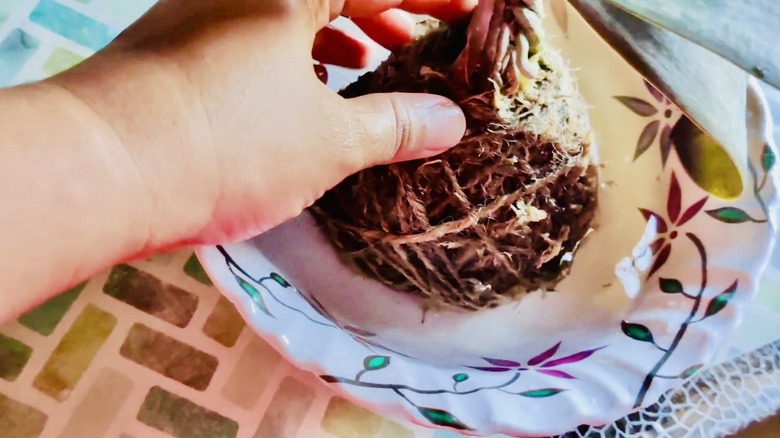
Because of the delicacy of orchid flowers and buds, create your kokedama when the orchid is no longer blooming and is actively growing new leaves and roots. Consider wearing gloves while working with the moss, as it can contain sharp plant materials. Soak several clumps of sphagnum moss for about 20 minutes and the roots of your orchid for 10 minutes. Rinse any debris off the roots. This is a good time to inspect for rotting or dead roots and remove them. Make a small mesh packet containing orchid mix; you can use pantyhose or the kind of mesh bag produce comes in. Tie the packet to close it, and cut off the excess mesh.
Fashion the packet of orchid medium into a sphere and carefully wrap the plant's roots around the ball. Squeeze any excess water out of the moss and start draping the longest strands you can find all around the roots, keeping the shape as round as possible. You will likely need multiple layers; secure each layer by wrapping clear thread or fishing line around it. It's also possible to use small fern pins to hold down the wrapped moss instead of wrapping with thread, which could help to give you some more control over their placement.
Styling and caring for your orchid kokedama
When your plant's roots are completely covered and you're pleased with the shape, knot the clear filament to secure the ball. Many kokedama creators do a final wrap with visible and decorative material, such as jute, twine, yarn, or thin ribbon, often wrapping it in attractive patterns. Adding a hook or loop so the kokedama can be hung is also popular.
The possibilities for displaying your orchid kokedama are nearly endless. Kokedamas are among the stunning DIY hanging planters you can make to liven up your home, and a hanging kokedama moss ball planter looks striking in a window. It's the purr-fect alternative for pet owners, out of the reach of mischievous paws. You don't have to hang yours, though. Display it in a saucer, clear bowl, or on natural element such as a piece of wood or grouping of rocks and pebbles.
To care for your orchid kokedama, plop it into a bowl of water weekly for a good 10-minute soak, allowing it to drain in the sink. If the kokedama feels heavy or damp, forgo watering and adjust your schedule as needed. Adapt your usual orchid fertilizing routine by placing diluted fertilizer in the watering bowl, following the label's instructions. Place the kokedama in a spot where it will get indirect light at a medium or bright intensity. You will likely need to create a new kokedama in about a year, as sphagnum moss breaks down. It's also useful to to know general information about how to successfully care for indoor orchids.