

It Was In Many '60s Kitchens, Now It's A Valuable Thrift Store Gem Worth Hunting For

We may receive a commission on purchases made from links.
Not every valuable collectible starts as a luxury item. Sometimes, the most sought-after treasures are the everyday objects people once took for granted. Texas Ware Confetti bowls are a perfect example. The company behind them was the Plastics Manufacturing Company of Dallas, Texas. They started making kitchen products in 1946, and became noted for their wares in melamine, a hard plastic that was lightweight and cheap to produce. Under the Texas Ware name, they made all kinds of everyday items, but the mixing bowls really stood out to customers — specifically, the Confetti line.
What's interesting is that those bowls weren't designed to be art. They were actually created from a form of recycling. Leftover colored melamine pellets from other production runs were tossed into heated molds, and the result was a bowl with a random, speckled pattern that no machine could replicate twice. Every single bowl came out looking slightly different, which is a big part of what makes them thrift store finds that will boost your kitchen's aesthetics.
They came in sets of different sizes, and finding a complete set today is genuinely difficult. A single large bowl can cost as much as $75 online, while sets retails somewhere between $100 and $200, depending on condition. The bolder, more saturated colors tend to sell for more, while the softer tones are slightly easier to find. Either way, stumbling across one at a thrift store is still very much possible if you know what you're looking at.
What to look for when you're out hunting
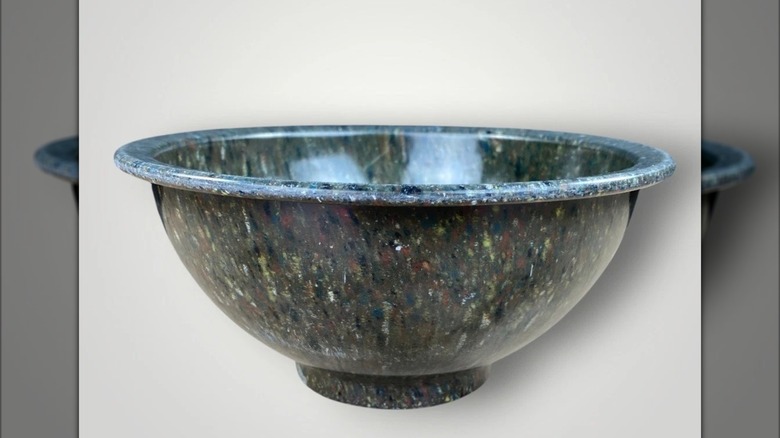
Since these items are still popular today, several brands have produced lookalike versions, but it's easy to spot a genuine Texas Ware Confetti bowl with these tips. Flip any piece over and check the underside. A real Texas Ware piece will have a raised logo that reads "Texas Ware," inside a circle or square, sometimes by the words "Plastics Manufacturing Co. Dallas, Texas, USA." On mixing bowls, that mark will likely also include a size number. The 111 indicates an 8-inch, the 118 is a 10-inch, and the 125 is an 11-inch bowl. The diameters can vary slightly, but those numbers are your guide.
That said, don't walk away from a confetti-style bowl just because it doesn't have a maker's mark. Unbranded pieces still sell well, and thrift stores rarely price them any higher than the branded ones. For resellers especially, an unmarked bowl picked up for a couple of dollars can still turn a solid profit. Branded pieces do fetch more, but there is also a market for unbranded confetti bowls.
If you don't want to flip it, there are other unexpected ways you can use thrifted bowls, but you must keep two things in mind. First, melamine does not play well with microwave radiation, so make sure you never microwave this dishware. Second, skip the dishwasher. Heat and heavy detergents can dry the material out over time. If you, however, wash them by hand using mild soap, these bowls can last for a few more decades.