

What Happens If You Install A Circular Saw Blade Backwards
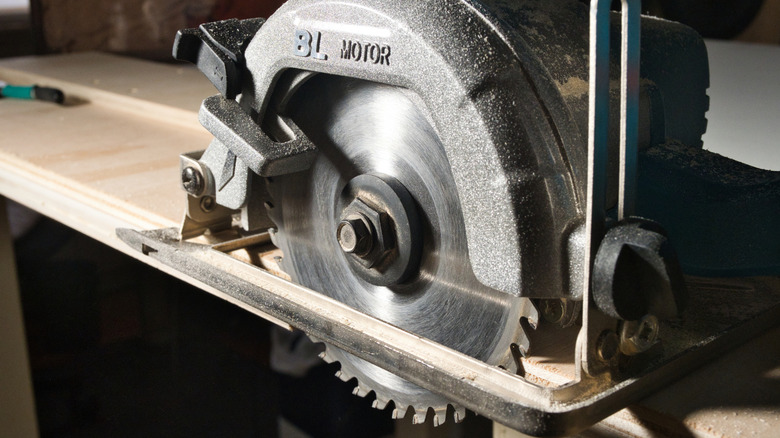
A circular saw can make fast and accurate cuts through a variety of materials, including wood, metal, and tile. But in order to do this, you need to know how to safely use a circular saw to avoid mistakes while taking on projects around the house. One common mistake when changing blades is installing the saw blade backwards. Apart from this possibly affecting how deep a circular saw can cut, it can create a range of problems that impair performance, damage the blade, or even put you, the device's operator, at risk.
Circular saw blades are typically designed to rotate in a specific direction, which is counter-clockwise (when viewed from the front). This is important because, when installed correctly, the teeth are angled to slice into the material efficiently as the blade spins. If the blade is installed backwards, the teeth will attack the material from the wrong angle, negatively affecting the quality of the cut and performance of the blade. The motor will suffer as it will have to work harder to compensate for the inaccurate direction. What's more, the strain this causes could generate heat and smoke, putting unnecessary stress on the cutting equipment. Worse, there's a high risk of a kickback, or the sudden jerk reaction of a spinning blade as it struggles to cut through a material.
How to tell if your circular saw blade is installed backwards
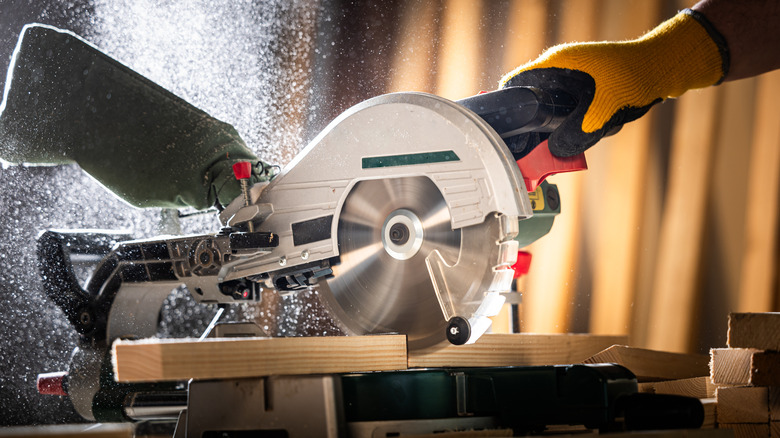
An incorrect blade direction is easy to fix and even easier to avoid if you know the necessary safety tips before using a circular saw. Many manufacturers include directional arrows on the blade itself to guide users during installation. This is especially true for diamond blades. Before you begin using your saw, check whether the directional arrow printed on the blade matches the rotational direction marking on the machine, usually found next to the motor housing or blade guard. This is the best way to tell if your circular saw blade was installed incorrectly.
In case your circular saw blade does not have a directional arrow, you can inspect its teeth to see if it's mounted in the wrong direction. Most blades are supposed to spin counter-clockwise, and their teeth should point upwards or into the cut. Of course, there's no better way to tell an erroneously installed blade than to observe how it performs. As previously mentioned, a backwards blade can cause many issues, like unusual vibration, excessive heat, rough cuts, difficulty cutting through material, and an increased risk of kickback or other safety hazards. If any of these issues persist as you cut through a material, there's a big chance that an incorrectly mounted circular saw blade is the culprit.