

Ditch Traditional Lawn Aerators: There's A Cheaper Option Sitting In Your Shed Already
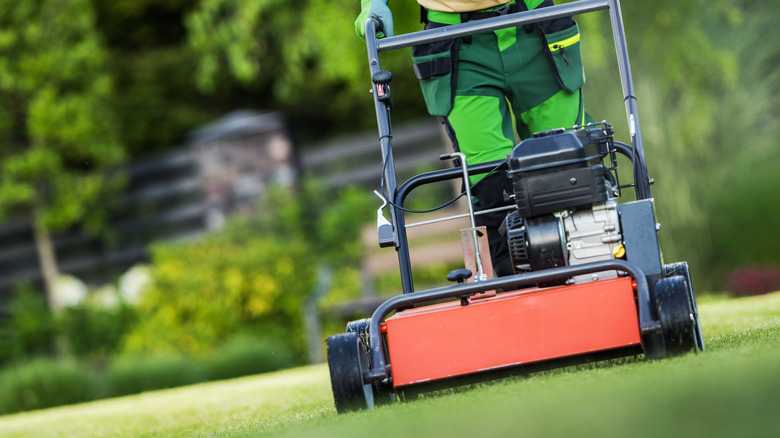
Over time, the soil under your lawn gets compacted. It doesn't take much to prevent air and water from getting to the roots of the grass, and as a result, it becomes weaker. Aeration is the process of making small holes so those vital nutrients can get to where they are needed. It is one of the key habits of people who keep their lawns lush, but because it usually only needs to be done once a year, it can be difficult to justify the cost of a traditional machine. Fortunately, it's highly likely you have a cheaper option already sitting in your shed: a garden fork.
Aerating your lawn should always be done when the grass is actually growing, so it's not a job for the winter. Doing it with a garden fork is simple. Push the tines down around 5 or 6 inches, give the fork a bit of a wiggle, move it no more than a foot, and repeat. Clearly, this is going to take some time. However, while there are a number of other ways to aerate your grass for a healthier lawn, towable tools for lawn tractors cost at least a couple of hundred bucks, and gas-powered walk-behind versions are a couple of thousand — a garden fork certainly the most budget-friendly approach.
When to use a garden fork for aeration, and when one of the alternatives is better
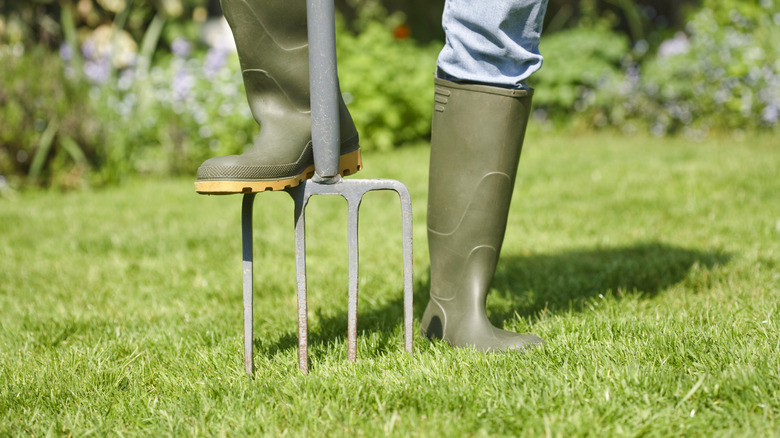
Avoiding aerating your lawn is not really an option, as it could be one of the surprising ways you're killing your grass without knowing it. A garden fork is better than nothing. That said, there are experts who feel that using one is not the best aeration method. It could compact the soil around the tines, might damage grass, and could even encourage weeds. This method is particularly ineffective in clay soils or lawns that are especially compacted.
In these cases, a core aerator (also called a plug or hollow tine aerator) should be used. These don't push the soil aside — they actually cut out a small cylinder of grass and dirt so there's no additional compaction, allowing air and water can reach the roots easily. Manual versions of this tool look a bit like a garden fork and start at around thirty bucks. Their main drawback is that in addition to being slow, you also need to pick up and dispose of the cores. Some machines will collect them, making the job a whole lot easier ... at a price.
As a general rule, experts recommend that garden forks are used for small lawns and grassed areas that are difficult to reach with a machine. Spiked mechanical aerators (with rotating tines or blades) can be used and are a mid-priced option, but core models are considered the best tool for aerating your lawn if you have the budget.