

The Mistake That Is Preventing Your Petunias From Blooming All Summer Long
We may receive a commission on purchases made from links.
For years, folks have liberally planted petunias in their gardens, and why wouldn't they? With their diversity of colors, forms, and shapes, they instantly spruce up beds, borders, containers, window boxes, and hanging baskets, making them highly versatile. Plus, they lure in a bevy of butterflies and hummingbirds. But their biggest upside lies in the long flowering period. Planted in spring, they bloom continuously through fall, ensuring a near-steady display for over 24 weeks in the south — 12 weeks high up north.
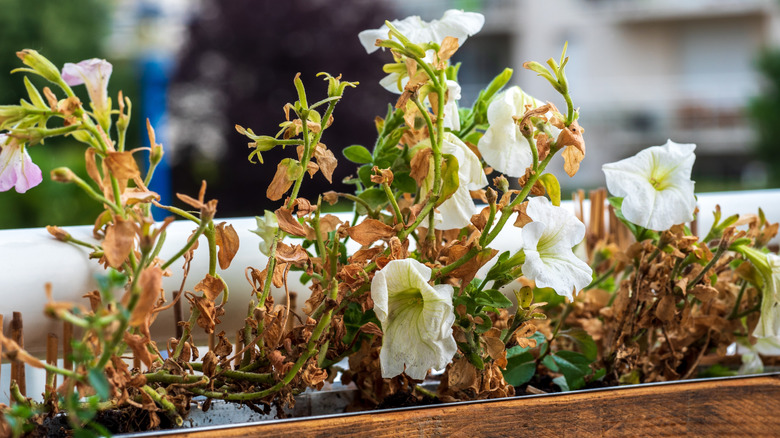
But if your petunias are growing sparse or flowerless in the summer, you may be making the mistake of underwatering them. Petunias are thirsty plants. Apart from six hours of direct sun exposure and regular fertilization, they require consistent watering to maintain perpetual blooms. This makes sense because plants continually move water from their roots through their leaves through the process of transpiration. But when they can't access it in adequate quantities, the plant is pushed into survival mode, with growth slowing down. Eventually, foliage becomes yellow and wilts, and flower production can slow or stop until conditions improve.
Watering requirements are highly variable
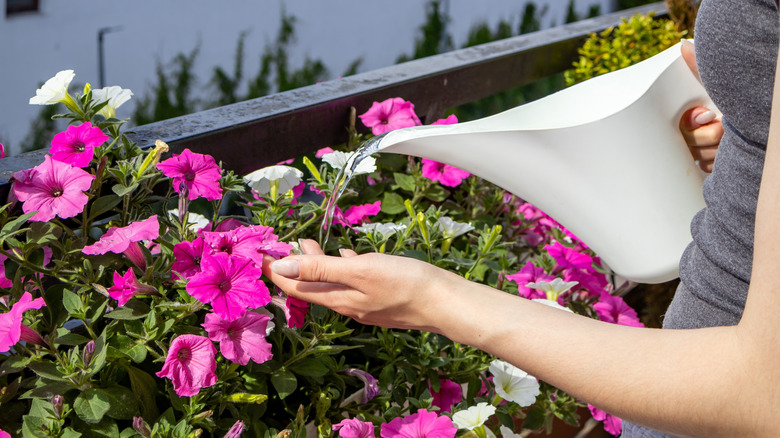
To grow and bloom successfully, petunias require consistently moist soil. In other words, the soil should neither stay soggy enough to invite rot nor dry out long enough for the plants to droop. Sadly, finding that balance can be challenging because water requirements vary based on climate, weather, plant size, and even cultivar. To understand how, take newly planted petunias. Since they're still developing a full root system, you must water them diligently every day for a couple of weeks. However, once established, they generally require less frequent watering because their roots are better developed.
During spring and fall, when nights are relatively cool and water doesn't evaporate as rapidly, you can afford to water them less if the soil stays moist. And if it rains? You're off irrigation duty. But to get your petunias to rebloom and last through the summer heat, you must raise the frequency to daily. In fact, petunias potted up or in baskets may require a drink twice a day to prevent parching. That's because containers dry out faster due to limited soil — terracotta pots or ones on the small side even faster. Exposure to dry, desiccating winds may also dehydrate them. Certain varieties, like wave petunias, may tolerate some drying out, but trailing varieties may require constant babying.
Keep petunias well-watered for steady blooms
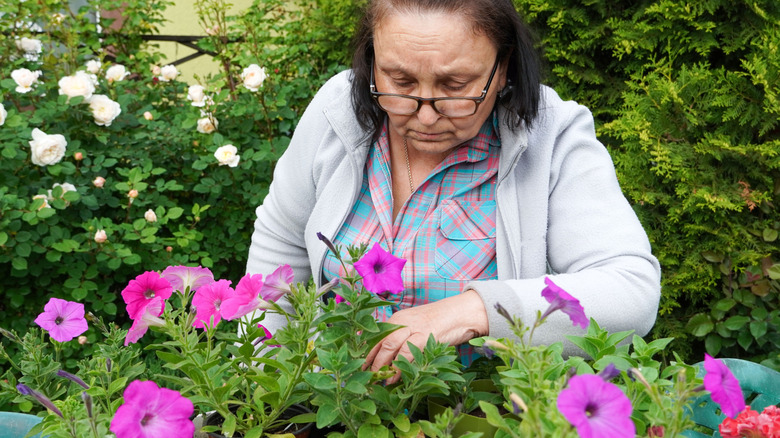
Rather than getting fixated on a set schedule, the best thing you can do to water petunias for more blooms and healthier plants is to check the soil. When you insert a finger a few inches into the soil, it shouldn't feel dry. If it does, give the plant a slow, deep soak so the top 6 inches are evenly moist. This will encourage the development of a deep root system, as opposed to a shallow one, enabling the plant to go without supplemental water for longer. Be sure to water at the base, as wet leaves can become hotbeds for diseases or slimy pests. If watering overhead is unavoidable, do so early in the morning so foliage has time to dry during the day.
If you've planted this fast-growing flower to bring color to a container garden, check for dryness to a depth of 2 inches. Or, hold up the pot to feel its weight. If the soil is dry or the pot is light, soak until the water runs out of the drainage hole. Another option is to fit petunias into self-watering pots like these from the Fielda Store. Simply fill up the saucer tray every week, and it'll release water as necessary through the cotton wick. Because frequent watering can leach nutrients from container soil, regular fertilization may be necessary throughout the growing season.