

What's The Average Lifespan Of A Japanese Maple Tree?
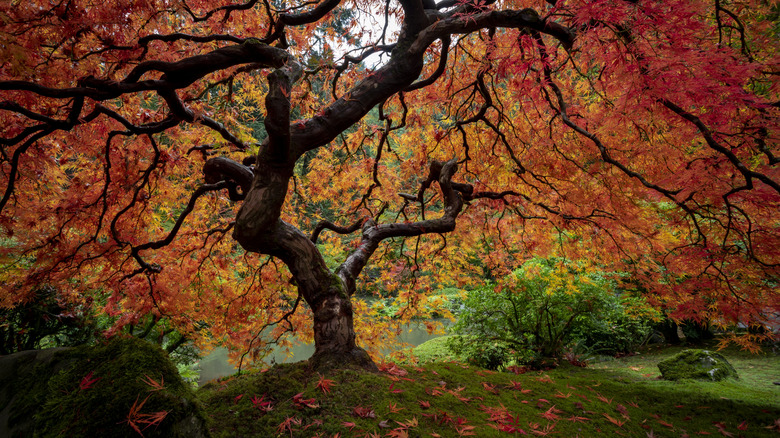
Imagine a quintessential Japanese garden, and you'll likely picture delicately pruned Japanese maples (Acer palmatum) with dramatic foliage, set among carefully placed boulders, raked sand, and stone pagodas. The Japanese maples with gnarled trunks and sculptured branches are most striking, especially when their leaves drop to expose the manicured bones of the tree. The landscape is meant to mirror the beauty and serenity of nature — effortless and timeless.
This ageless characteristic of Japanese gardens may lead us to believe that maples last for centuries, but in actuality, the average lifespan of a Japanese maple is about 100 years. Compared to upwards of 2,000 years for redwoods, 1,000 years for pines, or even 300 years for oaks, the longevity of Japanese maples is quite low. There are actually differences between short- and long-lived trees to consider when deciding which to plant.
Although Japanese maples are relatively easy to grow, they won't hit the century mark on their own. For starters, they thrive in USDA Hardiness Zones 5 through 8, which are areas characterized by four seasons, including mild winters and warm summers, though zones across this range will see slight differences. The trees also need proper care, which means gardeners need to give them what they need in terms of sunlight, drainage, water, and other care.
Proper care for a Japanese maple
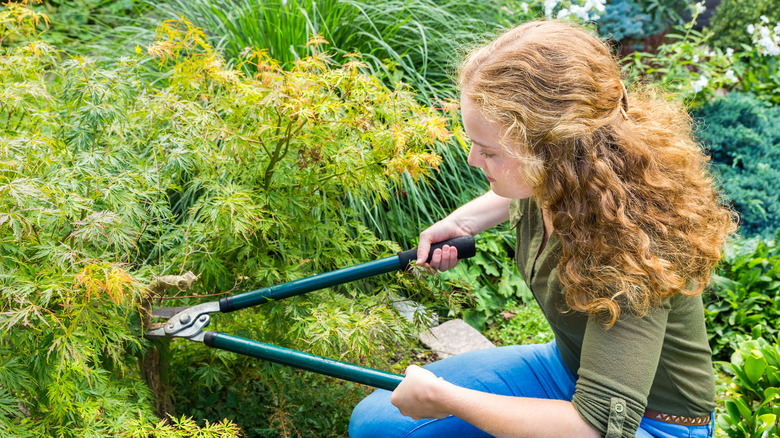
A Japanese maple can easily be a stunning centerpiece for any yard. With hundreds of cultivars, including these 12 varieties that will bring beauty to your yard, you can easily find the right size, foliage shape, and color that appeals to you. But your decision to add one to your landscape can't be based simply on the tree's wow factor.
First, finding the best place to plant a Japanese maple is key. Since maples max out at a height and spread of 10 to 25 feet (depending on the cultivar), is the spot you have in mind large enough? Also, while maples do love some sun, they can't tolerate extremely hot and dry areas, especially intense afternoon heat. Make sure the soil is slightly acidic and well-drained, ideally with organic matter. In particularly warm areas, layer mulch around the base of the tree to keep the soil and roots cool.
Although we often think of the most beautiful Japanese maples as being exquisitely pruned, this should be done minimally. While the plant is young, focus on cutting away dead branches and those that are growing into one another. Pay attention to when you prune, as well. Get rid of dead wood in the spring as leaf buds are growing, and make only minor cuts during the summer. The main pruning window is in the fall and early winter once the leaves have fallen and you can clearly see the tree's shape.