

Sharpen Your Lawn Mower Blades With A Simple Drill Attachment
We may receive a commission on purchases made from links.
Routinely sharpening your lawn mower blade is an important maintenance task. In fact, it's recommended you do so after every 20 to 25 hours of cumulative mowing. So, if you've forgotten this bit of lawn mower upkeep, know that you can actually sharpen your mower's blade yourself at home using a power drill. The drill attachment you need is called a blade sharpener. It's basically a grinding stone, and it's made from an extremely hard mineral called corundum.
To sharpen a rotary mower blade using your power drill, you'll also want to first gather a few other items, including a vise to secure the blade while sharpening, and a lawn mower blade balancer to check your work. Both the stone and balancer can be purchased together, such as with this sharpening kit by Arnold. Or, if you'd like to get them separately, you can as well. Walmart, for example, carries this mower blade balancer by VENUSY for under $5. In addition to these items, you'll also want to have some protective eyewear, safety gloves, and ear protection.
Along with the stone, a blade sharpener also has a plastic guide. The lawn mower blade will fit between the grinding stone, which is beveled, and the guide. Once you start sharpening the blade, by running the grindstone across its edge, the guide will help to steady your passes.
Using corundum to sharpen your lawn mower blade
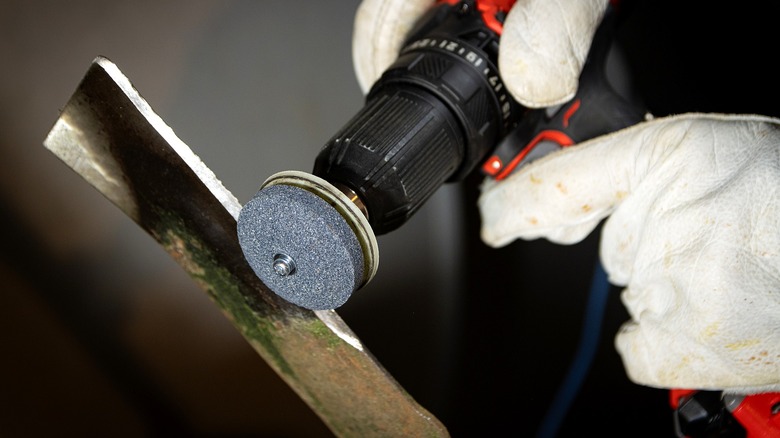
While you can sharpen your mower blade by hand using a file, what's great about using a corundum stone is that it makes use of a tool you already own: a power drill. To begin, attach the stone to your power drill's chuck, just as you would any other drill attachment. You will also need to secure your mower blade in a vise to ensure the blade stays put once the sharpening begins.
Next, fit the blade between the blade sharpener's stone and guide. Again, the grindstone is beveled. It's possible the bevel will perfectly fit the angle of the blade. However, if it's slightly off, angle the stone to match the blade (e.g., a 30-degree blade and a 40-degree stone). Begin sharpening at the end of the blade and move inward, going no more than 4 inches in a single pass.
As Leah Bolden of See Jane Drill explains, the grinding stone can jump at the end of the blade. To account for this, apply a bit of forward pressure on the guide, to keep it flush with the blade. When you make your passes, make sure to use smooth, continuous motions to ensure even sharpening. After completing the first side, flip the blade over to sharpen its other edge.
Once both sides of the blade are sharpened, use the blade balancer to ensure the same amount of metal was removed. If not, sharpen the heavier side until balanced. Note, this step is important, as any imbalance can lead to vibrations and needless pressure on the lawn mower's frame. (Read about the mistakes everyone makes when sharpening lawn mower blades.)