

Skip Pyrex: The Hand-Painted Antique Dishware Worth Hunting For At Thrift Stores

Next time you come across an array of various dishes at an estate sale, thrift store, or garage sale, keep an eye out for the brand known as Blue Ridge Pottery. Founded in 1917 by the company Southern Potteries, the Tennessee-based manufacturer produced millions of pieces across roughly 4,000 patterns, many of them hand-painted by skilled female artists. In 1920, the company formally incorporated as Southern Potteries Incorporated.
Southern Potteries began by applying decals to its pieces, much as other vintage dinnerware you might be thrilled to find at the thrift store. However, in 1938, it switched to hand-painting designs directly onto the pottery before the glaze was applied. The "Blue Ridge" name began appearing in the early 1930s, inspired by the surrounding Blue Ridge Mountains region of the Appalachian Mountains. But what made the pottery something that everyone had in the 1940s was the shift to hand-painted underglaze decoration. Blue Ridge pieces featured freehand-painted flowers, fruit, leaves, and colorful motifs that felt lively and personal. Those elements still attract buyers almost 100 years later. Unfortunately, the rise of inexpensive imports and plastic dinnerware hurt sales, and Southern Potteries closed in 1957. But that closure only helped cement Blue Ridge's place in collecting history.
Blue Ridge Pottery prices vary based on dish type, rarity, pattern, and condition. Larger pieces, such as a pitcher, can fetch $400 to $500, depending on the pattern, while holiday-themed dishes might go for $200. The more elaborate or niche the design, the more it may be worth to collectors.
How to Identify Blue Ridge Pottery
Think you spotted Blue Ridge Pottery at a thrift store? First, look for the brand's signature style. Because of the hand-painted nature of the pieces, the designs frequently show slight imperfections or variation from piece to piece. That inconsistency is actually a good sign. Floral designs are especially common, often painted in loose, expressive brushstrokes rather than perfectly symmetrical patterns. Signed artist pieces can command especially strong interest because Southern Potteries occasionally allowed decorators to create and sign original designs.
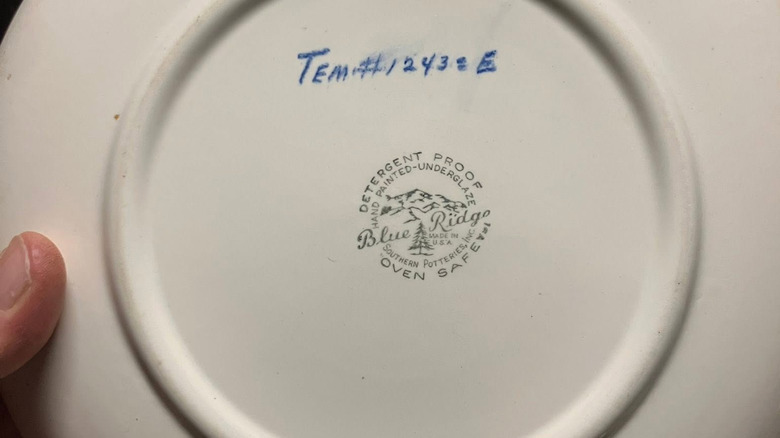
Another indicator as to whether you're holding Blue Ridge Pottery is the backstamp, a great way to check the value of vintage pottery. Many authentic pieces feature stamps such as "Blue Ridge Hand Painted Underglaze," "Blue Ridge Southern Potteries," "S.P.I.," or featuring a circular Blue Ridge logo. Pieces from the 1950s often bear "Detergent Proof" or "Oven Safe." Yet new collectors may be surprised to find out that not every piece of Blue Ridge Pottery has a stamp. Southern Potteries produced a substantial number of unmarked items. This makes collecting Blue Ridge pieces even more fun, because you learn to identify them based on shape, glaze, and pattern recognition in addition to the markings.
Color and shape are defining characteristics of the pottery brand. Blue Ridge used recognizable molds and dish forms across many patterns. Plates often have soft scalloped edges or gently rounded rims, but the company also put out unusual serving pieces like pitchers, platters, and cookie jars.
What are the most wanted Blue Ridge Pottery patterns?
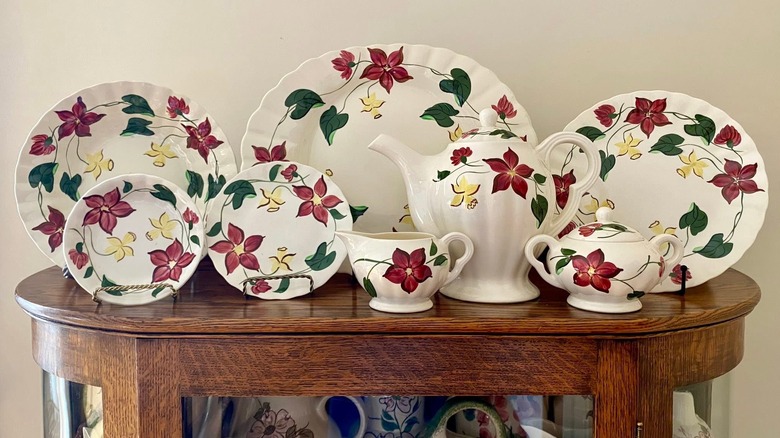
Collectors have documented thousands of Blue Ridge patterns, but the company itself never issued a complete official catalog. As a result, enthusiasts and collectors spent decades identifying and naming patterns after the fact. Smaller pieces may only show a fragment of the full design, which can make identification tricky. Floral patterns tend to dominate the collector market, especially bold hand-painted flowers in reds, yellows, blues, and greens. Fruit-themed patterns also remain highly sought after because they fit beautifully into cottagecore, farmhouse, or vintage kitchen aesthetics. Animal or scenic motifs are also a favorite.
Single plates in common patterns may only sell for modest amounts, especially if they show chips or crazing. But rare patterns, complete sets, artist-signed pieces, and unusual serving items can bring significantly higher prices among collectors. Collectors often seek exclusive patterns, such as 1947's "County Fair" salad plates given to Avon salespeople who met an order quota of $200. Character jugs featuring American figures like "Daniel Boone," "Pioneer Woman," and "Paul Revere" are also highly prized. For many collectors, Blue Ridge also has sentimental value, because these colorful plates and dishes may have once sat in their grandparents' kitchen. And maybe, if you're lucky, you'll find a few pieces for your own kitchen.