

The Shelf That Made History In The '20s For Changing Kitchen Storage Forever
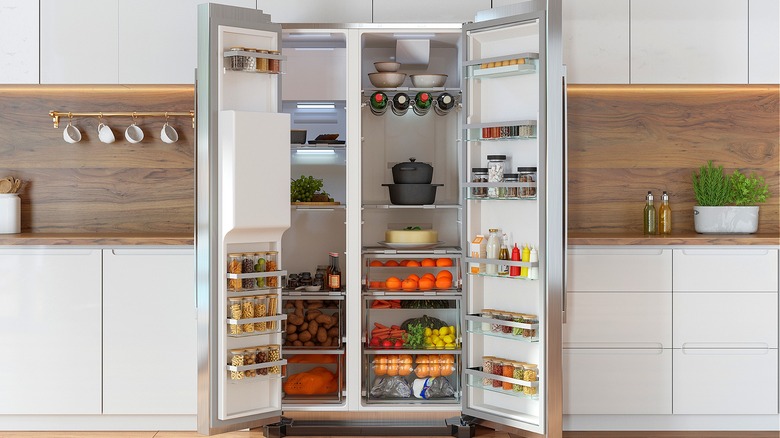
If you follow the vintage kitchen rule that decides where countertops and a stove should be, then you're familiar with the work triangle. This concept explains how triangular placement of a sink, an oven, and a fridge maximizes a person's ability to move efficiently between the most-used kitchen areas. This work-triangle strategy (aka the golden triangle) was developed by Lillian Gilbreth, a psychologist and engineer born in 1878. Gilbreth's work focused a lot on efficiency, and most of her later career was devoted to figuring out how to make domestic tasks easier through simple, yet impactful, changes to the way people interact with their homes.
For example, one of Gilbreth's most lasting inventions, dating back a century to the 1920s, was to integrate shelves into the doors of refrigerators. As strange as it may seem, there was a time when refrigerators didn't have door storage; it's not difficult to imagine how their absence made keeping an organized fridge that much more difficult. Just think about how many condiments, beverages, and other bottles and containers that are kept in the average fridge door today.
You'd be hard-pressed to find a modern-day refrigerator that doesn't have a shelf on the door, and that's entirely due to Lillian Gilbreth, who also invented, by the way, the forerunner to the step trash can. (See the fridge organization method that keeps food fresh and out of the trash.)
Refrigerator door shelves were a revolution
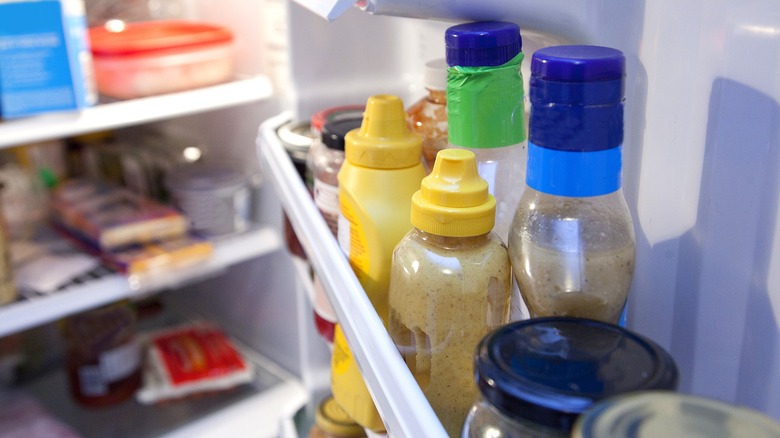
Lillian Gilbreth's mission to redesign the American kitchen led to many other changes in addition to her revolutionary idea of shelves on the fridge door, such as the practice of keeping utensils next to all the other cooking equipment. She also, as mentioned, conceived the step can — a trash can you could operate via foot pedal. And for the fridge, Gilbreth engineered a specific compartment just for eggs, and one for butter.
Gilbreth said her goal was to "make [homemaking] as interesting and satisfying as it is important." She also said in her book "The Home-Maker and Her Job": "Waste of energy is the cause of drudgery in work of any kind." We can see this motivation in play just by looking at Gilbreth's contributions to the refrigerator.
It may seem unremarkable these days, but imagine living your entire life only being able to store things inside the refrigerator itself. Then, one day, you get a new refrigerator with shelves on the door, including dedicated spaces for your essentials. Now you suddenly have much more storage to keep food fresh, you can find things easier, plus you get the satisfying experience of putting every egg, stick of butter, carton of milk, or bottle of mustard in its perfect place.
This boost to convenience and storage is why refrigerator door shelves — a 1920s invention — are among the many old-fashioned home gadgets that are still around today. (On the flip side, check out decades-old household staples that no one uses anymore.)