

Not Vinyl, Not Chainlink: The Fence Alternative That'll Add A Rustic Touch

We may receive a commission on purchases made from links.
Whether you are looking to add a bit of privacy and protection for your family or you want to potentially increase the value of your home, consider installing a fence. The challenge, though, is finding one that works for you — both aesthetically, practically, and financially. For example, chainlink fences are affordable, but they're not the most attractive option. Vinyl fences are modern and sleek, but also made from artificial materials. You can take steps to make them more charming, but they're always going to look pretty urban. If you're channeling a charming, rustic vibe in your yard, there is another solution — a living fence made from flexible dormant willow (Salix spp.) branches.
One of the most popular — and arguably one of the easiest — methods of making a willow fence is to push fresh-cut stems of this supple tree into the ground around your property's perimeter and weave them together in a diamond pattern. To get started, push thick stems of willow into the ground vertically at 1-foot intervals. Drive lots of thin stems into the ground at a 45-degree angle in between these thick stems. Repeat the same action with equal-sized stems on the other side, but make sure the new row of stems faces the opposite way to the first. Weave them in and out between each other to form an interlocking fence. If you're satisfied with the strength and level of privacy, stop here and trim the tops of the stems to the height you need. Alternatively, you can start weaving more branches between them horizontally. Whichever approach you take, your willow branches are almost guaranteed to sprout with little care, forming a living fence.
Taking care of your living willow fence once you've made it
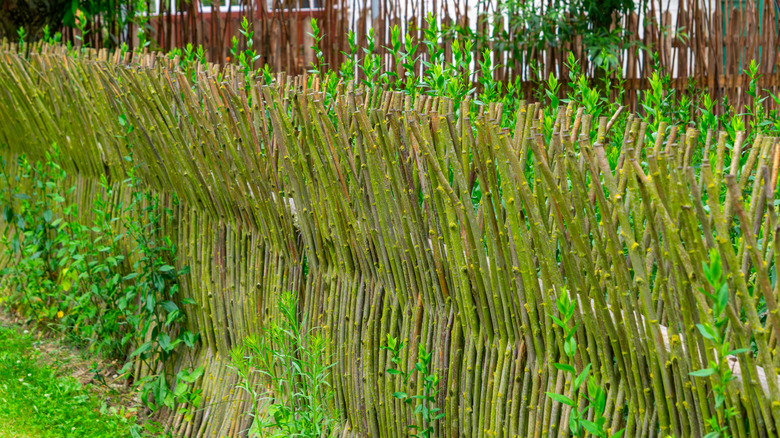
Ideally, you should start your willow fence in spring, after any chance of frost has passed. If you're taking cuttings — or whips — from an established willow tree, you can use your loppers after the tree has gone dormant in fall right up until the plant starts sprouting new growth in spring. Keep fall harvested stems moist by placing the bottom end of the whip in water. This keeps them alive and ensures they'll grow again when planted once the weather starts to warm up again.
Don't think you can hang up your gardening gloves the minute you finish weaving a new willow fence. In fact, the work is just beginning. One of the downsides of living fences is the constant maintenance. Willows like a lot of water, and their root systems are always on the hunt for new sources — which is, incidentally, why they are popular trees you shouldn't grow near your house. If you live in an area that sees a lot of rain or your yard is somewhat boggy, your fence should be pretty happy. Otherwise, you'll need to make sure they get enough water to avoid roving roots.
Additionally, willows need regular pruning and occasional fertilization to stay healthy. Additionally, they will continue to produce shoots throughout the growing season. You can weave them back into the fence in winter to add strength and density or you can cut them off.Once you get the hang of willow fence weaving, you can turn your hand to all sorts of garden projects. For example, willows are perfect for whimsical living playhouses you can make entirely of plants.
Caring for a living willow fence isn't easy for everyone
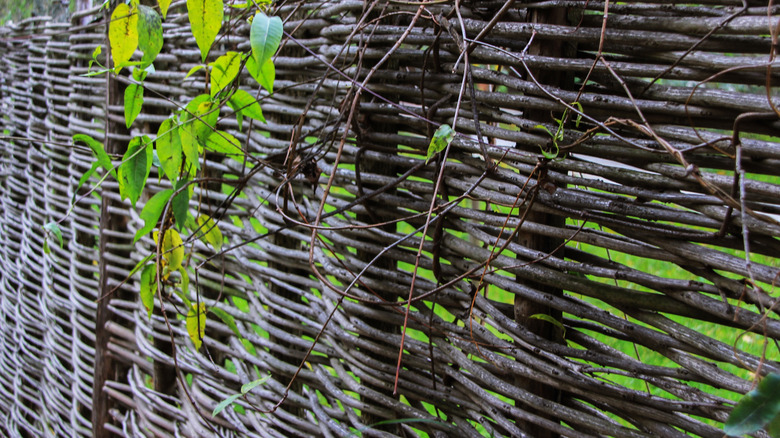
While living willow fences undeniably add a rustic touch to a backyard, they're not for everyone. This kind of fencing requires more maintenance than pretty much every other fencing option. You can create some neat patterns with willow — from straight lines or haphazard, wabi-sabi arrangements to waves, peepholes, and braids — and it's certainly eco-friendly, but maintaining that design requires work. What's more, depending on where you live, you may not be allowed to grow certain willow varieties because they're aggressive growers.
For example, the white willow (Salix alba), goat willow (Salix caprea), crack willow (Salix fragilis), purple willow (Salix purpurea), hybrid willow (Salix x rubens), and Austree willow (Salix matsudana x alba) are all listed as invasive in the Midwest. Also, if you think you may sell your house in the near future, a living willow fence may not be the right option. While installing a fence can increase the value of your home, a willow fence can be hard to remove once it's established — and that's the kind of hassle that could put potential buyers off.
Thankfully, if the maintenance of a living willow fence is too much for you, or you live outside of the genus Salix's USDA Plant Hardiness Zones of 4 to 9, making this type of fence simply not an option, consider a dead stem fence. In this case, you weave the stems together just as you would a basket. It's fast, provides more privacy, and is easier to maintain, lasting up to 10 years. A 100-pack of 3-foot-long CZ Grain Fresh Cut Willow Branches costs about $157, while a bundle of 30 CZ Grain Willow Twigs costs just $13.