

They Were Big In The 80s — Now It's The Desk Accessory We Want In Our Homes
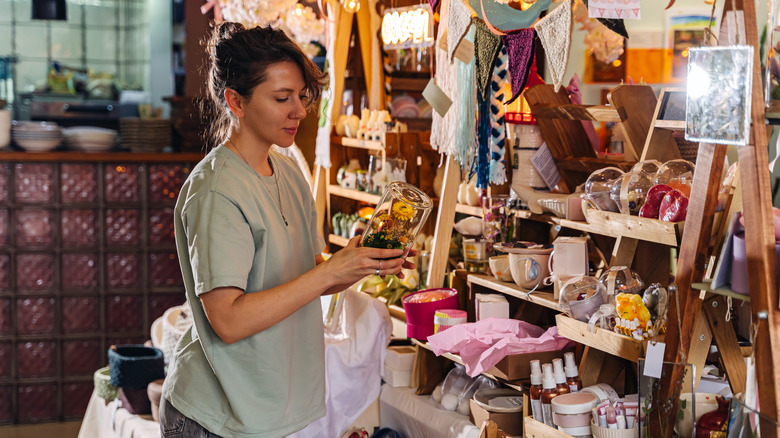
The '80s stood out for bold, bright colors, as seen in fashion, furniture, trinkets, and other trends of the time. However, colorful curios have always been present throughout history, thanks to talented artisans. There is one such object that went big in the '80s as a homage to the enduring art of glasswork: glass paperweights. Most of these objects take on a circular, orb-like shape and are filled in with intricate patterns and shapes using different glassmaking techniques. While it may be fair to think that these colorful paperweights were just one of the decor items and features you only saw in the '80s, a closer look at this vintage desk accessory unearths fascinating glass art techniques that date back centuries.
The origins of glass paperweights can be traced back to the 1800s in France. It was carried on by French glassmakers like Baccarat and Saint Louis, and was practically brought to a renaissance by American glassmakers like Charles Kaziun Jr. in the 1950s. A few decades later, glassmakers like Orient & Flume and Stuart Abelman, among others, produced their own style of iridescent, colorful paperweights inspired by these techniques, all of which are sought-after pieces to this day.
Get yourself a beautiful '80s glass paperweight
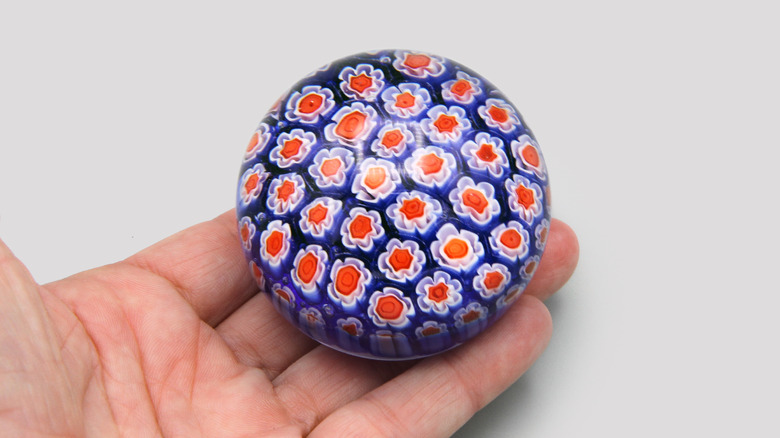
Spotting valuable, high-end objects like artisan glass paperweights is sure to fetch a good amount on resale, with these being sold at curated websites from $100 up to thousands of dollars. On the other hand, getting your hands on an '80s glass paperweight requires knowing how to recognize what it can look like, who made it, and when it was made. You may come across signed pieces in which the artist's or the studio's name is engraved beneath the paperweight, along with the date or year it was created. While that can help make the search easier, you might as well learn the distinctions of a true '80s-era glass paperweight.
For example, most of Orient & Flume and Stuart Abelman's glassworks are surface-decorated, meaning thin layers or strings of glass were used to color and cover the orb. Moreover, their designs rely heavily on vivid, multicolored gradients, and their works are often described as iridescent and even hypnotic.
If you spot glass paperweights that look more illustrative, as if something was drawn or captured inside it — especially if there's lots of florals — then they may have been designed by legacy glassmakers at Baccarat or Saint Louis; and if you see a bird in frame, then it could be one of Rick Ayotte's works. If you spot lots of tiny flowers within a glass paperweight, then it's possibly one of the many millefiori pieces made by Perthshire Paperweights or Whitefriars.
How to use and display your glass paperweight
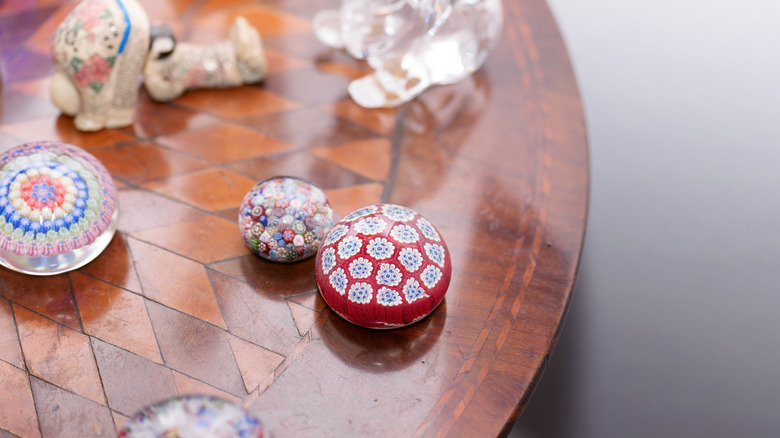
A singular glass paperweight with such intricate designs can easily stand out on its own, whether you decide to use it for its intended purpose or as statement decor that anyone can gaze at. There's no problem with securely holding down a stack of papers with it or simply keeping it in your workspace, but if you're the type who makes aesthetic decor more practical, you can look beyond your home office, too. For instance, you can use your glass paperweight to keep a hefty stack of table napkins from scattering across your dinner table. Or, you can use it as one of your handy crafting tools whenever you need to hold down one end of a fabric as you work on the opposite end.
Use it as statement decor that can add trendy, whimsical accents to your home. Give it some dedicated space on your end tables, bookshelves, or on your mantel. If you have a paperweight collection, however, you can display them in a china cabinet or gather them all in a basket at the center of your coffee table. Another way you can display this elegantly is by stacking them neatly by a window so they can reflect light whenever the sun hits them.