

It Was Big In The '50s — Now It's The Art That's Making A Stylish Comeback
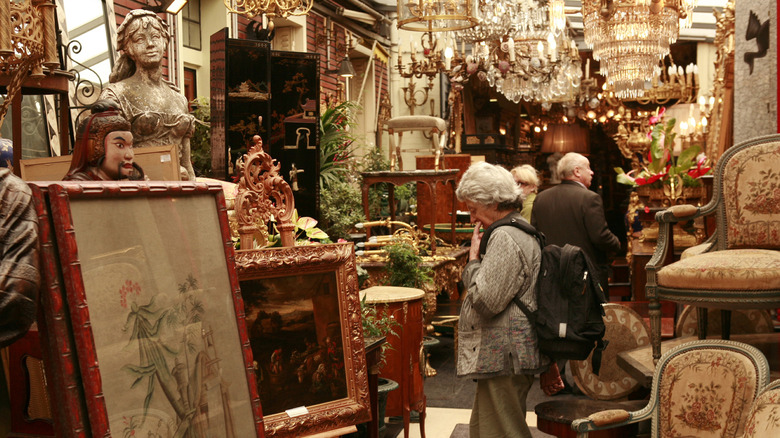
Ask anyone what first comes to mind when they think of 1950s art, and it's highly likely that they'll mention the illustrations of Norman Rockwell and Coby Whitmore, the surrealist canvases of Pablo Picasso, or the abstract creations of Jackson Pollock. Not a lot of people can name a brutalist artist or artwork at the drop of a hat — perhaps because most of us associate brutalism with bleak, hulking concrete buildings that exude cold authority. Brutalist art, however, embraces bare concrete or metal in ways that look almost futuristic even today. Artists of the movement rejected the colorful aesthetics so common in '50s art in favor of raw, distressed, post-war scrap materials, turning them into alluring artworks that we in the 21st century are starting to pay attention to. In particular, brutalist metal wall sculptures are trending.
While you may associate brutalism with the 1970s and 1980s, this art movement actually emerged in the U.K. during the 1950s as a way of repurposing and processing the material and, arguably, psychological remnants of World War II. Today, brutalism is experiencing a resurgence in popularity, with aficionados seeking to not just revive but also redefine the genre. By focusing on the beauty and depth found in simple, raw materials, they're pushing past the oppressive connotations of the movement and re-introducing it into homes in more humanizing ways. If you're someone who's into the bare, exposed vibe of industrial design, love pared-back minimalist interiors, or, conversely, embrace wabi sabi, the interior design trend that finds beauty in imperfection, keep your eyes peeled for a few brutalist metal sculptures to add to your walls.
Spotting and styling brutalist metal wall sculptures
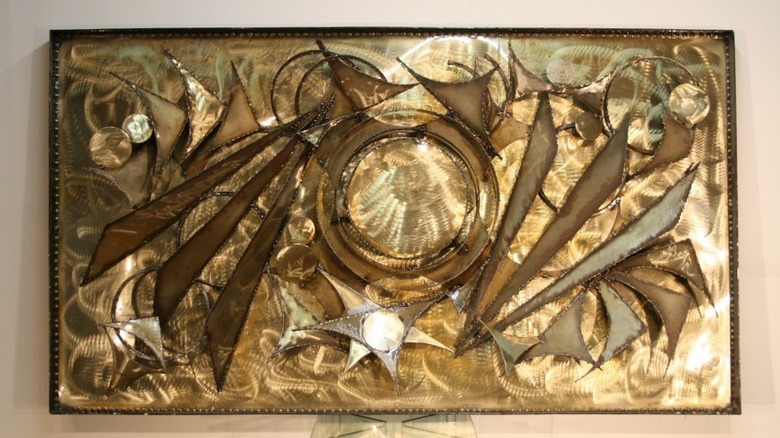
Most brutalist metal wall sculptures are highly abstract, intentionally unpolished, and feature unfinished materials and surfaces. Marcello Fantoni and Reg Butler, two leading 1950s brutalist artists, made sculptures from raw brass and copper wire. If you're lucky enough to come across a piece that resembles an architectural blueprint, with thick wire forming or connecting abstract geometric shapes, it may have been produced by artisan metalworking house Curtis Jeré — the works are typically signed C. Jeré. If you see a collection of random scrap metal artfully arranged on a canvas, it could be the work of Dutch metal artist Henrik Horst, who was most active in the 1970s.
Brutalism is one of this year's hottest home trends. To nail the look, you need to embrace neutral colors, boxy furniture, and roughly textured accents. Dramatic metal wall sculptures are the perfect addition to a brutalist-inspired room. If you find full-on brutalism a little cold, surround the tough wall art with soft shapes and organic materials — the work will stand out, but the space around it will stay warm. When decorating a large wall with a heavy brutalist metal wall sculpture, drive purpose-designed artwork mounting hooks with a weight limit higher than your piece into studs or use wall anchors. You can also display the wall sculpture on a shelf or console table — again, so long as it can support the weight of the artwork. Looking for a trendier, more laid-back alternative? Place the metal sculpture on the floor, leaning against a wall for stability.