

You'd Be Thrilled To Find Vintage Mirrors From These Eras — Keep Your Eyes Peeled At Estate Sales
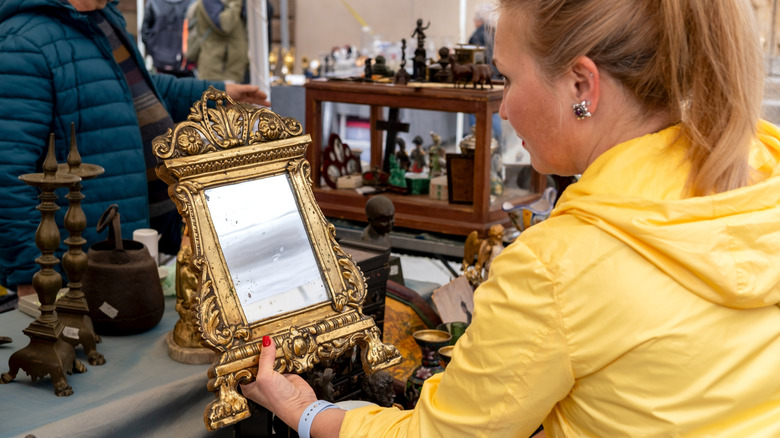
Mirror, mirror on the wall, which of you will fetch the fairest price of them all? Well, if you ask collectors, the decor piece you want to find in an antique shop or estate sale is a vintage one. Because mirrors that are anywhere from 50 to 100-plus years old can net you quite the tidy profit. But before you start scouring those shelves, you'll want a clear picture of what you're looking for. To start, there are some thrifting terms you need to know: vintage refers to any piece that's more than 20 years old, and antique is at least 100 years old. And each generation has its own unique style.
Dating back to 1837, Victorian antiques tend to be ornate and over-the-top with either gilded or carved wood frames. Among the most valuable treasures from that era is the carved walnut pier mirror, which can command more than $1,300 on marketplaces such as eBay.
From 1890 to 1910, art nouveau decor featured curved lines and floral themes. Art deco styles from the 1920s and 1930s, meanwhile, are more geometric and sleek, largely in metallic shades. An etched glass vanity from this period could net hundreds of dollars. And, finally, vintage mid-century modern pieces have a streamlined, minimalist look, with the stunning sunburst mirror fetching thousands.
What to look for when buying a vintage mirror
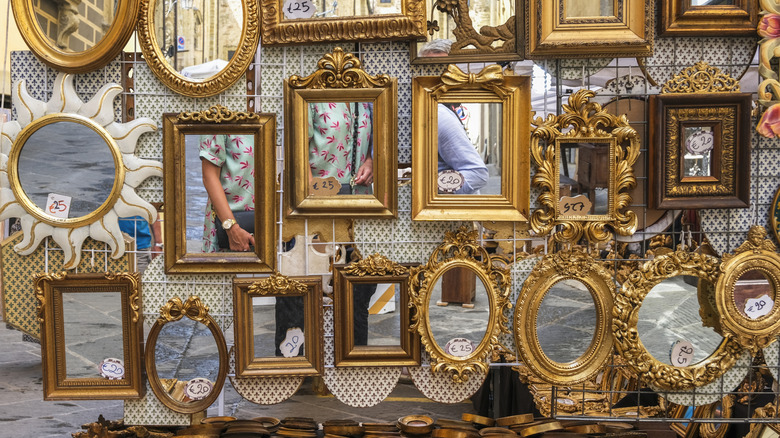
To be transparent, you don't want to snap up just any vintage mirror you come across. To shop for vintage mirrors, it's crucial to know what you're looking for. You'll want the piece to be in good condition, paying close attention to the joinery and any cracks or chips. But you don't want things to appear too picture-perfect. Unlike reproductions, true vintage items will have charming flaws such as slight discoloration, wavy surfaces, or cloud-like spots known as foxing.
Other factors that could increase the value of your vintage find are the size, with larger statement pieces fetching top dollar, and the material. Woods such as mahogany, walnut, and cherry tend to be more desirable, as are gilded finishes and anything featuring hand-painted or hand-carved detailing. Provenance is also important, meaning there's documentation of its origin.
There are certain recognizable manufacturers that tend to be more valuable, as well. Keep an eye out for anything made by LaBarge, Friedman Brothers, or Austrian Biedermeier-era makers. But if you're still unsure if you have a true find on your hands, a local antiques dealer or appraiser could inspect the mirror and help you see things more clearly.