

Not Grounds: The Leftover Coffee Waste That Should Get Added To Compost

Surprisingly enough, making your own cup of coffee not only helps you save money, but it's also an eco-conscious choice if you're smart about preventing food waste. If you dump your used coffee grounds into your compost bin and toss the filter into the trash without a second thought, then you're overlooking another compost-worthy material. In fact, your coffee filter can be cleverly repurposed here, because it has just as much potential to buff up your compost as your coffee grounds do. Instead of sending the filter straight to the trash can, think of it as one more ingredient for your compost bin. Note that this only works for certain types of paper coffee filters — you're better off disposing of plastic-based filters, and it's also best to keep metal filters away from the compost bin.
The best type of paper coffee filter to add to your compost is unbleached. Unbleached paper filters are made of pure paper pulp that naturally breaks down in a compost pile — this makes them a good source of carbon, or "brown" compost material, whereas coffee grounds are considered a nitrogen-rich "green" material. However, paper filters treated with chlorine bleach may negatively affect your compost; they release harmful chemicals that remain in the resulting fertilizer, so they're best tossed into your regular trash bin. Filters treated with oxygen bleach are safe to use.
How to add paper coffee filters into your compost
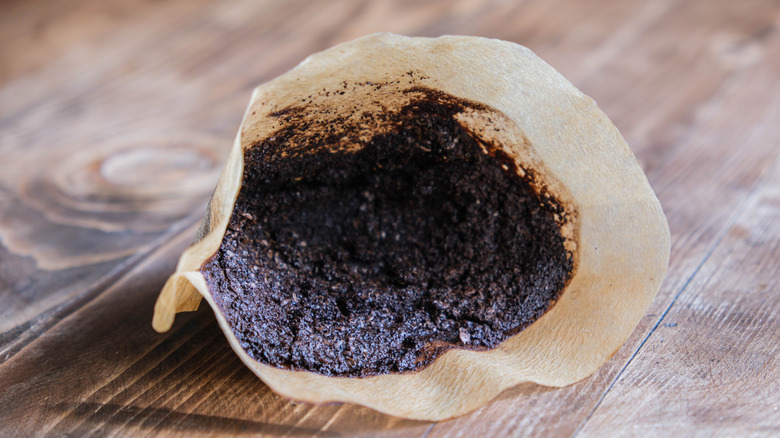
Rather than dropping the coffee filter into the compost bin whole, tear or shred it into smaller pieces before mixing it into the center of the pile. Spread the torn filter pieces out to cover more surface area and speed up the decomposition process. If the filter still contains coffee grounds, leave them together — the grounds will add nitrogen while the paper supplies carbon. Ideally, you should add the filter while it is still wet rather than letting it dry out, and avoid adding too many filters at once, as they may clump together.
Of course, a healthy compost cannot rely on coffee waste alone — the decomposition process works best when there's a variety of both green and brown materials. Add other types of green materials to give your compost pile a serious nitrogen boost, like food scraps and grass clippings. For additional brown materials, add dry leaves, shredded newspaper, and cardboard. Your compost is sure to thrive when these two types of materials are balanced at a ratio of 2 to 3 parts browns and 1 part greens; just remember to keep the compost pile moist and turn it regularly to encourage faster decomposition and maintain a consistent temperature.