

It Was Popular In The '80s — Now It's The Vintage Kitchen Appliance We Want In Our Homes

You know that old saying, "they just don't make them like that anymore"? Never has a statement been more true than with the stainless steel Bodum Ottoni stovetop kettle. Invented by Danish designer Carsten Jørgensen for Bodum in the 1980s, this valuable vintage appliance is a must-add to your thrift wishlist. Its popularity may be because, (besides it being a piece of postmodern art), some of Jørgensen's other creations are featured on "Star Trek". Examples include the infamous bistro cups and the blue melamine utensils. Due to the designer's notoriety and the item's unique characteristics, the Ottoni kettle can boast a hefty price tag, which is why finding it for cheap at a thrift store or estate sale would be an absolute dream. The price you can expect to pay varies depending on the seller, design variations, and the item's condition, but some go for as low as $75 while others can be upwards of $200.
Even if you're not a fan of all things Spock, the Ottoni's character-filled details, sleek curved shape, and use of natural and man-made materials is reason enough for a full-blown obsession. The kettle combines a shiny stainless steel frame with steampunk-esque rivets for a polished yet industrial vibe. A carved wood handle and gold metal details offer a warm contrast, while a blue acrylic knob nods to the colorful Memphis design trend introduced in 1980s Italy. Being constructed from quality materials, you can still use this vintage kettle in your kitchen for the purposes of boiling water. However, using it as a display piece will ensure it stays in pristine condition. After all, it's definitely a sought-after collector's item.
Tips for finding a Bodum Ottoni stovetop kettle
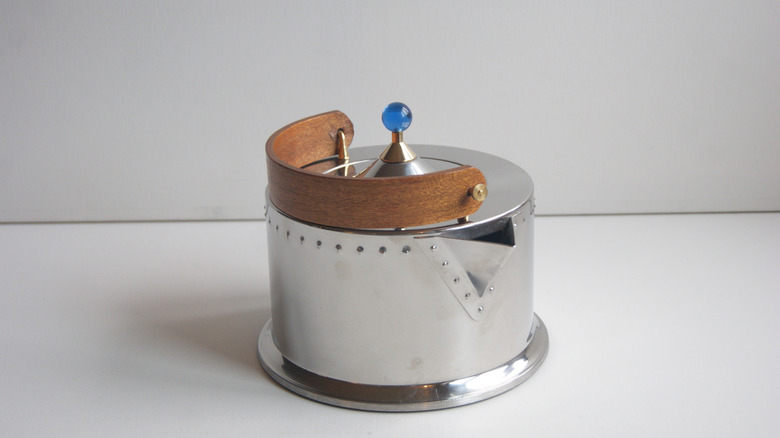
While discovering this vintage stovetop kettle in a secondhand store is many a thrifter's goal, you'll be happy to know that you can also find them through online sellers via websites such as eBay and Etsy. No matter where you search, it's important to know how to identify if you've found an authentic Ottoni. There should be an engraving on the underside of the kettle that reads: "Design, C. Jørgensen, Made In Italy, INOX 18/10, Bodum", or a similar variation. Online sellers should provide a picture of the authentication label for potential buyers to view. If not, be sure to ask for additional photos. Aside from doing an authenticity test, you need to be aware of other vintage and modern-day Bodum products that were invented by Jørgensen or inspired by his creations. This will help you better distinguish between the stovetop kettle and similar options during your search.
For example, Bodum released a modern-day electric version of the Ottoni kettle. It looks almost exactly identical to the original, except it has a blue power lever located on the side. However, as it's currently sold out, finding an electric version secondhand would still give you some serious thrifting cred. Carsten also made comparable products during his time at the company, which are also statement pieces in their own way. The Naoko and Teaball teapots carry the same postmodern notes and silver metal construction, but are different in shape and lack the wood handle and blue acrylic knob. The Osiris kettle is another Jørgensen design which practically looks the same as the Ottoni, except it has a black handle and lacks any ornamentation.