

Clint Eastwood's Vintage Kitchen Photo Shows The Staying Power Of This Simple Storage Idea

We may receive a commission on purchases made from links.
Clint Eastwood, now 96, is one of America's most accomplished living filmmakers. His most iconic roles include his stoic performances as "The Man with No Name" in Sergio Leone's Dollars trilogy (1964-1966) and as Police Inspector Harry Callaghan in "Dirty Harry" (1971). But Eastwood is perhaps just as well known for his work behind the camera. He has directed 41 films, stretching from 1971's horror thriller "Play Misty for Me" to the 2024 legal drama "Juror #2". The four-time Oscar-winning filmmaker is famous for his efficiency, consistently wrapping films ahead of time and under budget. Would it surprise you to know that he extends the same level of control to his kitchen?
Eastwood has spent much of his life at his home in Carmel-by-the-Sea, California, the setting of his directorial debut. He founded his Carmel restaurant, the Hog's Breath Inn, in 1970, and served as the primary owner for 27 years. The rustic yet refined establishment befits the auteur; its patrons spend cool evenings on the patio, next to a crackling fireplace, dining on California wines, prime cuts of steak, and fresh-caught seafood from the nearby Pacific.
In the past few months, a 1978 photo of Eastwood eating a burger in the restaurant's kitchen has circulated on Facebook and Instagram. In the photo, just above Eastwood's head, you'll notice a rack of hanging pots and pans, just one of many rustic kitchen ideas you'll want to steal, whether you decide to go DIY with it or purchase a hanging rack online.
What makes this kitchen style unique?
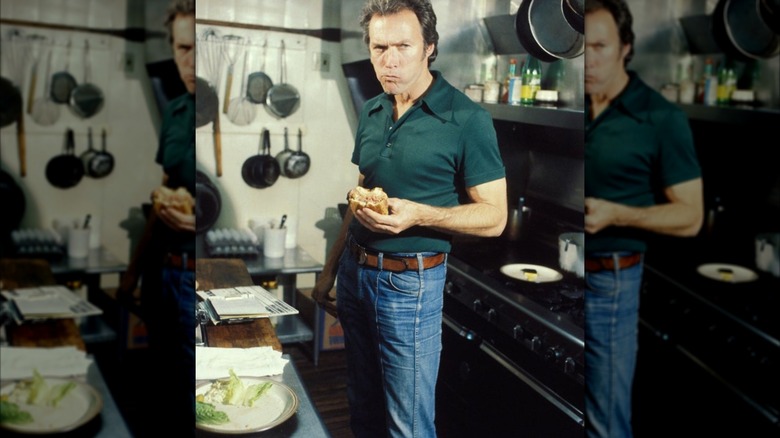
This photo captures many of the aesthetic and practical elements that define Eastwood's style. If you are interested in fashion, his wardrobe — a well-worn pair of Levi's, a characteristic Western belt, and a tucked-in polo — might give you inspiration. But if you explore beyond the subject, to the margins of the image, you'll find a tidy, organized space. The tools Eastwood presumably used to prepare his lunch that day, which looks to be a hamburger, are scattered throughout the kitchen. A few lettuce leaves have been left behind on the plate in front of him.
Behind Eastwood, there is a gas stove, with several hanging steel pans and what appears to be a cast iron skillet. On the wall next to him, there are more hooks with smaller pans and cooking implements attached to them. Instead of storing supplies on the counter or cabinets, he's decided to go vertical. Like most of Eastwood's work, this kitchen setup is classic, but it also doesn't feel dated. You can see everything you need. Unlike kitchens with a lot of drawers, this storage won't hide anything; plus, cast iron and stainless steel don't won't warp with moisture, so you don't need to worry about the effects of leaving them out in the open.
Hanging cooking utensils is just one of the many decorative solutions you can use to keep your kitchen clutter-free, which Eastwood's certainly is. If you need to clean the counters at the Hog's Breath Inn, you simply run a rag over it. But the space also isn't overly minimal and lifeless, either — this functional storage system also doubles as a way to give the room more character.
How to incorporate Eastwood's style in your own kitchen
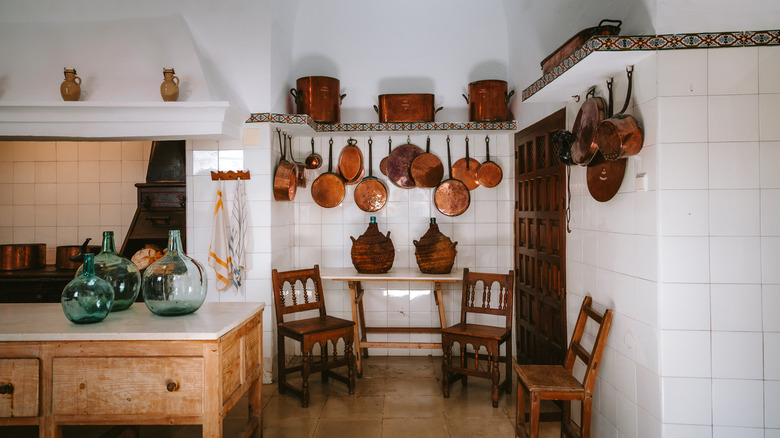
To model your kitchen off of the Hog's Breath Inn, you'll need lots of wall space to attach your racks and hangers. This can be a challenge if you live in a small apartment, especially if your landlord doesn't allow you to drill holes in the walls. You can always use adhesive strips or hooks with suction cups attached, but those can have trouble staying stuck, especially when there's a lot of steam in the air. The best way is to drill holes, because you don't want a heavy steel pan falling onto someone's head or splashing into a boiling pot.
The best way to make space is to get rid of your bulky cabinets and reorganize what's inside them. In the 1978 photo, you'll notice the knee-high stainless steel table behind Eastwood. You can use one of these tables in your own kitchen to store those items you won't be able to hang, including plates, silverware, and cutting boards. Next, with that extra wall space, you can install your rack. A KES 30-inch Kitchen Pot Rack is a great option, especially since it includes shelves for heavier pots. If you need something that takes up a little less space, try an Oropy 38-inch Pot Bar Rack, or try out this DIY hanging pot wall to add rustic appeal.
The process of securing a wall rack is simple. Use a stud finder to locate the joists, then drill pilot holes, and then attach your rack. If you can't find joists, place drywall anchors in your pilot holes, instead. Finish off with your pots and pans, and you'll be left with stylish, functional storage.