

Not Vinyl Or Brick: The Exterior Wall Material That You See Everywhere In California

Obviously, when you buy a home, it already comes with an exterior finish. But you don't need to stick with the same kind forever. You can change it up to something that will fit you and your family best, whether you're focusing on looks or function. Knowing which one you want to go with, though, takes some research. If you're looking for an idea that makes it feel like you are enjoying the California sun all the time, stucco siding could be a great option.
It's especially common throughout Southern California. However, this material isn't limited to just one state. Many areas of the United States, especially in the southwest regions, use it for the outside of homes. It has plenty of advantages, including a lifespan that can exceed 50 years, often outlasting vinyl siding when properly maintained. It's also generally less labor-intensive to install compared to materials like brick.
The reason that it works so well in California's southern region is because the area is hot and dry. But you don't have to live in a desert to use it. It's also commonly used on Mediterranean-style homes and looks especially at home in coastal settings. The problem is, though, that stucco isn't meant to handle constant rain and humidity. If you are going to use it in these kinds of conditions, you need to know about waterproofing stucco.
Why stucco may be a good option for the exterior of your home
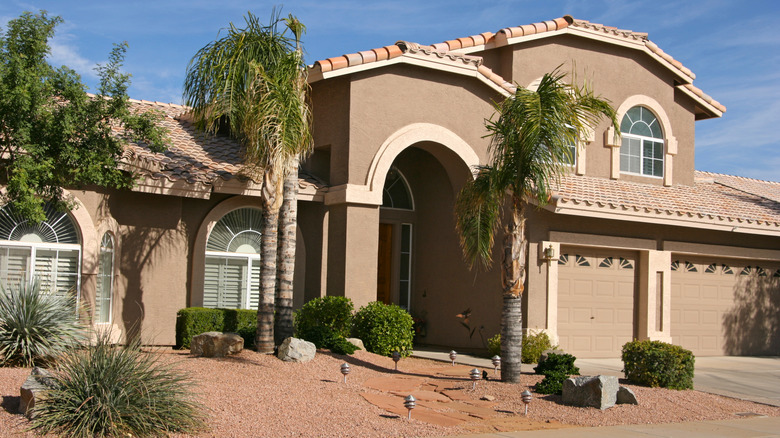
While this material has a certain charm to it, it's about more than looks. There are a few reasons why it's practical. For one, it's pretty cheap. It's made from a mix of cement, sand, lime, and water. The raw materials are widely available, which can help keep material costs reasonable in many regions. Additionally, some homeowners choose to tackle smaller DIY stucco projects to add texture to their home themselves, though larger applications often require professional experience for the best results.
However, the biggest perk is the fact that it helps to moderate temperatures. Desert areas, like the southwest of the United States, tend to be very hot during the day and cold at night. Unless you want to constantly bounce between heat and AC, you need something to keep the temperature stable. Because of its thermal mass, stucco helps slow heat transfer, making indoor temperatures more consistent throughout the day. That's not to say you won't need any heating or cooling, but it definitely keeps the temperatures more consistent and your home insulated.
Another advantage is that stucco is highly fire resistant. In areas where fires are common, having housing materials to defend against fire is pretty much a necessity and can give you a bit of peace of mind. It won't completely save your home, but it's another layer of protection, especially when paired with door, window, and roof materials that can protect against heat and flames.
Stucco's versatility can help you fit it into your design
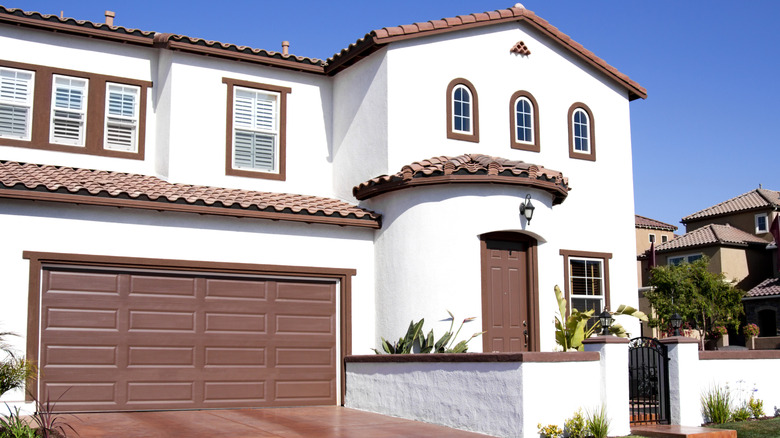
Thankfully, because stucco has so much variety, you can really adapt it to your own style. First, consider different types of stucco siding, including synthetic or traditional. There are also several finishes ranging from English to Santa Barbara textures you have to decide between. While stucco is often put on the outside, if you like the design, you can also use it on your house's interior. To add a bit more to a stucco home, you can combine it with other materials to add some depth. Metal, wood, natural stones, and brick all pair really well.
Another way you can make stucco fit your personality more is by picking out a color. Shades of tan are the most classic in the United States, and white is more commonly seen in the Mediterranean along the coasts. If you want to add a bit of a modern feel, taupes, creams, and linens are great color choices.
However, you can also pick out bolder and more unique options, including pink, black, orange, and blue. Traditionally, to get these colors, you tint the stucco before it's applied. If you end up picking out what you want later on, you can paint it. Make sure you choose a breathable masonry paint with a flat finish to help prevent moisture from becoming trapped in the stucco.